Taj Mahal dress code: what to wear, shoes and a small day bag
There is no official dress code at the Taj Mahal, so wear clothes and shoes you can walk in. What matters more is the weather, the shoe covers at the tomb and the security list. Here is what to wear in each season, what to leave behind and where to leave it.
By Priyanka Singh, Travel expert
 (opens in a new tab)
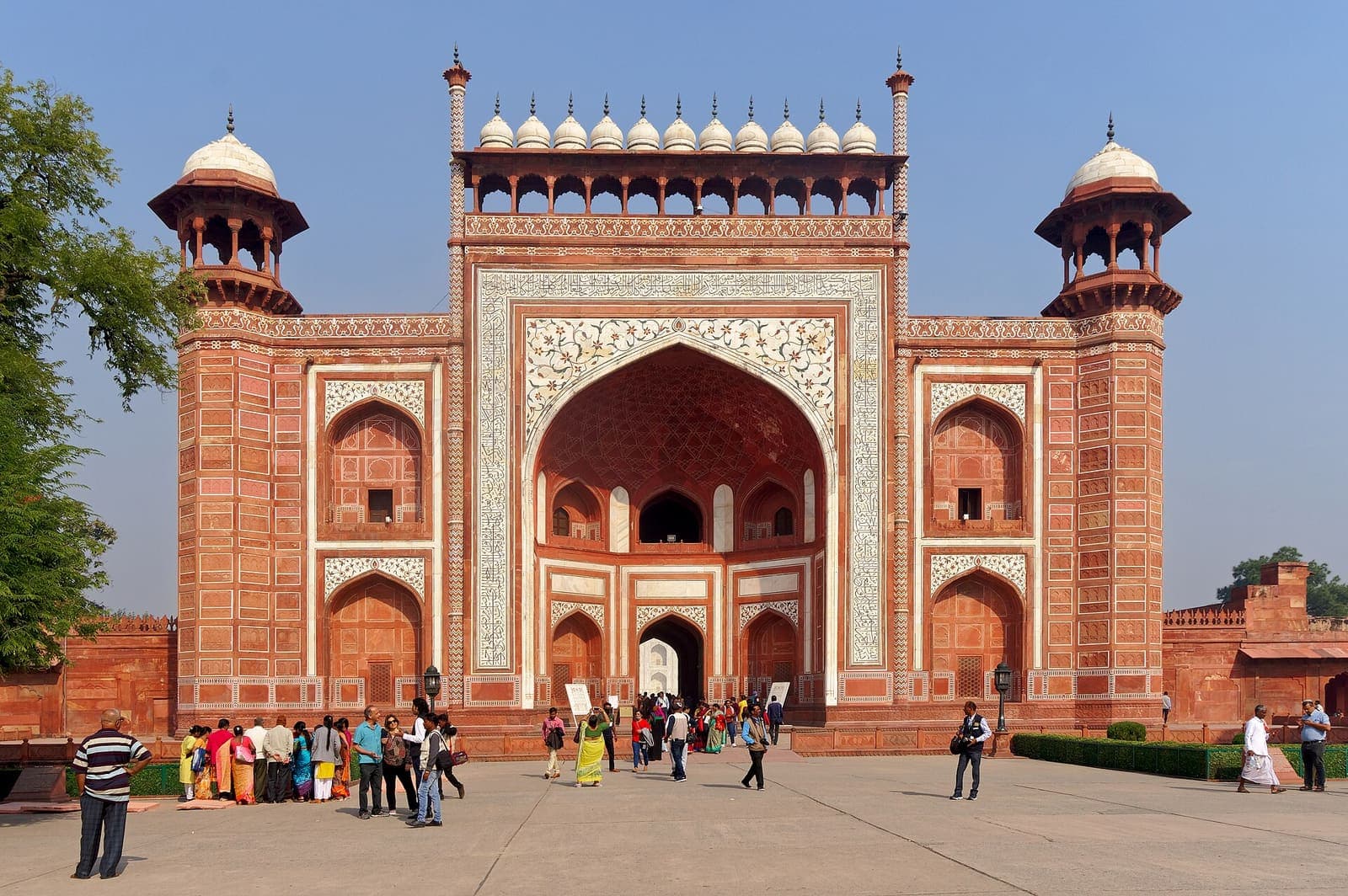
Photo: Jakub Hałun · Wikimedia Commons · CC BY-SA 4.0 · resized for web
There is no official Taj Mahal dress code. The official visitor rules, checked on 22 October 2026, say nothing about clothing, and in 2017 the Ministry of Culture confirmed that the ASI puts no restriction on the colour or religious design of what visitors wear. Wear clothes you can walk and sit in and shoes that slip off easily, and leave food, chargers, headphones and tripods behind: security checks what you carry, not what you wear.
| Question | Practical answer |
|---|---|
| Must I wear Indian clothes or a sari? | No. The official rules set no dress code; a traditional outfit is your choice. |
| What works well? | Comfortable trousers or a longer skirt, a breathable top and walking shoes you have already worn. |
| Shoes at the mausoleum? | Wear the free shoe covers that come with foreign, SAARC and BIMSTEC tickets, or leave your shoes at the free racks just below the tomb. |
| Sunrise visit? | Check the forecast, and add a warm layer from December to February. |
| What cannot go in? | Food, tobacco and lighters, chargers, headphones, tripods, knives and drones. Cloak rooms at both gates take them. |
| Friday visit? | The Taj Mahal is closed to visitors every Friday. |
The rules in this guide are the official Taj Mahal site’s, checked on 22 October 2026; the clothing and packing suggestions are ours, not extra entry rules. On the day, the instructions of the security staff at the gate come first.
Is there an official Taj Mahal dress code?
No. The useful distinction is between an official restriction and advice about comfort or courtesy. The official do’s and don’ts cover security, behaviour and items to carry; they publish no dress code and no compulsory outfit. You do not need to rent a costume because a tour seller says every visitor must wear traditional clothes.
A Ministry of Culture clarification from April 2017 says the ASI had placed no restriction on the colour or religious design of visitors’ scarves or clothing. It followed a report that tourists had been made to remove saffron scarves, which the CISF, the force that runs security at the Taj, said had not happened; what it had asked visitors to deposit in the cloak room were cigarettes, lighters, chewing gum and chocolates. Security is looking at bags and pockets, not outfits.
Courtesy still counts. The UK government’s travel advice for India asks visitors to respect local dress codes and customs, particularly at religious sites, and the Taj complex includes a working mosque. If you are also visiting a mosque, temple or gurdwara elsewhere in Agra, check that place’s own rules; they are not Taj Mahal entry rules.
What should women and men wear for the visit?
A breathable top with comfortable trousers is an easy default for women and men alike. A loose dress or longer skirt also works if you can climb steps in it and manage it while dealing with your shoes. The aim is a normal sightseeing outfit, not a wardrobe chosen only for a photograph.
If you prefer extra coverage, a light overshirt or scarf gives you flexibility without a complete change. Choose something you already know is comfortable: a newly bought, stiff outfit may look good at the hotel and become a distraction on a long walk. Keep trailing fabric clear of steps and other visitors.
Shorts and sleeveless tops are often discussed online as if one published rule covered them. The official pages do not ban them. Covering your shoulders and knees is still the simplest choice: it keeps the sun off, it is respectful in a complex with a working mosque, and the same clothes then suit the rest of an Agra day, a mosque or gurdwara included.
Try the outfit before travelling: walk, sit, raise your arms and check your pockets. If it needs constant adjustment, choose something simpler. Decide too where your ticket and photo ID will go. The official ticketing page asks every visitor to carry government-issued identity proof, and you should be able to reach both without unpacking your bag in a queue.
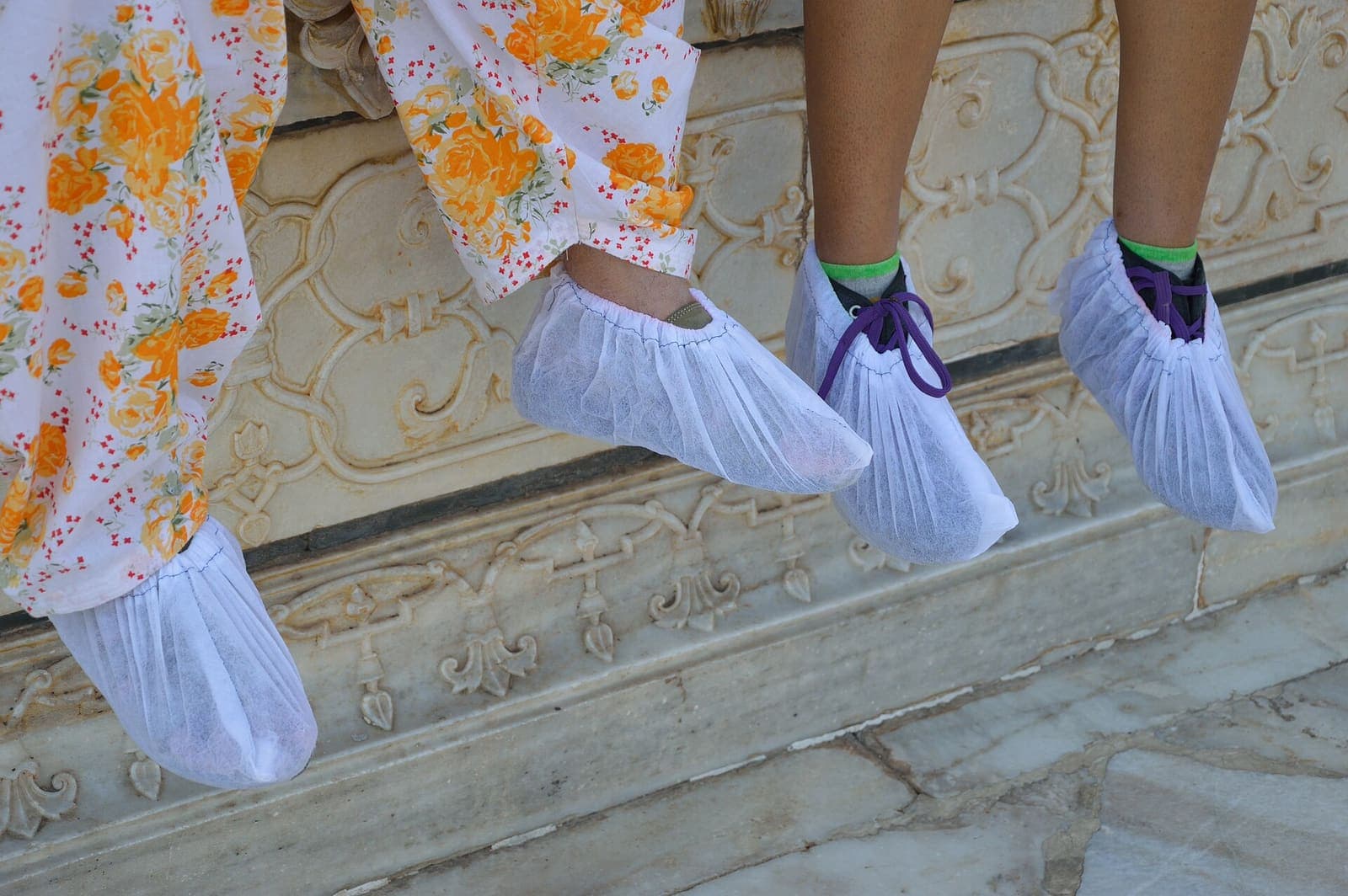
Photo: Biswarup Ganguly · Wikimedia Commons · CC BY 3.0 · resized for web
Which shoes work, and do I need shoe covers?
Wear familiar shoes with a secure fit and a sole you trust. You will walk from the battery bus to the gate, through the garden and up to the marble platform, so supportive trainers or comfortable walking sandals make more sense than new heels. Shoes that slip on and off quickly make the mausoleum easier too.
Before the marble platform of the main mausoleum, shoes either go into covers or come off. Foreign, SAARC and BIMSTEC tickets include shoe covers, according to the official ticketing page, and the same page lists free shoe racks just below the main mausoleum for everyone else. Ask the staff on duty where to collect covers rather than buying them from the first person who approaches you, and keep your ticket to hand.
Shoe covers are not a reason to wear footwear that already slips or hurts. Move carefully, especially where the marble is wet. In the hot months the marble warms through the day, so if you leave your shoes at the racks, keep your socks on. If you have a mobility need, the ASI office at the Taj keeps wheelchairs and a first-aid box; our Taj Mahal accessibility guide covers the routes and what to ask for.
The separate ₹200 main-mausoleum ticket decides whether you go inside the tomb, so check the Taj Mahal ticket guide before planning that part of the visit. A shoe cover is not a ticket: your ticket controls access, and the footwear rule protects the monument.
How should I dress for sunrise or a changing forecast?
Dress for the month first, then for the forecast. Agra runs from cold, foggy winter dawns to summer afternoons that average more than 40°C, so one outfit will not do all year. The India Meteorological Department’s long-term averages for its station at the Taj show the range; the clothing suggestions are ours.
| Months | Average low and high · what to wear |
|---|---|
| October | 18.7°C and 34.7°C · light, breathable clothes; a thin layer for a sunrise start |
| November | 13.2°C and 29.2°C · a light jumper or jacket at dawn, short sleeves by midday |
| December and January | Lows of 7 to 8°C, highs of 22 to 24°C · a warm jacket, scarf and closed shoes at dawn; about five foggy days a month |
| February and March | Lows of 10 to 14°C, highs of 26 to 32°C · layers in February, summer clothes by late March |
| April to June | Lows of 20 to 26°C, highs of 38 to 42°C · loose cotton or linen, a hat, sunglasses, and socks for the warm marble |
| July to September | Lows of 23 to 25°C, highs of 33 to 36°C, and most of the year’s rain · quick-drying clothes and shoes that grip on wet stone |
These are averages, not a forecast, so check the forecast for your date the evening before. An overshirt or light jacket that fits into a small bag is more useful than one bulky outfit you cannot adjust: you will stand still in the queue at dawn and walk in the sun later.
For a sunrise visit, lay out your clothes the evening before and put your ticket and ID together, which takes one rushed decision out of the morning. The sunrise planning guide gives the opening time for your month, and the best time to visit guide shows how the heat, the light and the crowds change through the day.
In rain, favour secure footwear and keep documents in a zip bag. If you are planning photographs, choose a colour you like, but let the weather and your comfort make the final decision.
What should go in a small Taj Mahal day bag?
Start with the essentials and work backwards from the official list of what is not allowed. A short packing list is easier to check and quicker through security than a bag holding everything you might need for a day in Agra. Leave onward-travel luggage at your hotel or in a cloak room you have confirmed.
- Your ticket or booking confirmation, saved so that it opens without a network connection.
- The original of a government-issued photo ID; foreign visitors carry their passport.
- A water bottle, which the official visitor page allows. Foreign, SAARC and BIMSTEC tickets come with a half-litre bottle.
- Your phone, charged for the visit and the ride on, because a charger or power bank will not get through security.
- A camera, if you use one; tripods are not allowed.
- Sunglasses, a hat and a small layer if the forecast calls for them.
| Not allowed | Includes |
|---|---|
| Food | Any eatables, toffees included |
| Smoking | Smoking items and tobacco products, lighters and matches |
| Electrical goods, except cameras | Phone chargers, power banks, headphones and wire |
| Camera supports and drones | Tripods; drones are banned inside and around the Taj |
| Weapons and liquor | Knives, arms and ammunition, and liquor |
Anything on that list goes into the cloak rooms, which the official ticketing page places at both gates; big bags and books only slow the security check. Keep your phone switched off or on silent inside. The night viewing is stricter still: phones, video cameras and spare batteries are banned too, so a daytime packing list does not carry over.
If medication, a baby’s needs or a mobility aid calls for an exception, ask at the gate or the ASI office before you join the queue; a blog cannot settle an individual security decision. Keep any such item easy to explain, and do not pack unrelated things around it. For the drive and the drop-off points, see getting from Agra Cantt to the Taj Mahal, and for where cars stop now, the Taj Mahal parking guide: the East Gate’s Shilpgram car park closed at the end of May 2026 for building work.
Photo: Raya Sharbain · Wikimedia Commons · CC BY-SA 4.0 · resized for web
How can I dress for photos without making the visit harder?
Choose one outfit you can wear comfortably for the whole visit, and keep photographs within the visitor rules. You do not need a hired costume or props to enjoy the garden, the gateway and the marble details, and a busy public place is no setting for several changes of clothes.
Colour is your choice: many visitors pick a strong one that stands out against the white marble, but no rule says either way. Keep bags and fabric out of walkways, wait your turn at the popular spots, and ask before making another person the subject of a close photograph.
Photography is not allowed inside the main mausoleum, so take your pictures in the garden and on the platform before you go in. Our Taj Mahal photography guide has the rules and the best spots, and the guide to the Taj Mahal interior shows what the ₹200 ticket buys.
If you hire a photographer or guide, agree what you will get and the total charge before you begin. The official advice is to use approved guides and photographers who show their identity cards. Nobody can sell you an empty monument or permission to enter a restricted area.
Can the same outfit work for the rest of an Agra day?
Yes: practical sightseeing clothes are the right start for a day that goes on to lunch, another monument and dinner. You will get more from a rest than from carrying a formal evening outfit through security; keep any change at your hotel.
Allow flexibility between stops. An early visit may leave you ready for breakfast and a rest rather than another queue. If your plan includes Agra Fort, the markets or a long drive, choose clothes and footwear for the whole day. The Agra sightseeing guide groups the main stops without turning every hour into an attraction.
For a later meal, Altitude Rooftop Lounge, the rooftop restaurant that publishes this journal, is on the top floor above MG Road 2, Jaipur House, about 6.5 km and 25 minutes by road from the Taj. It is open every day from 1:00 PM to 11:30 PM, a lift goes to the top floor, and it has a city view, not a Taj Mahal view. Our menu and table-booking page let you plan food and seating directly.
On a foreign passport, all drinks there are buy one, get one free from 1:00 PM to 7:00 PM, dine-in only, under the offer terms. For a separate restropub evening, Cheers & Beers publishes its own opening, age and entry information; check those details before you go.
What should I check the evening before?
Confirm the date, the opening time, the forecast, your ticket and what is in your bag. The official visiting-hours page gives the rule, open from 30 minutes before sunrise to 30 minutes before sunset and closed every Friday, and our Taj Mahal timings guide turns it into clock times. No outfit can rescue a plan built around a Friday.
Lay out shoes you have already worn, an outfit you can move in and any layer the forecast justifies. Save your ticket and the name of your gate, and check how you will get back or on to your next stop before your phone battery runs low.
Finally, keep it in proportion. You are going to see a monument, not sit an exam on what tourists should wear. Comfortable clothes, a small bag and attention to the official list cover every decision that matters, and leave you room to walk slowly and look closely.