Taj Mahal photography: the rules, the best photo spots and hiring a photographer
You can photograph the Taj Mahal almost everywhere except inside the tomb itself. Here are the official rules on cameras, phones, tripods and drones, the best spots in the order you walk them, the light by hour and season, the views from across the river, and how to hire a licensed photographer or plan a pre-wedding shoot.
By Priyanka Singh, Travel expert
 (opens in a new tab)
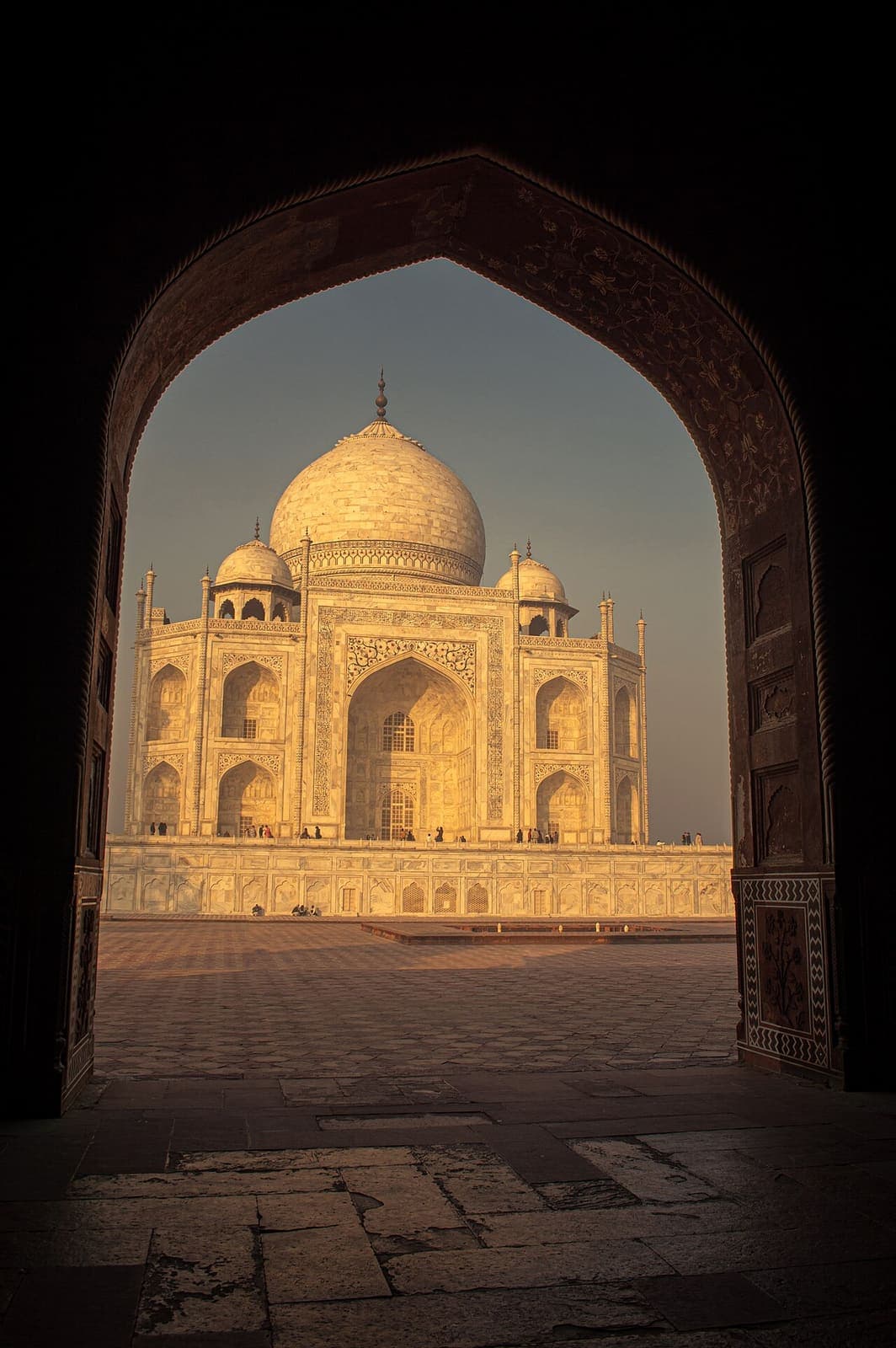
Photo: Philip Nalangan · Wikimedia Commons · CC BY 4.0 · resized for web
Yes, you can take photos at the Taj Mahal. Cameras and phones are allowed throughout the grounds, from the great gateway and the garden to the mosque and the marble platform, but photography is prohibited inside the main mausoleum. Tripods and drones are banned, and at night viewing only a still camera may go in.
| What | The rule |
|---|---|
| Cameras and phones | Allowed in the grounds; phones off or on silent |
| Inside the main mausoleum | No photography |
| Camera fee | None listed on the official ticket pages |
| Tripods and other camera stands | Not allowed |
| Drones | Strictly prohibited, inside and around the Taj |
| Selfie sticks | Not named on the official lists; security decides |
| Lights and props | Lights need written ASI permission; banners, flowers and mats are banned |
| Night viewing | A still camera only: no phones, video cameras or spare batteries |
| Photographers for hire | Approved ones who show an identity card |
| Professional or commercial shoots | Written permission from the ASI’s Agra Circle |
What the official rules say about cameras, phones, tripods and drones
The official dos and don’ts ban “electric goods (except camera)”, so cameras are in by name, and phones may come in switched off or on silent. With tripods, headphones, mobile chargers and “wire” also banned, power banks and cables stay out, as do food, tobacco, knives and liquor. Inside the main mausoleum photography stays banned: with the Ajanta caves and Leh Palace, it was one of three exceptions the ASI kept when it lifted its photography restrictions in July 2018, Scroll reported.
The ASI’s Agra Circle adds items that catch out photoshoots: flags and banners, flowers and garlands, toys, mats and torches. Behind both lists sit the Ancient Monuments rules of 1959: anyone may photograph a monument, but a camera stand, a stool, or any artificial light other than a camera’s flash needs an archaeological officer’s written permission. By that rule a monopod counts as a stand, and a ring light needs permission.
Selfie sticks are not named on either official list, so security decides at the gate; one with tripod legs is a tripod. A motorised gimbal is an electric good that is not a camera, so expect it to be stopped.
Drones are “strictly prohibited inside and around the Taj Mahal”. Since May 2025 a police anti-drone system has watched a 500-metre perimeter round the monument and brings drones down by jamming them, PTI reported; Mehtab Bagh, across the river, is well within its reach.
Is there a camera fee at the Taj Mahal?
No. The official fee table lists no charge for a camera or a phone, only entry and the optional ₹200 mausoleum ticket. Video for your own use is fine in the grounds: the 1959 rules allow non-commercial filming outside the buildings, without a stand or anyone performing. They also provide for a ₹25 video fee at monuments such as the Taj, but no current Taj ticket page lists one.
Photography at night viewing
Night viewing is stricter: phones, video cameras and spare batteries are banned on top of the daytime list, and a still camera is allowed after the security check. With 30 minutes and a moonlit tomb a few hundred metres away, a fast lens matters most; the night viewing guide has the dates.
The best photo spots inside the Taj Mahal, in walking order
From either gate you reach the tomb the same way: across the forecourt, through the Great Gate and north down the garden. Facing the tomb you look north, so the morning sun is on your right and the afternoon sun on your left.
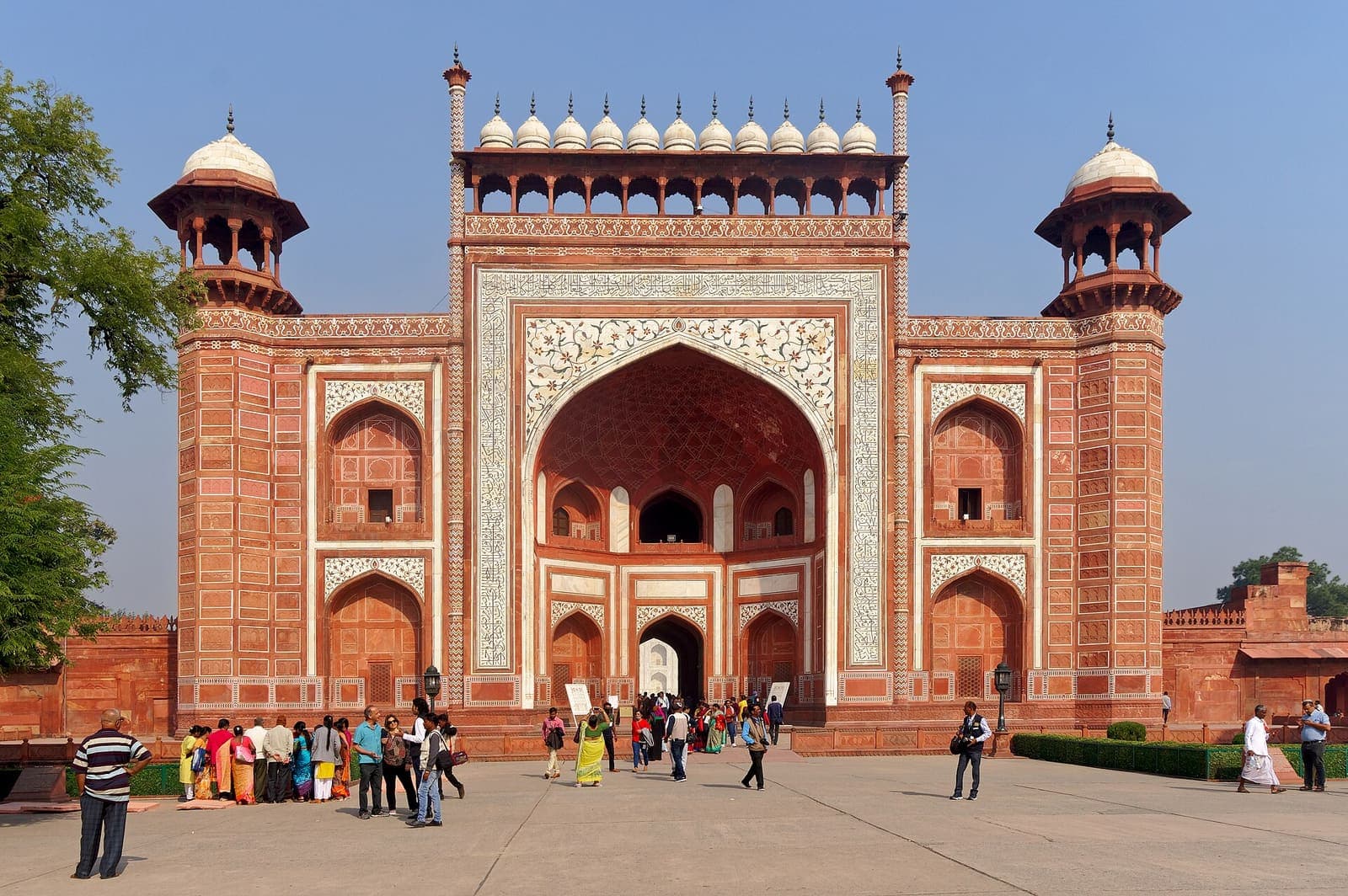
- The Great Gate from the forecourt. Red sandstone, marble calligraphy, a wide lens. It faces south, so from October to March the sun is on it all day.
- Inside the gateway arch. Your first sight of the tomb, framed by the dark arch. Expose for the marble and let the arch go black; on a phone, tap the tomb. Step aside: people stop dead here.
- The head of the water channel. The view everyone knows. For the reflection, crouch at the near end so the water fills the foot of the frame, and come early: a breeze breaks it up.
- The central platform and the Diana bench. A raised marble platform with a pool and five fountains, ringed by four marble benches that Lord Curzon had put there in 1907–08, the official site says. Princess Diana was photographed alone on the far one, in line with the tomb, in February 1992. Go there first.
- The side walkways. Quieter, with cypresses for a foreground and the tomb on the diagonal.
- The mosque and the guest house. The red sandstone mosque stands on the west, to your left, and the Mehman Khana, the guest house, on the east; their arches make ready frames, as in the photograph at the top. Shoot the tomb from the guest-house side in the morning and the mosque side in the afternoon, with the sun behind you. The mosque still opens for Friday prayers, so keep your voice down.
- The marble platform. Shoes go into covers or come off. Look up at a minaret or close in on the inlay, without touching the stone; from the back edge, Mehtab Bagh lies across the Yamuna. Then the camera goes away for the mausoleum.
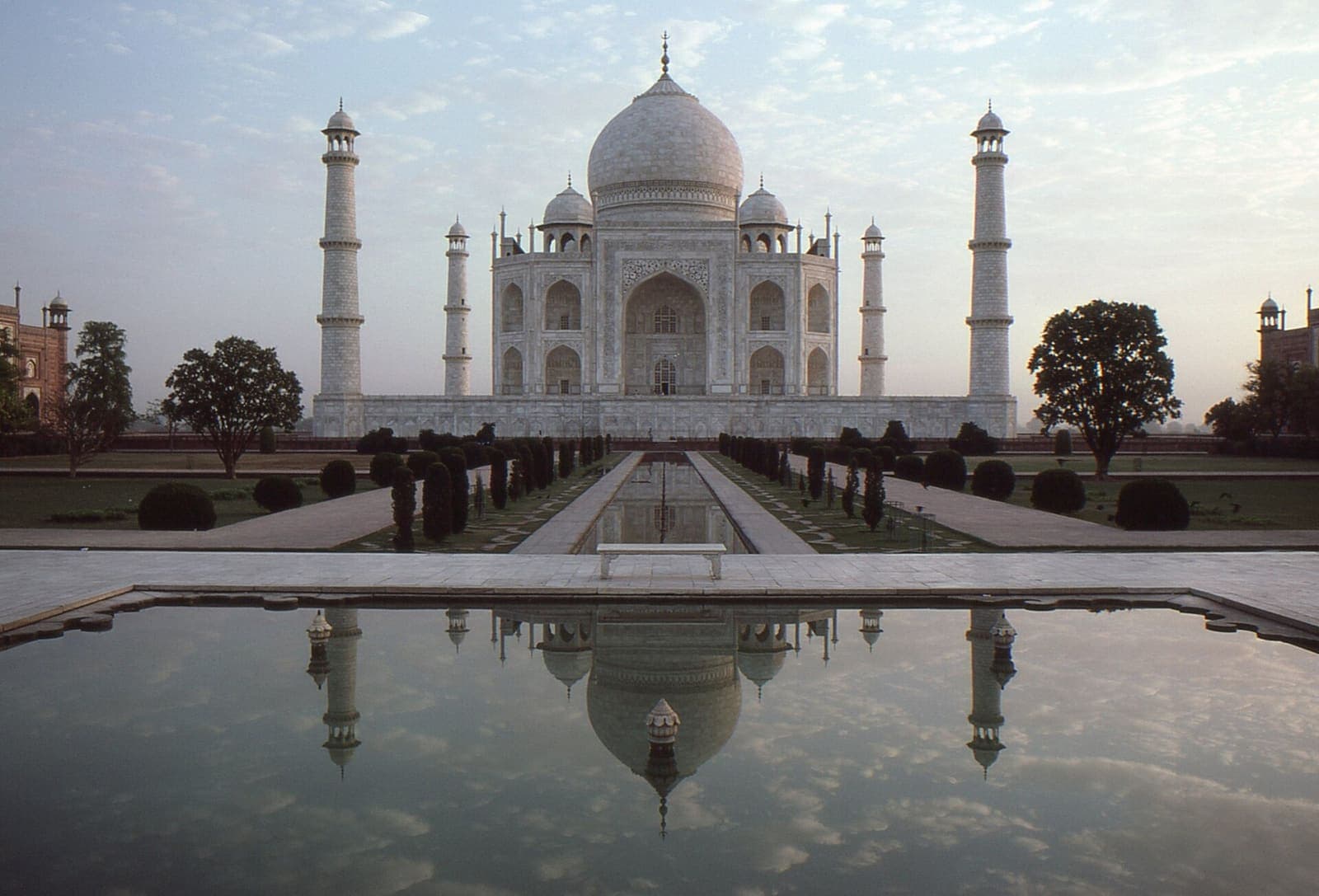
Photo: Chris Mills · Wikimedia Commons · CC BY-SA 3.0 · resized for web
Outside the walls: Mehtab Bagh, Agra Fort and the Taj Ganj rooftops
The Taj closes 30 minutes before sunset, so sunset and dusk belong to the views outside.
Mehtab Bagh at sunset
Mehtab Bagh is the Mughal garden directly across the Yamuna, on the Taj’s own axis: from its river end the tomb stands centred over the water a few hundred metres away. It is open every day from sunrise to sunset, Fridays included. On the official fee table on 22 October 2026, tickets were ₹25 for Indian, SAARC and BIMSTEC visitors and ₹300 for other foreign visitors, with under-15s free.
Be inside an hour before sunset, which is at about 5:42 PM on 23 October 2026; the gates shut when the sun goes down. It sets to your right, warming the dome’s west side. The monsoon can leave water on the riverbank for a reflection, and in December and January fog can hide the dome. The Mehtab Bagh guide has the drive.
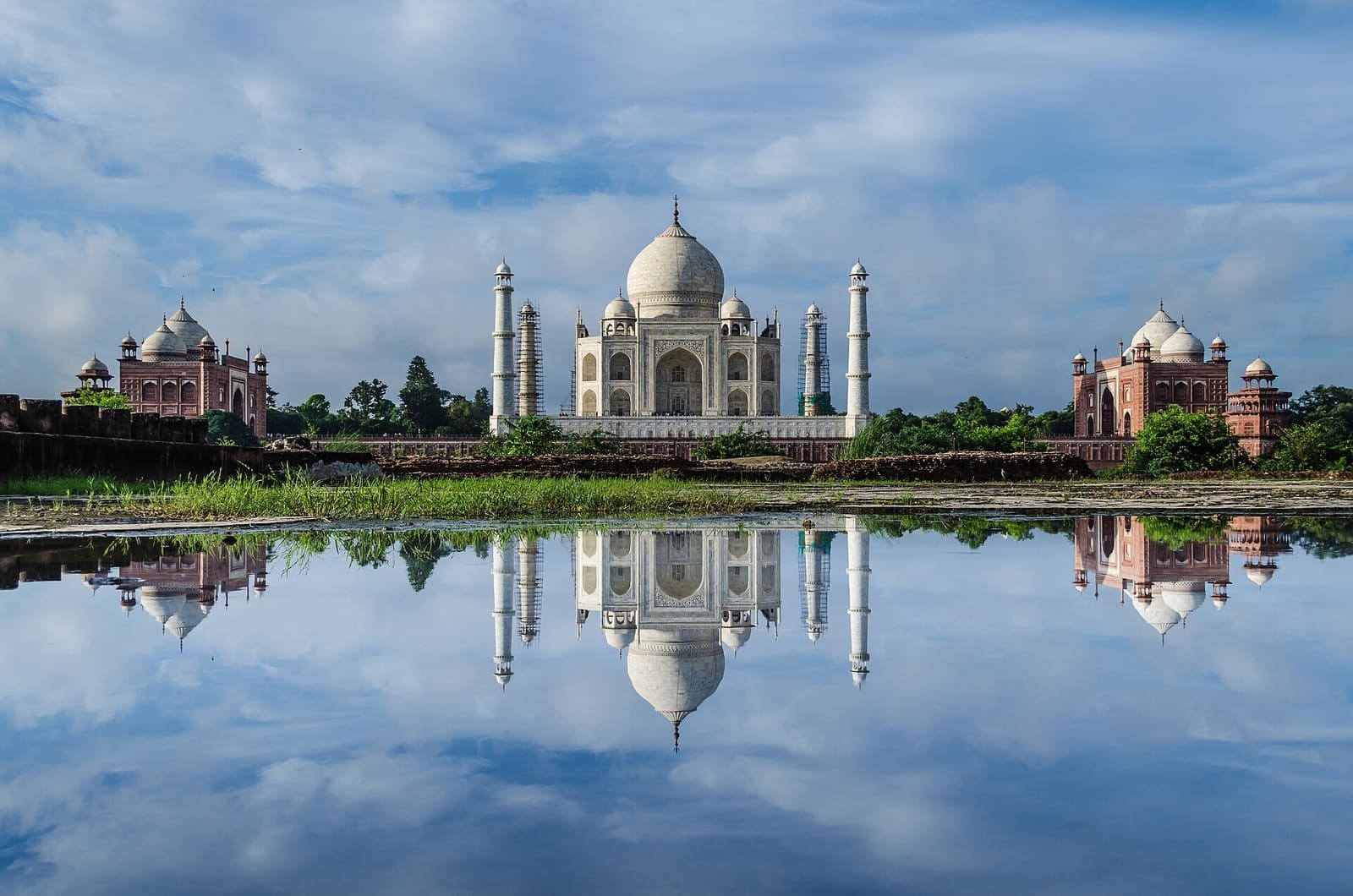
Photo: Antrix3 · Wikimedia Commons · CC BY-SA 4.0 · resized for web
For dinner afterwards, Altitude Rooftop Lounge, the rooftop restaurant that publishes this journal, is on the top floor above MG Road 2 at Jaipur House, about 25 minutes by road from the Taj, a little longer from Mehtab Bagh, and open every day until 11:30 PM. It has no Taj view, so take your last pictures by the river; booking a table is free.
Agra Fort: the terrace beside Musamman Burj
Agra Fort looks down the river to the Taj about 2 km away, best from the terrace beside Musamman Burj, the railed-off marble tower where Shah Jahan spent his last years. Go in the afternoon with the sun behind you, and bring a long zoom or use the carved windows as a frame. It opens daily, sunrise to sunset; tickets are ₹50 for Indians and ₹650 for foreign visitors, or ₹600 after the Taj. See the Agra Fort guide.
Taj Ganj rooftops
South of the Taj, the guesthouses and cafés of Taj Ganj have flat roofs that look over the walls to the dome: the place for dusk and the blue hour, after the gates close. On 23 October the sun sets at about 5:42 PM and the sky stays lit until about 6:05 PM. Expect the top of the tomb, not the whole building, and buy something before you set up; our guide to restaurants near the Taj Mahal covers the cafés. Near the East Gate, the Taj Nature Walk has views of the dome through the trees.
The best light for Taj Mahal photos, by hour and by season
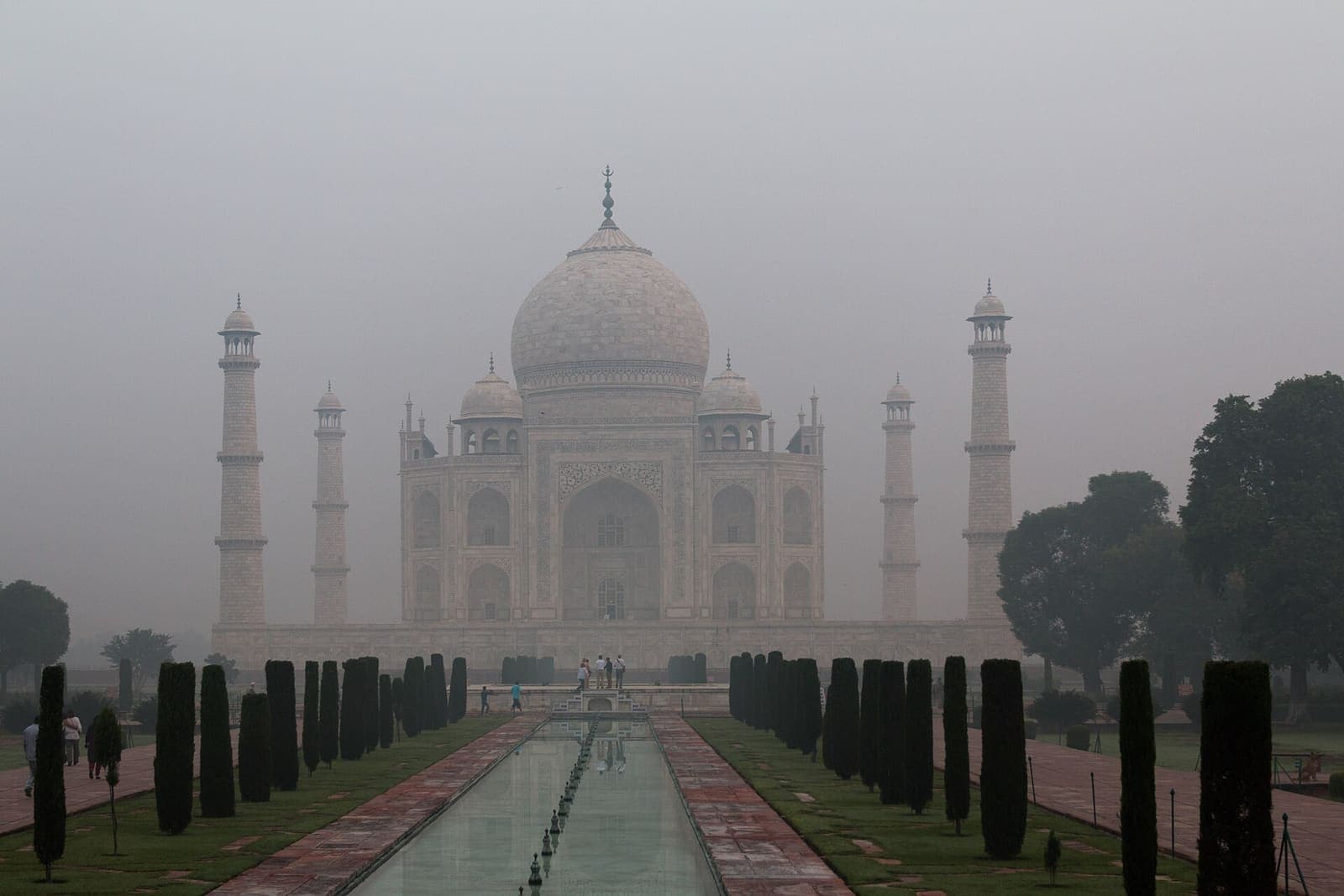
Plan around the first hour. The gates open 30 minutes before sunrise, when, in the official FAQ’s words, “the twilight gilds it with pink color”; early visitors also miss the heat and the crowds, and the FAQ adds that sunset draws more people. On 23 October 2026 the gates open at about 5:52 AM, the sky colours from about 5:58 AM and the sun rises at 6:22 AM.
The season moves the sun. From October to March it rises and sets south of east and west, so the famous south face catches it at both ends of the day; in June it rises well north of east and stands almost overhead at noon, flattening everything by mid-morning.
| Months | Light and conditions |
|---|---|
| October and November | Sunrise about 6:17 to 6:37 AM. Dry, clear mornings; fog is rare |
| December and January | Sunrise about 6:59 to 7:08 AM. Soft light, but about five foggy days a month (India Meteorological Department averages) |
| February and March | Sunrise about 6:54 to 6:27 AM. The fog fades and the air clears |
| April to June | Sunrise about 5:53 to 5:22 AM. Average highs of 38 to 42°C: shoot the first hour |
| July to September | Monsoon skies and reflections on the far bank, but rain can take a morning |
Fog is the one thing that can take the Taj away, so in December and January check the forecast the night before. See the best time to visit Agra for the seasons and the Taj at sunrise for opening times by month.
| Spot | Best time |
|---|---|
| Inside the Great Gate’s arch | The first half hour after opening |
| The water channel, for the reflection | Dawn, on a still morning |
| The central platform and the Diana bench | Straight after opening |
| The guest-house (east) side | Morning |
| The mosque (west) side | Afternoon |
| Mehtab Bagh | The last hour before sunset |
| Agra Fort, beside Musamman Burj | Afternoon |
| Taj Ganj rooftops | Dusk, after the Taj closes |
Hiring a photographer inside the Taj Mahal
You will be offered photographs from the forecourt on. The official site advises visitors to hire “approved guides & photographers who exhibit their identity cards”, and the 1959 rules require an ASI licence to photograph visitors for money inside a monument. Under the ASI’s 2017 licensing policy, upheld by the Delhi High Court in October 2023, overcharging or not handing over prints counts as misconduct.
That policy fixed the charges at ₹25 for a postcard-size print up to ₹80 for 8 × 12 inches, and ₹100 for up to 25 digital photos, then ₹4 each, PTI reported in May 2017. We found no newer list and no recent report of actual prices, so treat those as a 2017 benchmark and agree these before the first frame:
- The price, per photo or for the session, and whether digital copies are included.
- How many photos you get, and whether you choose them.
- Delivery: printed on the spot, sent to your phone before you leave or emailed later, edited or not.
- Payment: after you have the pictures.
- The identity card: check it and photograph it, so you have a name if anything goes wrong.
Booking online before the trip? Ask for the photographer’s ASI licence or identity card number first.
Photoshoots in Indian dress, couples and pre-wedding shoots
A casual shoot needs no permission. There is no dress code, so a sari, lehenga or sherwani is your choice, and a friend or a licensed photographer can photograph you anywhere in the grounds. Arrive dressed, keep to one outfit and pin a long dupatta: there are steps, shoe covers and a security queue. The Taj Mahal dress code covers clothes by season.
A professional shoot is different. A photographer you bring and pay, a stand, lights or reflectors, props from the banned list, or a video with people performing all need the ASI’s written permission. For filming, the ASI’s Agra Circle says to apply to its Superintending Archaeologist on Form IX with the script, crew and equipment lists and the fee by bank draft, plus a no-objection certificate from the Ministry of External Affairs for foreign applicants. The 1959 rules ask for three months’ notice.
The fee figures disagree: the Agra Circle’s FAQ says ₹5,000 a day per monument, the ASI’s Bhopal Circle ₹1 lakh a day at a World Heritage site plus a ₹50,000 deposit, and nothing is published for a still pre-wedding shoot. Ask the Agra Circle in writing, at 22 The Mall, Agra, or circleagra.asi@gov.in; its contact page lists phone numbers.
Commercial shoots get noticed: in June 2026 an apparent sari promotion filmed inside raised questions about how it had been allowed, Navbharat Live reported. For lights and outfit changes, use a Taj-view roof or hotel terrace outside the walls, with the owner’s permission; drones are still banned.
Ten Taj Mahal photoshoot poses that work
Keep them quick, stay off railings and ledges, and do not touch the stone.
- The walk. Stroll towards the camera down the central path, the tomb behind you.
- The bench. Sit on the far bench of the central platform, the tomb centred behind you.
- The silhouette. Stand in the Great Gate’s archway, dark against the bright garden.
- Over the shoulder. Back to the camera, looking at the dome, a hand on your dupatta or shawl.
- The side arch. In profile inside an arch of the mosque or the guest house, the tomb beside you.
- The reflection. Stand to one side of the channel, small in the frame, and let the water work.
- Hands and detail. Hands with mehndi or bangles in front of carved marble, close but not touching.
- Face to face. For couples, foreheads close or hands joined. It is a tomb, so keep it gentle.
- The breeze. On the riverside terrace, hold the end of a dupatta or sari and let the wind take it.
- The pinch. From the gate end, hold the finial between finger and thumb while the photographer lines it up.
A gear checklist that gets through security
- Bring: a camera with a wide lens and a zoom, charged batteries, memory cards, your phone on silent, a lens cloth, water, your ticket and an original photo ID.
- Leave at the hotel: tripods, monopods and any camera stand; drones; gimbals, power banks, chargers and cables; headphones; lights and reflectors; banners, flowers and mats.
- For night viewing: a still camera only. No phone, no video camera, no spare battery.
- A small bag: big bags slow the check, and anything banned goes in the cloak rooms at both gates.
Foreign, SAARC and BIMSTEC tickets include shoe covers and water. For what to wear and pack, see the dress code guide.
How to keep the crowds out of your Taj Mahal photos
- Not on a Friday. The Taj is closed; Mehtab Bagh and Agra Fort are open. See Agra on a Friday.
- Be in the first group. Windows open an hour before sunrise, the gates 30 minutes before; Taj Mahal timings has your date.
- Use the East Gate, which the official site recommends for avoiding the crowd.
- Buy your ticket online the day before; the ticket guide shows how.
- Walk past the first view. Most people stop at the gate; go straight to the central platform, then work back.
- Choose a weekday, and the morning over the evening.