Taj Mahal night viewing: dates, tickets and what you actually see
The Taj by moonlight is real, but it is a few nights a month, half an hour at a time, from a platform at the far end of the garden. Here is how the night viewing actually works, the dates to March 2027, and what to do when none of them fit.
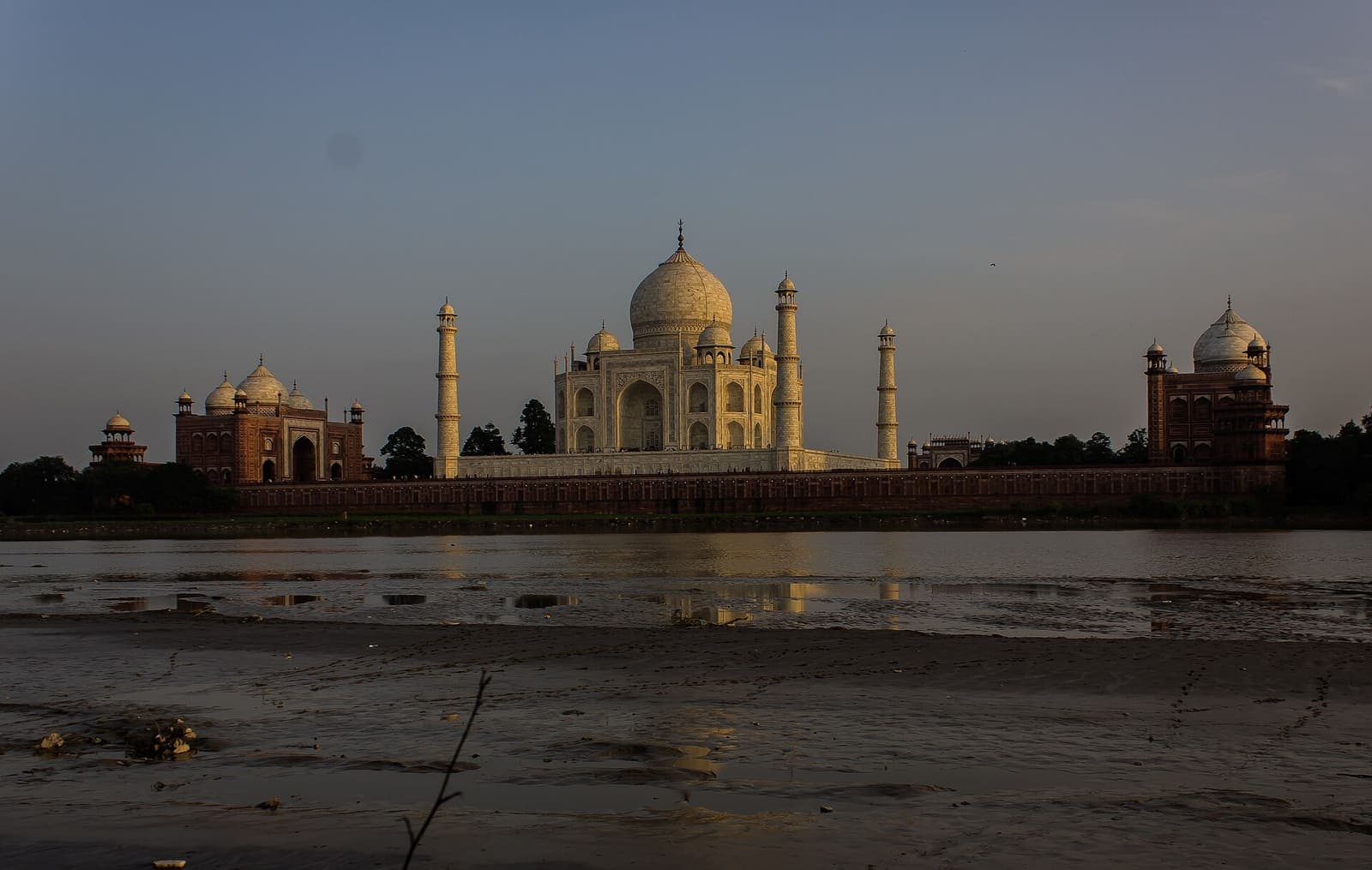
Photo: Vipinyadav3011 · Wikimedia Commons · CC BY-SA 3.0
Yes, you can see the Taj Mahal at night, but only on a handful of nights a month and never on a whim. The Archaeological Survey of India (ASI) opens it on the night of the full moon and the two nights either side, never on a Friday and not during Ramzan, in half-hour batches of up to 50 people. You watch from the red sandstone platform at the main gate, the length of the garden away from the tomb, and you do not go inside.
Tickets are ₹510 for Indian adults, ₹750 for foreign adults and ₹500 for children, sold online from seven days before each night. Below are the ASI’s rules for 2026–27, the dates to March 2027, and what to do when none of them fit. We run a rooftop restaurant on MG Road 2, not a ticket office, so check everything here against the ASI before you travel.
What you actually see
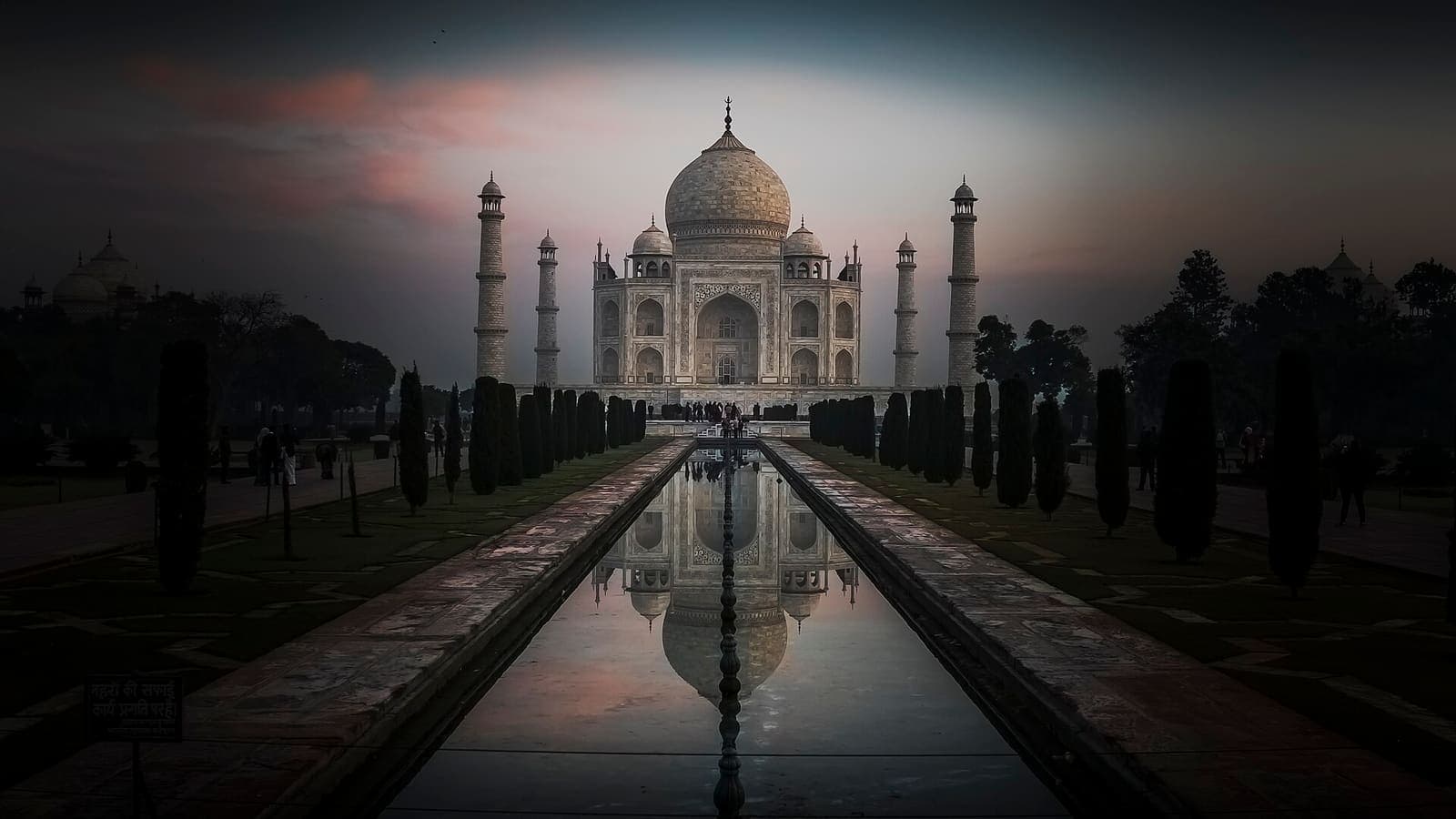
Night viewing does not take you into the garden, onto the marble terrace or inside the mausoleum. The ASI’s instructions to ticket holders give the view point as the red sandstone platform of the main gate, the great gateway at the south end of the garden, and that is where your half-hour is spent. The tomb stands at the far end, a few hundred metres away.
What you see from there depends on the moon and the air. The tomb is not floodlit. On a clear night close to the full moon the marble holds a soft, pale light and the dome and minarets stand clear of the sky; on a hazy one it is a grey outline you take partly on trust. Either way it is the classic view straight down the garden, shared with 50 people rather than the daytime thousands.
Binoculars are allowed and are the most useful thing you can bring. Give your eyes a few minutes to adjust; half an hour goes quickly.
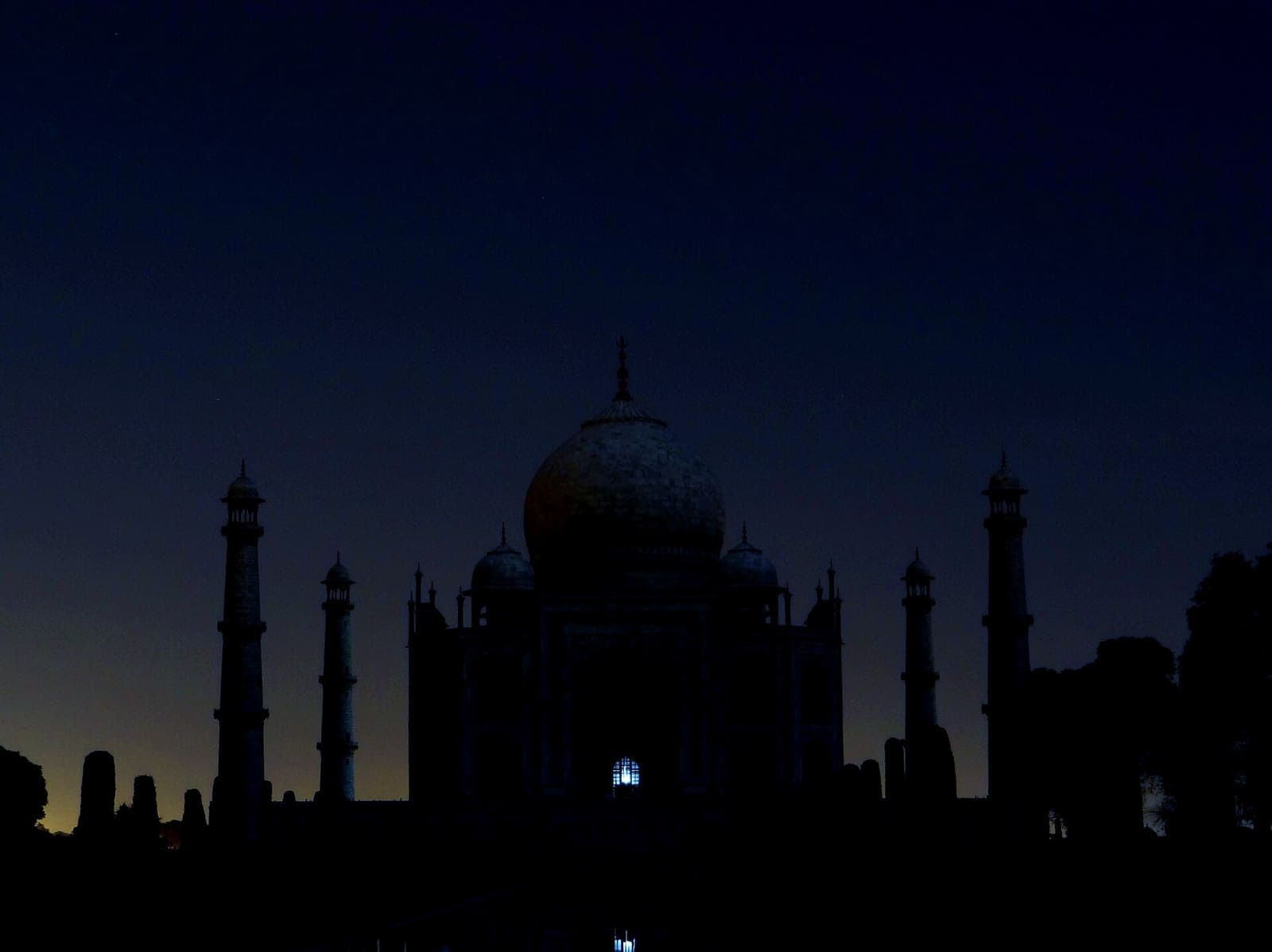
Photo: Gauravkapoor · Wikimedia Commons · CC BY 3.0
Which nights: the full moon, two either side, never a Friday
Night viewing began on 28 November 2004 under an order of the Supreme Court, and the rule has stayed the same: the full-moon night, the two nights before it and the two after. Fridays are excluded, as the Taj is shut anyway, and so is the month of Ramzan. A month gives you five nights at most, and four when one of them is a Friday.
The ASI also fixes its own full-moon date, and it does not always agree with a moon app. For December 2026 the apps say the 24th and the ASI says the 23rd; for March 2027 the apps say the 22nd and the ASI says the 21st. The tickets follow the ASI.
| Month (ASI full-moon date) | Viewing nights |
|---|---|
| October 2026 (Mon 26) | Sat 24, Sun 25, Mon 26, Tue 27, Wed 28 |
| November 2026 (Tue 24) | Sun 22, Mon 23, Tue 24, Wed 25, Thu 26 |
| December 2026 (Wed 23) | Mon 21, Tue 22, Wed 23, Thu 24. Not Fri 25. |
| January 2027 (Fri 22) | Wed 20, Thu 21, Sat 23, Sun 24. Not Fri 22. |
| February 2027 | None. The full moon falls in Ramzan and the ASI has cancelled the month. |
| March 2027 (Sun 21) | Sat 20, Sun 21, Mon 22, Tue 23. Not Fri 19. |
January is the awkward month: the full moon itself is a Friday, so there is no viewing on the night it is fullest. The dates are from the ASI’s notice for 2026–27, which is on the official Taj Mahal site, and the ASI can cancel a viewing for unforeseen reasons. Confirm your date with the ASI before you build a trip around it.
Timings, batches and the moon’s own timetable
Each night runs in eight batches of half an hour, with up to 50 people in each: 400 a night at most. The two official sources disagree about the clock. The official Taj Mahal site, run by UP Tourism, says 8:00 PM to midnight; the ASI’s Agra Circle site still says 8:30 PM to 12:30 AM. Your ticket shows your batch, and that is the time that counts.
You report half an hour before it at Shilpgram, the complex near the East Gate, for a security check, and go in through the East Gate. Polluting vehicles are not allowed within 500 metres of the Taj, so cars stop at the Shilpgram parking.
One thing the ticket will not tell you: the moon rises roughly an hour later each night. On the nights before the full moon it is well up when the first batch goes in. On the second night after it, the moon rises between about 7:00 and 8:00 PM (8:05 PM on 24 January 2027, by the US Naval Observatory’s tables), so the first batches that night see a low moon or none. If you can choose, take the full-moon night or one of the two before it; after it, take a later batch.
Ticket prices, and the refund question
- Indian adult: ₹510
- Foreign adult: ₹750
- Child aged 3 to 15, Indian or foreign: ₹500
Mind the children’s price. Under-15s get into the Taj free by day but pay ₹500 at night, so two adults and two children at Indian rates come to ₹2,020. These are the ASI’s prices as of October 2026; check the booking site before you go.
There is no refund if fog, cloud or rain spoils the view. The ASI says so in writing, down to the “non-visibility of the moon”. On cancelling for any other reason it contradicts itself: its night-viewing instructions allow a cancellation until noon on the day with 25% deducted, while its refund policy calls night tickets strictly non-refundable. Treat the money as spent once you book.
How and when to book
Online, on the ASI’s ticketing site, where the night viewing is listed as a monument of its own. The ASI’s notice for 2026–27 says booking opens seven days before each night, and with 400 places a night there is no reason to wait once your date is fixed.
- Open the ASI site and choose the Taj Mahal night view.
- Pick the date and the batch, with the moon times above in mind, and pay.
- Print the ticket. The ASI asks for a physical copy with the QR code clearly visible, and your phone will not be allowed in to show it anyway.
- Carry an ID for everyone in the group; the ASI asks every visitor for one.
You will still find pages, including an older answer on the official Taj site, that send you to the ASI office at 22 The Mall to buy tickets a day ahead, between 10:00 AM and 6:00 PM. That is how it used to work. The 2026–27 notice names only the website, so start there.
On the night: Shilpgram, security and what to leave behind
Be at Shilpgram 30 minutes before your batch with the printed ticket and an ID for each person. The night rules are stricter than the daytime ones: on top of the usual banned list, night viewers may not bring mobile phones, video cameras or spare batteries. A handheld still camera and binoculars are allowed.
The phone rule is the one that catches people out. Leave it in the car or at the hotel, and agree with your driver beforehand where and when you will meet, because you will not be able to call. In December and January dress for a cold night: you will be standing still on stone for half an hour.
Photography: set your expectations low
No phone, no tripod, a building a few hundred metres away and no light on it but the moon: that is a hard photograph for any camera held in two hands. You are trading grain against blur, and most frames will lose.
If you bring a camera, open the lens as wide as it goes, push the ISO higher than feels right, tuck your elbows in and take several frames of every shot. Or leave it behind. The moonlit Taj most people carry in their heads comes from paintings and long exposures, and the half-hour is better spent looking.
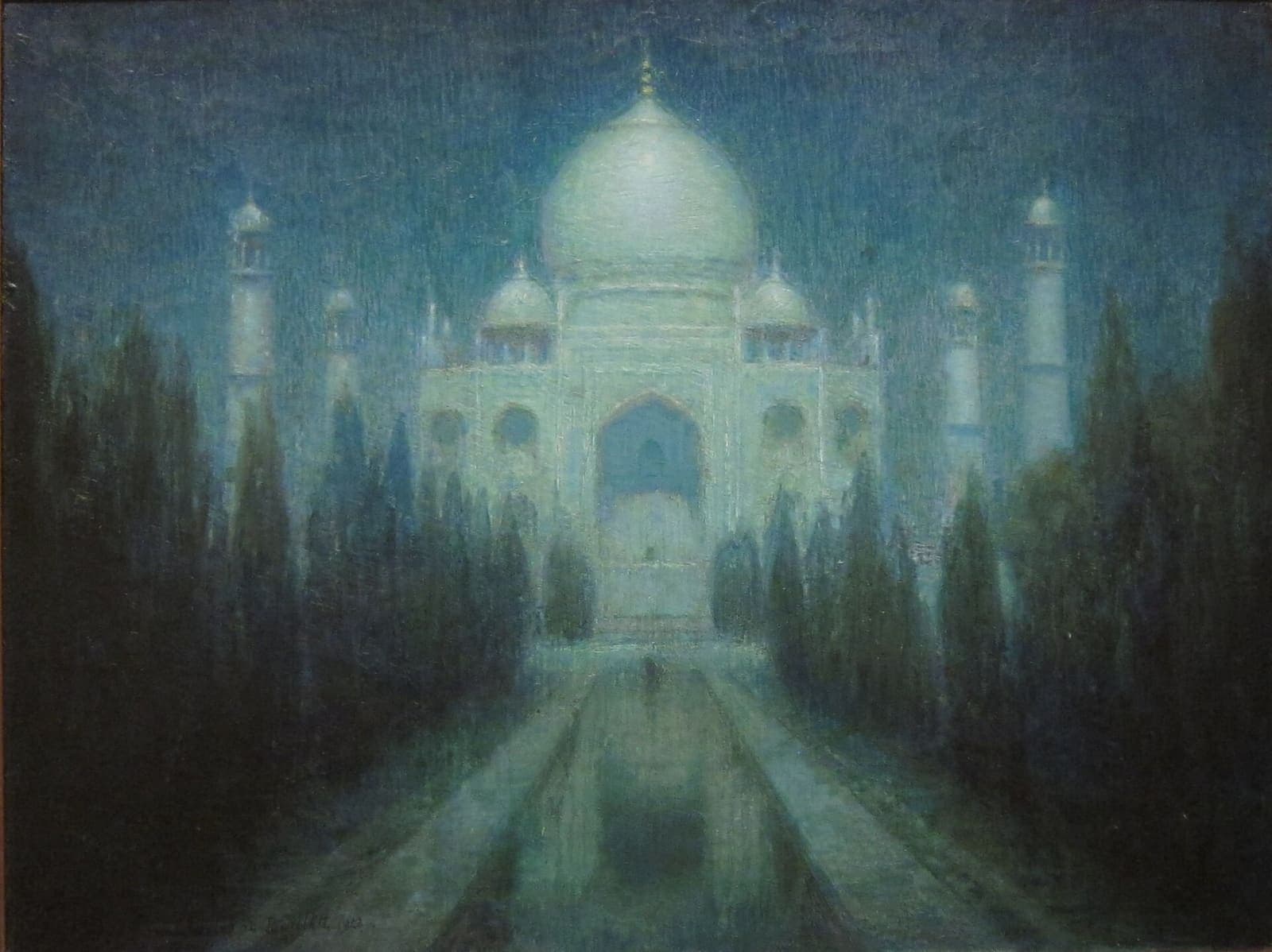
Photo: Charles William Bartlett · Wikimedia Commons · Public domain
Haze, fog and cloud
The moon is your only light, so anything between you and it matters. Agra’s air is often hazy, more so as the weather cools, and late December and early January are fog season on the plains; a thick night can hide the building completely. The ASI will not refund you for any of it.
The week-ahead booking helps a little. Look at the forecast before you choose, and if two nights in the window suit you, take the one with the clearer sky and the higher moon.
When the dates do not work
Most trips miss the window, or land on a Friday. There are two good ways to see the Taj in low light without a night ticket.
Mehtab Bagh at dusk
Mehtab Bagh is the Mughal garden on the opposite bank of the Yamuna, laid out in line with the Taj; the photograph at the top of this page was taken from it. It closes at sunset like most Agra monuments, so go for the last hour of light. The ASI ticket is ₹25 for Indians and ₹300 for foreign visitors, and unlike the Taj it is open on Fridays.
Taj Ganj rooftops
Taj Ganj, the old quarter just south of the Taj, is full of small hotels and guesthouses with terrace restaurants facing the dome. After dark the view is a silhouette, but on the nights around the full moon a terrace there gives you the moonlit dome over dinner, with no ticket and no batch. Ask whether the terrace serves non-residents before you go; our guide to Taj-view terraces and city rooftops explains the difference.
Dinner before your batch
The viewing runs late and lasts half an hour, so the sensible order is dinner first. We run the rooftop above MG Road 2, about 10 to 12 km from Shilpgram by road depending on the route; allow 30 to 45 minutes for the drive in the evening.
For an 8:00 PM batch you need to be at Shilpgram by 7:30 PM, so come up at five and leave by about 6:45 PM. Every mocktail is 30% off from 5 to 7 PM, and on weekdays a table booked online for between 1 and 6 PM takes 30% off what you order before six. For a later batch, eat at an ordinary hour and leave us an hour and a quarter before your slot.
If your batch is over by about 9:30 PM you can do it the other way round: the kitchen takes its last order at 11:00 PM and the doors close at 11:30 PM. Either way, book a table: it is free, confirmed instantly and cancels free up to two hours before, and a table booked online takes 15% off any day or 20% on weekdays. One offer per bill, and none on public holidays or major festivals; the offers page has the rest.
If the moon lets you down, our list of the top 10 nightlife places in Agra has the rest of the evening. And if your dates land on a Friday, when neither the Taj nor its night viewing opens, read Agra on a Friday first.