Akbar’s tomb, Sikandra: timings, tickets, what to see and a day built around it
Akbar began his own tomb on the Delhi road and his son finished it in 1613: a gateway with four white marble minarets, a garden with blackbuck in it, and a plain grave at the end of a long, dim passage. Here is when to go, what it costs and what to see, and how to make a whole day of Akbar out of it, with Fatehpur Sikri in the afternoon light.
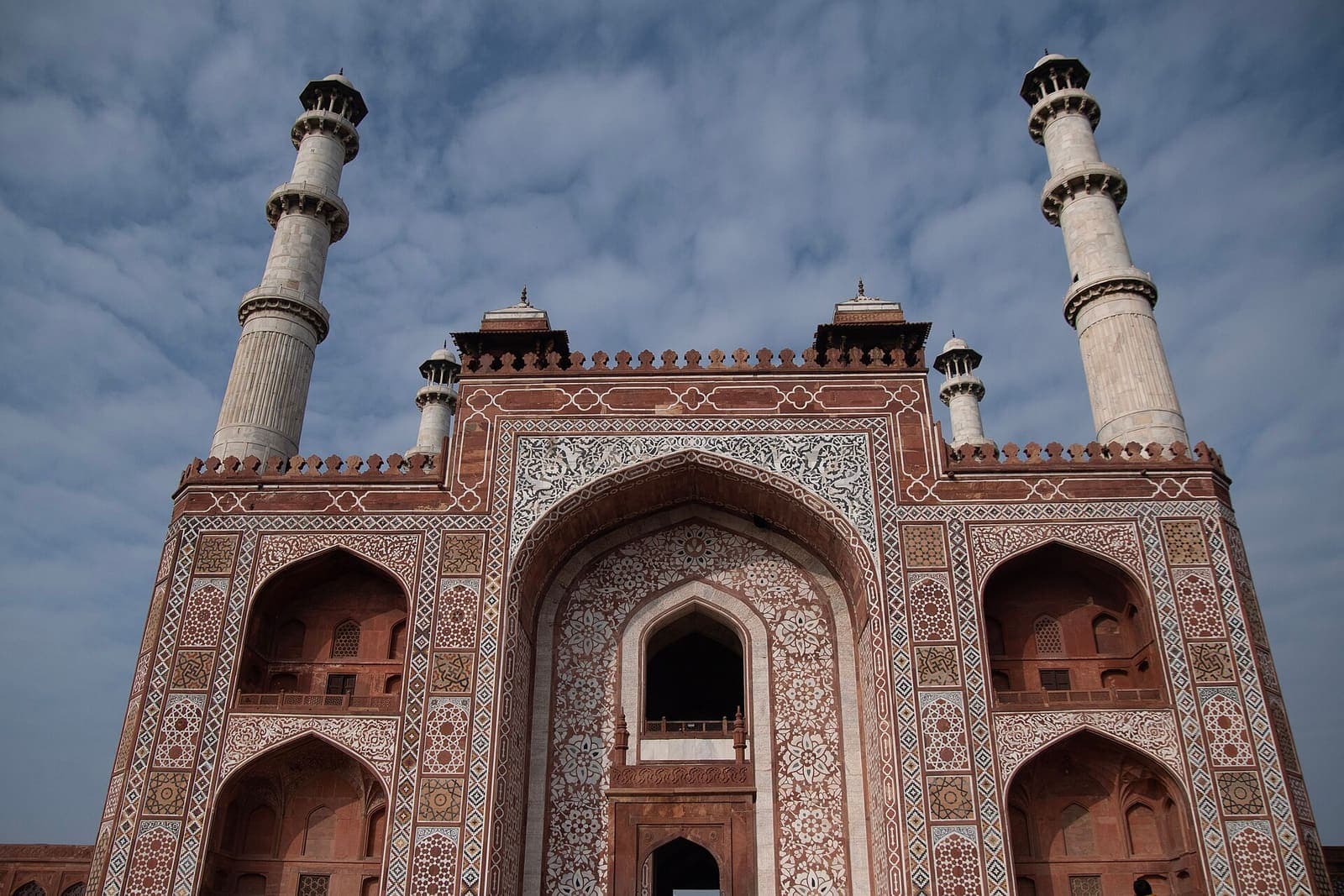
Photo: Darshanavenugopal · Wikimedia Commons · CC BY-SA 4.0
Akbar’s tomb at Sikandra is open every day from sunrise to sunset, Fridays included. A ticket is ₹30 for Indian, SAARC and BIMSTEC visitors and ₹310 for everyone else (₹25 and ₹300 on a Friday), and children under 15 go free. It stands about 10 km from the city centre on the Delhi highway, about 15 km by road from the Taj. Allow an hour or so, and go early.
It is the emperor’s own mausoleum, begun in his lifetime and finished by his son Jahangir in 1613: a gateway with four white marble minarets, a walled garden with blackbuck in it, a five-storey tomb of red sandstone and white marble, and Akbar’s grave at the end of a long, dim passage. It is far quieter than the Taj, and it is open on the day the Taj is not.
One disclosure. This is Altitude’s journal, and Altitude, the rooftop restaurant in Shahganj about 9 km from the tomb, is ours, which is why the page ends with a day plan that has lunch in it. Everything before that is what we would tell a friend.
Akbar’s tomb, Sikandra: timings and ticket price
The opening time is sunrise and the closing time is sunset, seven days a week, and the ticket counter stops selling about half an hour before sunset. In practice:
| What | Details |
|---|---|
| Open | Every day, sunrise to sunset, Fridays included |
| Opening time | About 6:15 AM in October, 7:10 AM in January, 5:25 AM in June |
| Closing time | About 5:50 PM in October, 5:25–5:45 PM in December and January, 7:15 PM in June |
| Indian, SAARC and BIMSTEC visitors | ₹30, or ₹25 on a Friday |
| Foreign visitors | ₹310, or ₹300 on a Friday or with a same-day Taj ticket |
| Children under 15 | Free |
| Time to allow | An hour to an hour and a half; two with the garden |
The ₹5 or ₹10 saved on a Friday is the Agra Development Authority’s toll, which it does not collect that day. Foreign visitors with a same-day Taj ticket have already paid it, so keep that ticket. You can also book online through the ASI; at the Taj that saves ₹5 an Indian ticket and ₹50 a foreign one, so compare. Unlike the Taj, this is not a World Heritage Site, hence the lower foreign rate. Rates change: check the ASI Agra Circle’s fee table before you go.
Getting there, and the distance to the Taj Mahal
Sikandra is on the north-west edge of Agra, on NH-19, the highway to Mathura and Delhi. A taxi or an app cab is the easy way, an auto is fine for two, and city buses and Mathura-bound buses run along the highway, cheap and slow. In a map app, check that it says Agra: there is another Sikandra on the Jaipur–Agra highway in Rajasthan. The official details are on the district’s page on the tomb.
Road distances from the tomb, rounded, with our estimate of the drive in daytime traffic:
- Taj Mahal: about 15 km, 35 to 50 minutes.
- Agra Fort: about 12.5 km, 30 to 45 minutes.
- Agra Cantt railway station: about 13.5 km, 30 to 45 minutes.
- Mariam-uz-Zamani’s tomb: about 1 km.
- Altitude, Shahganj: about 9 km, 20 to 25 minutes.
- Fatehpur Sikri: about 40 km, an hour to an hour and a quarter.
Akbar’s tomb history: who built it, and when
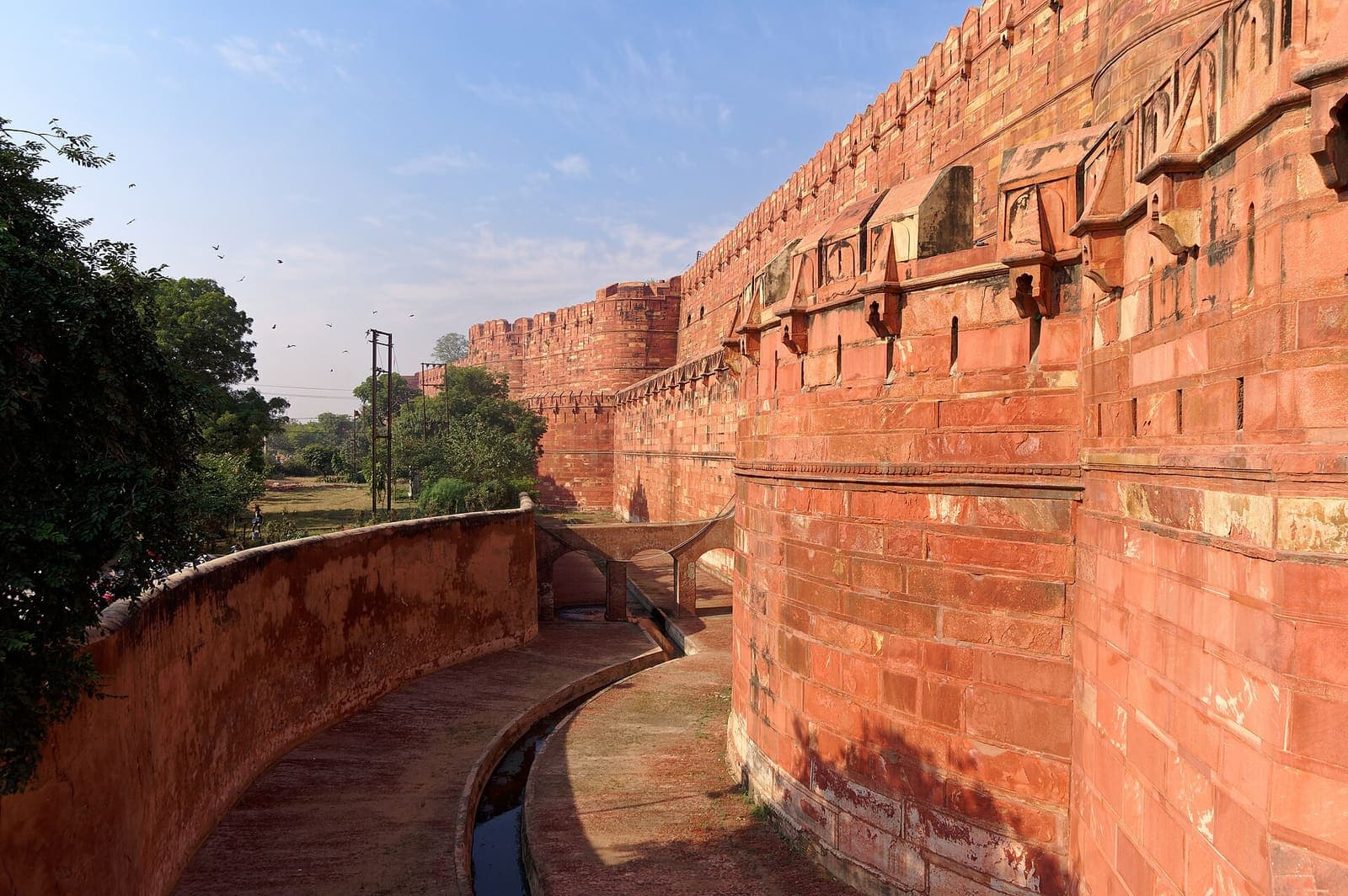
Akbar, who ruled from 1556 to 1605, began his own tomb here late in life and died in October 1605 with it unfinished. His son Jahangir took it over, did not like what the builders had done, and had parts rebuilt; the inscriptions on the south gateway date the finished tomb to about 1613. So if a quiz asks who built Akbar’s tomb at Sikandra near Agra, the answer it wants is Jahangir, with the footnote that his father started it.
Those inscriptions are by Abd al-Haqq of Shiraz, the calligrapher who later, as Amanat Khan, lettered the Taj Mahal. The building mixes Hindu, Islamic and Persian ideas, much as Akbar’s court did.
Its worst day came in March 1688, when Jat rebels under Rajaram plundered it of its gold, silver, carpets and lamps; two writers of the period, Niccolao Manucci and Ishwardas Nagar, report that they burned Akbar’s bones as well. It was repaired under the viceroy Lord Curzon, in work finished in 1905.
The suburb is named after Sikandar Lodi, Delhi’s sultan from 1488 to 1517, and a kilometre up the road a Lodi pavilion of 1495 became the tomb of Akbar’s Rajput empress Mariam-uz-Zamani, Jahangir’s mother, who died in 1623.
What you see, in walking order
- The south gateway. The largest of four, one in the middle of each wall: red sandstone inlaid with white marble in geometric, floral and calligraphic panels, with a white marble minaret at each corner. The inscriptions over the entrance praise Jahangir; turn round once you are through, because those facing the tomb praise Akbar.
- The causeway and the garden. A broad paved causeway runs through a charbagh, the four-part Mughal garden, its quarters divided by raised walks with narrow water channels. Blackbuck, India’s spiral-horned antelope, have lived in these grounds for decades (a 1966 study counted more than a hundred), and you may see spotted deer, langurs and peacocks too. The lawns are theirs; keep to the paths.
- The tomb. Five storeys stepping in like a pyramid: four of red sandstone, ringed with arcades and small domed kiosks, and a fifth of white marble, open to the sky, with marble screens and a cenotaph cut from a single block and carved with the 99 names of God. The upper storeys have been closed to visitors for years, so the marble top is something you see from below.
- The entrance hall. You go in through the great arch on the south side, into a hall whose walls and ceiling are covered in raised stucco painted in gold, blue and red: flowers, leaves and vases. Look up.
- The grave. From the hall a long, dim passage slopes down to the burial chamber: a high, bare, whitewashed vault with Akbar’s grave in the middle, a plain block of white marble. After the gateway, the plainness is the surprise. Two of his daughters are buried in the building too.
Shoes, cameras and manners
- Expect to leave your shoes at the tomb door, so wear a pair that slips off.
- It is a grave: cover shoulders and knees, and keep your voice down in the burial chamber.
- Photography is allowed, as at almost every ASI monument since 2018. Be discreet at the grave.
- Do not feed or follow the animals, and leave the drone at the hotel.
- If you hire a guide, agree the fee and the length first.
How long it takes, and the best time to go
An hour to an hour and a half is enough without hurrying, two if you like to sit in a garden. Mariam-uz-Zamani’s tomb up the road adds half an hour: the same hours, ₹25 for Indians and ₹300 for foreign visitors.
Go at opening. The first hours are the coolest of the day, the low sun is kind to the sandstone, and there are fewer people about; the last two hours before closing are the next best. If fog is forecast in December or January, go at nine instead.
October to March is the season. From April to June the afternoons are fierce, with May averaging about 42°C, so be at the gate when it opens and gone by ten. The monsoon turns the garden green and the air heavy. On a Friday it is open as usual and a little cheaper, the natural first stop of a day without the Taj; Agra on a Friday has the rest of that day.
How it differs from the Taj Mahal
People arrive expecting a smaller Taj. It is a different idea of a tomb:
- Red, not white. Sandstone inlaid with marble, with white marble only on top. The Taj’s tomb is white marble throughout.
- No dome. It rises in stepped storeys to an open marble terrace, where the Taj has its dome.
- The minarets are on the gate, four of them, built before the Taj’s.
- Three generations. Akbar was the grandfather of Shah Jahan, who built the Taj, and his tomb was finished almost twenty years before the Taj was begun in 1631.
- Cheaper, and open on Fridays. ₹30 against the Taj’s ₹50 for Indian visitors, or ₹310 against ₹1,100 for foreign visitors, before the Taj’s extra ₹200 for the main tomb.
The Akbar day: Sikandra to Fatehpur Sikri, with lunch on the way
Akbar is buried at Sikandra and built Fatehpur Sikri, about 40 km apart with Agra’s Fatehpur Sikri side in between. That makes a day: his tomb in the cool of the morning, lunch at one, his red sandstone city in the afternoon light, and back in Agra after dark. It suits October to March, and Fridays best of all.
| Time | Plan |
|---|---|
| 6:15 AM | Akbar’s tomb opens at sunrise; nearer 7:10 AM in January. |
| 6:15 to 7:45 AM | The gateway, the garden, the tomb and the grave. |
| 8:00 AM | Mariam-uz-Zamani’s tomb, a kilometre up the road. |
| 9:00 AM | Breakfast and a rest at the hotel, or Agra Fort, which Akbar rebuilt from 1565. |
| 1:00 PM | Lunch at Altitude in Shahganj, about 9 km from Sikandra. |
| 2:00 PM | On to Fatehpur Sikri: about 35 km, 50 to 60 minutes. |
| 3:00 PM | Car park, shuttle and tickets. The palaces first. |
| 4:45 PM | The Jama Masjid, Salim Chishti’s tomb and the Buland Darwaza. |
| 5:50 PM | The gates close at sunset; 5:25 to 5:45 PM in December and January. |
| 7:00 PM | Back in Agra. |
Not a morning person? Start at Sikandra at about ten and go straight from the tombs to lunch. You lose the cool, not the plan.
Lunch at 1:00 PM, on the way to Sikri
This part is ours, so weigh it accordingly. Altitude is on the top floor above MG Road 2 in Shahganj, on the Fatehpur Sikri side of the city: about 9 km from the tomb, then about 35 km on to the Fatehpur Sikri car park. Straight from Sikandra to Sikri is about 40 km, so the stop costs four kilometres or so, not a detour.
We open at 1:00 PM every day, not before, and the kitchen is on the roof: tandoor, wok and pizza oven. On a driver’s clock, order from the One Plate Wonders, complete meals for one, the curries with a butter naan, two butter rotis or steamed rice. On our menu as we write, the Dal Makhani Meal and the Kadhai Paneer Meal are ₹380, the Chicken Curry Meal ₹450, Chilli Paneer + Hakka Noodles ₹410 and Punjabi Chole Bhature ₹280. The pizzas are worth their 25-minute wait, just not on a day like this.
Sixty seats are on the open terrace and forty indoors in air conditioning, for May, June and the monsoon. There is no Taj view from our roof — the city and the sky. We do not serve alcohol; the cold list is mocktails, mojitos, iced teas, lemonades, shakes, frappes and coffee.
Fatehpur Sikri for the afternoon light
The palaces are ₹50 for Indians and ₹610 for foreign visitors (₹10 less on a Friday), the mosque side is free, and cars stop a kilometre short, with a shuttle to the gate. It closes at sunset, and the ticket windows a little before. Arriving at three in October leaves nearly three hours of light, less than we suggest for a morning visit, so be decisive: the palaces first, among them Jodha Bai’s palace, the home of the Mariam-uz-Zamani whose tomb you saw that morning, then the mosque for the last of the sun. Our day-trip guide to Fatehpur Sikri has the walking order, the guides and the touts.
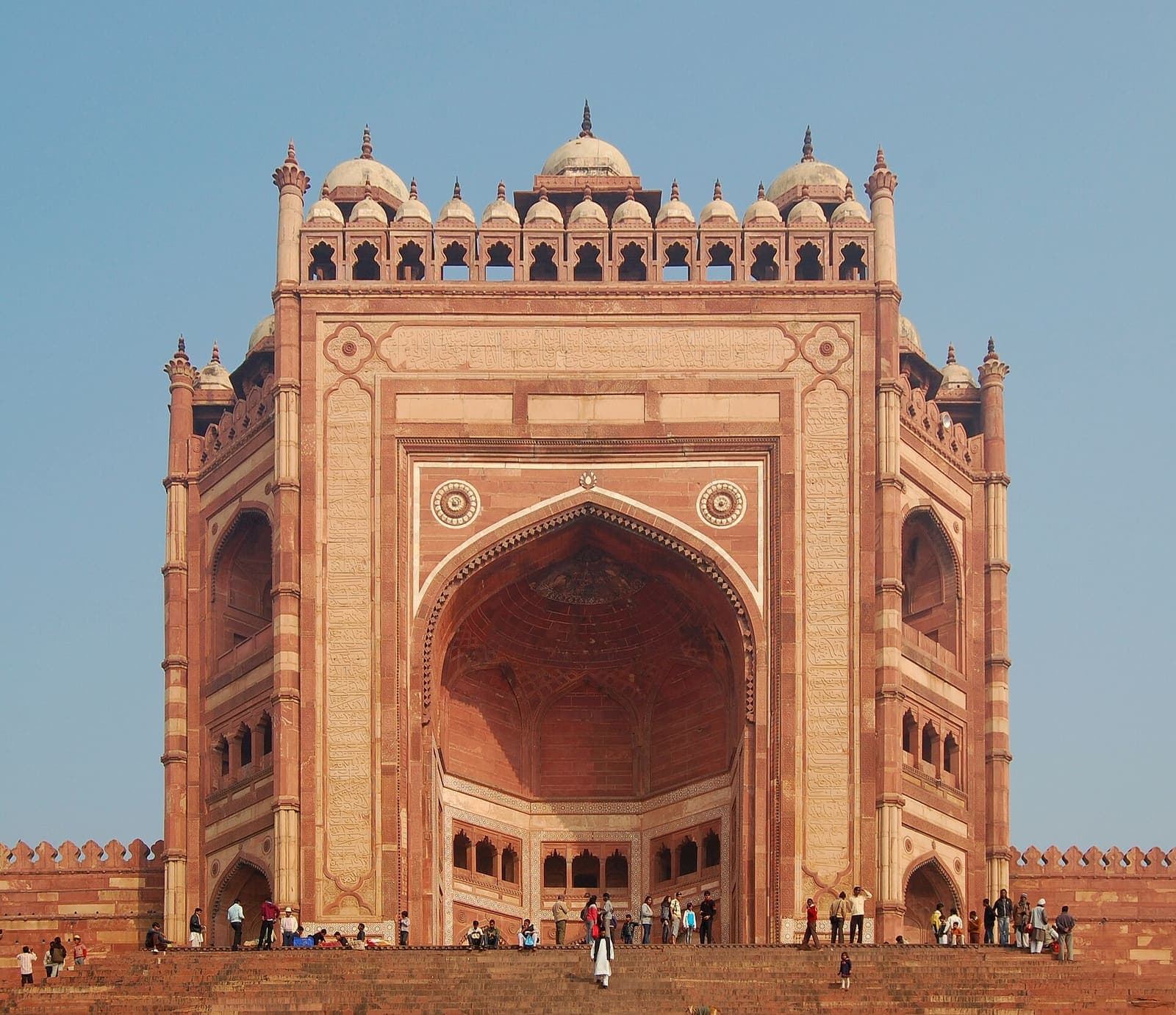
Photo: Marcin Białek · Wikimedia Commons · CC BY-SA 3.0
Leave as the gates close and you are back in Agra about an hour later, after dark from October to March; leave at five if you would rather drive in daylight. Fatehpur Sikri to Agra has the drive back, and if you are going on to Jaipur instead, Sikri is already on the way.
In summer, turn it round
From April to September the plan above puts you in a sandstone courtyard at the hottest hour. Turn it round: Fatehpur Sikri when it opens, back to Agra for the heat, lunch at 1:00 PM indoors, and Sikandra for the last two hours before it closes, about 7:15 PM in June.
On a Friday
Friday is the best day for all of it. The Taj is closed, both monuments are open and cheaper, Sikri’s midday prayer is over by the time you arrive, and Friday counts as a weekday for our table offer. From Delhi, the daily Shatabdi reaches Agra Cantt at 7:50 AM and leaves at 9:25 PM, which fits the whole day if you start at Sikandra at about 8:45. And if tomorrow is your Taj day, our one-day Agra itinerary starts at the Taj’s gates at dawn.