What you see inside the Taj Mahal, from the cenotaphs to the real graves below
Yes, you can go inside the Taj Mahal, for ₹200 on top of the entry ticket. Here is what fills its one dim, octagonal hall, where the real graves are, the rules inside and what the rest of the complex holds, from the mosque to the museum.
By Priyanka Singh, Travel expert
 (opens in a new tab)
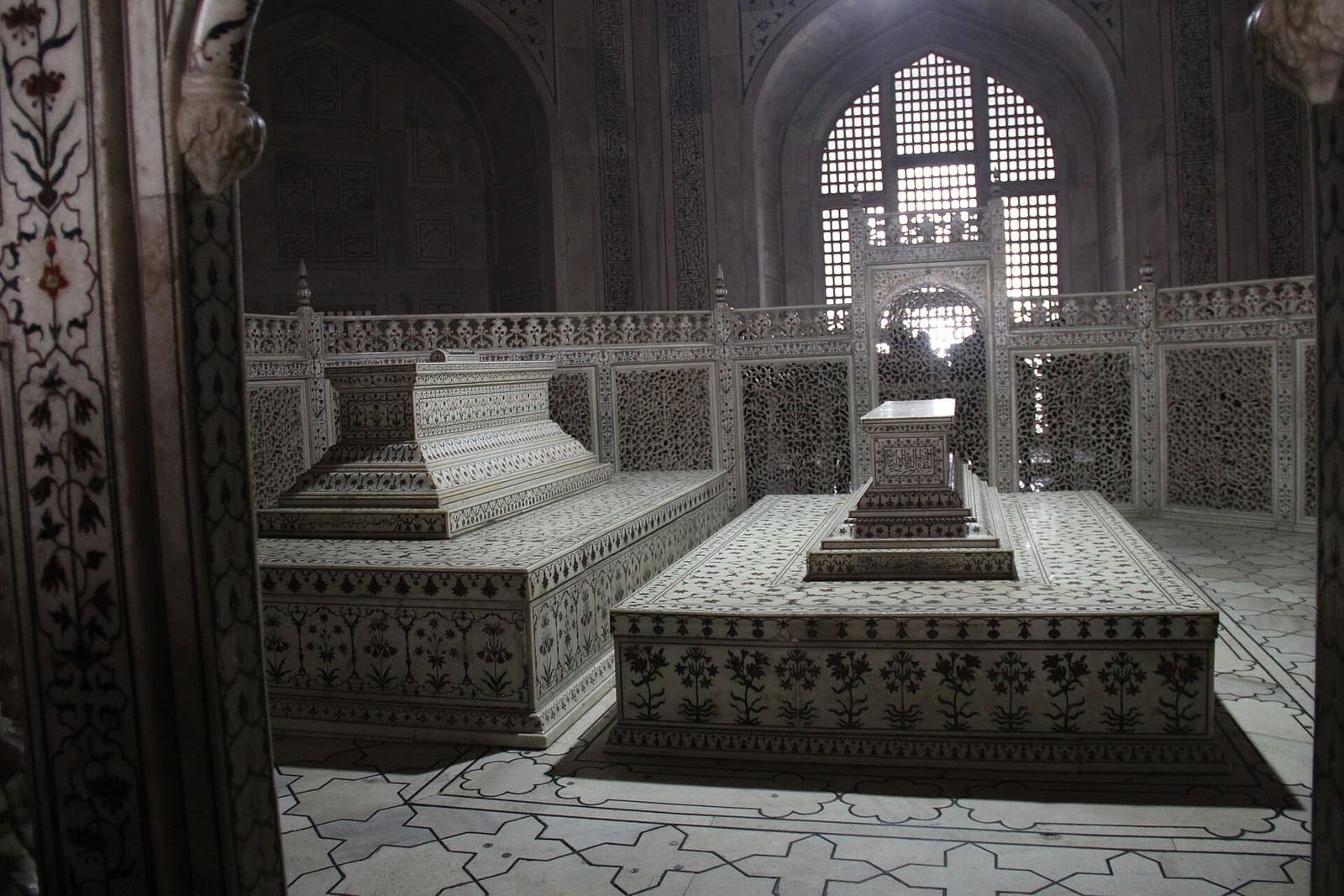
Photo: Gary Todd · Wikimedia Commons · CC0 · resized for web
Yes, you can go inside the Taj Mahal: the main mausoleum takes a ₹200 ticket on top of entry, any day but Friday. Inside is one dim, octagonal hall, where the cenotaphs of Mumtaz Mahal and Shah Jahan sit within a pierced marble screen. The real graves are in a crypt below, opened only during Shah Jahan’s three-day Urs.
| Question | Answer |
|---|---|
| Can you go inside? | Yes, into the main mausoleum, with an extra ticket |
| Mausoleum ticket | ₹200 on top of the entry ticket, the same for Indian and foreign visitors |
| Entry ticket | ₹1,100 foreign, ₹540 SAARC and BIMSTEC, ₹50 Indian; under-15s free |
| Opening hours | 30 minutes before sunrise to 30 minutes before sunset |
| Closed | Every Friday, mausoleum included |
| What is inside | An octagonal hall with two cenotaphs inside a pierced marble screen |
| The real graves | In a crypt below, opened only for the Urs (15 to 17 January in 2026) |
| Photography inside | Not allowed |
| Shoes | Covers free with foreign, SAARC and BIMSTEC tickets; free racks below the mausoleum |
| Taj Museum | In the garden, 10:00 AM to 5:00 PM, free; closed on Fridays |
Can you go inside the Taj Mahal?
Yes. To see the Taj Mahal inside, buy the ₹200 main-mausoleum ticket along with your entry ticket. Without it you can walk the garden and the terraces and see the mosque and the great gate, but not enter the tomb. The ₹200 is the same for Indian, SAARC and BIMSTEC, and foreign visitors; the Archaeological Survey of India (ASI) introduced it in December 2018 to take some of the load off the main building.
The entry ticket itself is ₹1,100 for foreign visitors, ₹540 for citizens of SAARC and BIMSTEC countries and ₹50 for Indians, with ₹50 off a foreign ticket and ₹5 off an Indian one bought online, and children under 15 go in free. Those are the prices on the official Taj Mahal site as of October 2026. A foreign, SAARC or BIMSTEC ticket also includes shoe covers, half a litre of water, a map of Agra and the battery bus or golf cart from the car park.
Children under 15 do not pay for the mausoleum either: on the ASI’s booking site on 16 October 2026, a child’s ticket with the mausoleum came to ₹0. Buy the ₹200 ticket at the same time as your entry ticket, at the window or online, where you choose “Taj Mahal With Mausoleum” instead of “Taj Mahal Only”.
The Taj opens 30 minutes before sunrise and closes 30 minutes before sunset, and it is shut to visitors every Friday, mausoleum included; Agra on a Friday has the alternatives, and our Taj Mahal timings guide has the clock times. For booking online step by step, the ID to carry and which gate to use, see the guide to Taj Mahal ticket prices and booking.
What does the Taj Mahal interior look like?
Under the main dome is a single tall hall, lit by daylight filtered through marble screens. The hall is a perfect octagon, 24 feet (about 7.3 metres) to a side, so about 18 metres across, with two tiers of eight arched niches; the niches on the four main axes are fitted with screens, and that is where the light comes in.
The floor is a pattern of stars and crosses in black marble set into white. Around the lower walls, vases of flowers are carved in low relief, irises, tulips, daffodils and narcissus among them, each bunch arranged in mirror symmetry, and bands of Quranic calligraphy run above. A bronze lamp inlaid with gold and silver hangs over the cenotaphs: Lord Curzon had it made in Cairo from an Arab model at the end of his time as Viceroy, and it was hung on 16 February 1909.
The official site credits the hall with one of the longest echoes of any building in the world, and visitors are asked to keep quiet inside. Behind glazed screens, two storeys of rooms ring the hall, later nicknamed the Shish Mahal, the mirror palace; like the crypt, they are not open to visitors.
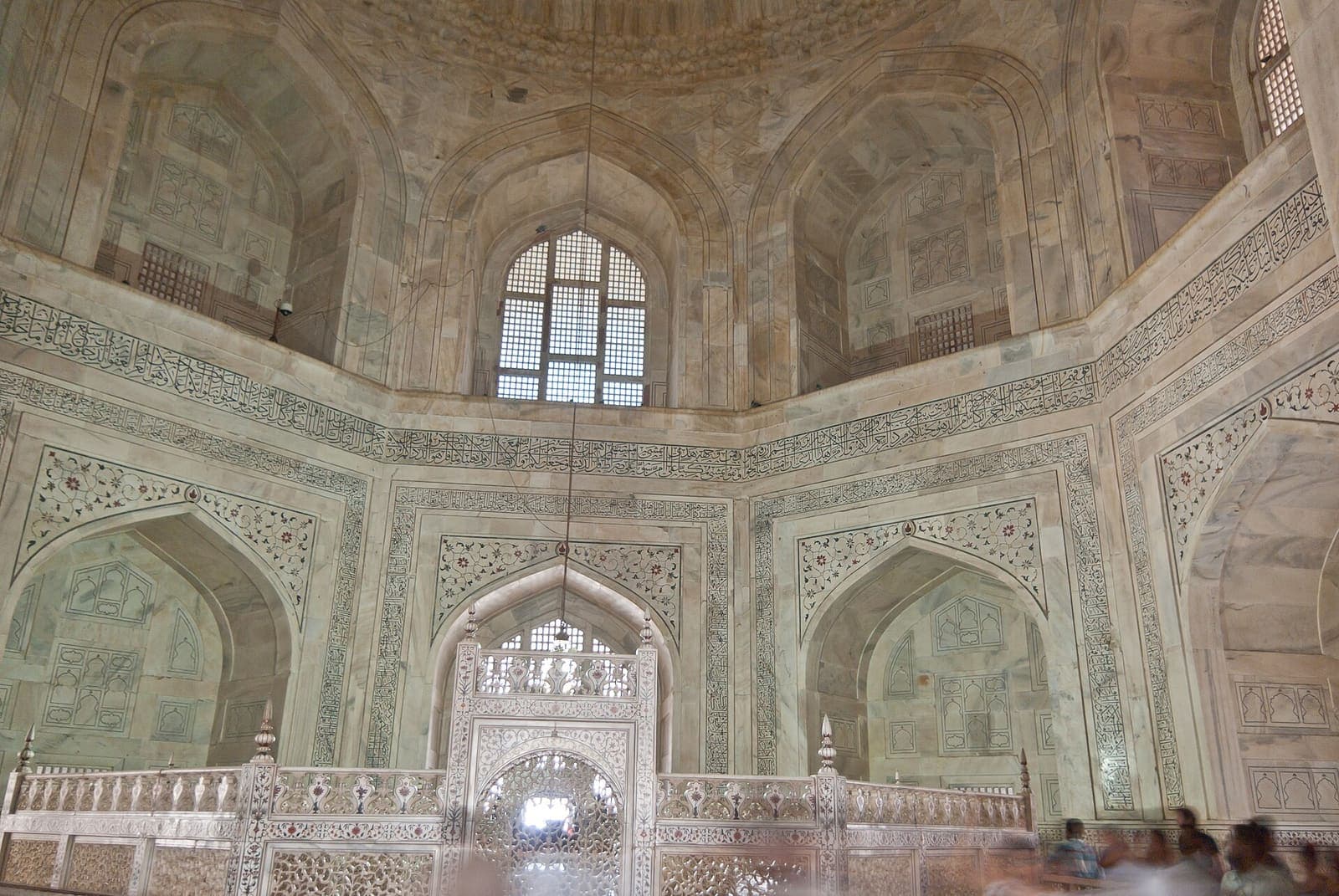
Photo: Antoine Taveneaux · Wikimedia Commons · CC BY-SA 3.0 · resized for web
Whose tombs are inside the Taj Mahal?
Mumtaz Mahal’s and Shah Jahan’s, or rather their cenotaphs: marble likenesses of tombs that stand over the real graves. Mumtaz Mahal’s is exactly in the centre of the hall, under the dome. Shah Jahan’s, which is larger, was added beside it on the west in 1666, more than 30 years later; set to one side like that, it appears, in the official site’s words, as an afterthought.
Each cenotaph is a single block of stone on a stepped base. A small pen box on top marks Shah Jahan’s as a man’s tomb, and Mumtaz Mahal’s carries a raised tablet. Hers is covered in verses from the Quran in a formal script, with her epitaph dated 1631; his is covered in inlaid flowers, poppies among them, with an epitaph dated 1666 (1076 in the Hijri calendar). Inlaid stone like this was reserved for members of the Mughal imperial family.
Shah Jahan’s off-centre tomb helped feed the story that he had planned a black marble tomb of his own across the Yamuna. That legend, and what digging there has actually found, is in the guide to Mehtab Bagh and the Black Taj.
Where are the real graves of Shah Jahan and Mumtaz Mahal?
In a crypt directly below the hall. As in other imperial Mughal tombs, the cenotaphs you see upstairs are not the burials: UNESCO calls the upper cenotaphs “only illusory”, with the real graves in the lower tomb chamber. A stairway from the southern entrance room leads down to it.
The crypt is a plain room faced in marble, with an undecorated ceiling and two simpler cenotaphs over the graves. Mumtaz Mahal’s carries the Ninety-Nine Names of God in small panels along its sides. Both bodies were laid on their sides, facing Mecca, which from India is to the west.
When the crypt opens: the Urs
The crypt is closed for the rest of the year and opens only for Shah Jahan’s Urs, the three-day anniversary of his death, held in the Islamic month of Rajab. For the 371st Urs, from 15 to 17 January 2026, the crypt was opened at 2:00 PM on the first day, and entry to the whole Taj was free from 2:00 PM to sunset on 15 and 16 January and from sunrise to sunset on the 17th, Patrika reported. Free entry brings far bigger crowds than usual.
The Islamic calendar is lunar, so the Urs comes about 11 days earlier each year, and the next one should fall in early January 2027. The dates are confirmed only shortly before, so check the Agra news if you hope to see the graves; our guide to the Taj Mahal’s free-entry days covers the Urs and the other days when entry is free.
The marble screen, the inlay and the calligraphy
The pierced marble screen around the cenotaphs is a replacement. According to the official site’s account of the interior, the first screen was of enamelled gold, made for the second anniversary of Mumtaz Mahal’s death, in 1633; the marble one went up in 1643, took ten years to make and cost 50,000 rupees, less than a tenth of what the gold had cost.
The screen is octagonal like the room, and its panels are the only jalis, or carved screens, in the Taj worked as flowing plants rather than geometry. Since 1994–95 an aluminium grille in a wooden frame has kept visitors’ hands off it, so you look at the screen through a plainer one.
The flowers on the screen and the cenotaphs are inlay, known in Mughal India as parchin kari and in Italy as pietra dura: pieces of coloured stone cut to shape and set flush into the marble. The official site names yellow marble, jasper and jade among the stones, and repeats the claim that one flower on Mumtaz Mahal’s tomb holds 35 different stones.
The calligraphy is the work of Amanat Khan, who came to India from Shiraz in Persia: Quranic verses in thuluth script, in black marble or jasper set into white. Panels higher up the walls use slightly larger letters, so that from the floor they read as one size. He signed the work inside, at the base of the dome: “Written by the insignificant being, Amanat Khan Shirazi.”
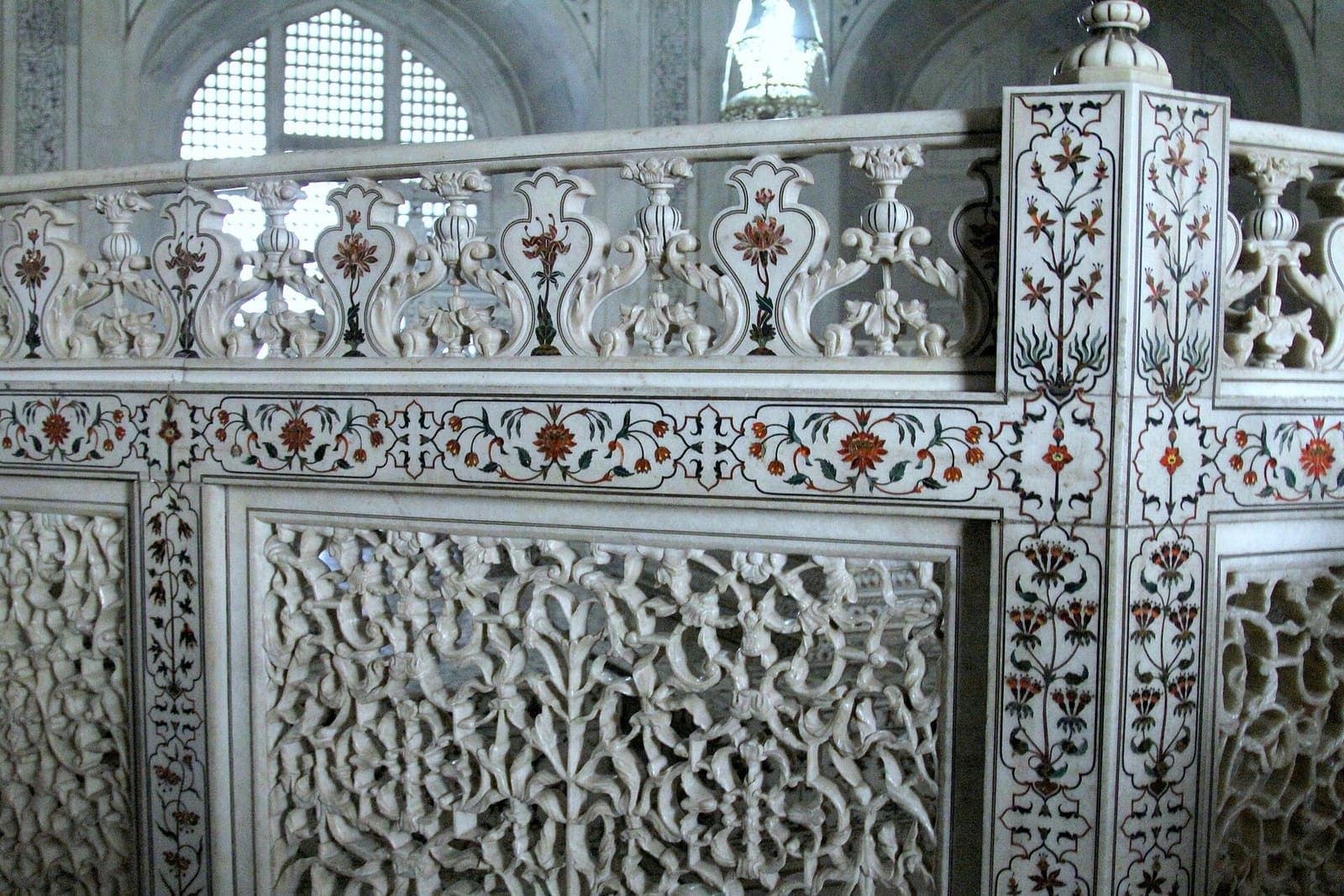
Photo: Piyush Kumar · Wikimedia Commons · CC BY 2.0 · resized for web
What are the rules inside the mausoleum?
No photography inside the main mausoleum: take your pictures on the platform before you go in, since cameras are fine in the rest of the complex, and our Taj Mahal photography guide has the best spots outside. The other rules, from the official do’s and don’ts for the Taj as of October 2026:
- Keep quiet and keep your phone switched off or on silent.
- Do not touch the walls or the screen: the marble is a heritage surface that needs special care.
- Shoes. Foreign, SAARC and BIMSTEC tickets include free shoe covers, and there are free shoe racks just below the main mausoleum.
- Travel light. Food (toffees included), tobacco, headphones, chargers, electrical goods other than cameras, tripods and drones are not allowed into the complex; water is. There are cloak rooms at both gates.
- Carry an ID. Visitors must carry proof of identity issued by a government authority.
- Need help? Wheelchairs and a first-aid box are kept at the ASI office at the Taj.
How long to allow
The hall is small enough to walk round in a few minutes; the wait to get in is what varies. Allow about half an hour for the mausoleum, longer at busy times, and two to three hours for the whole complex. The official site suggests the early morning, when it is cooler and less crowded.
What are the red buildings on either side of the Taj Mahal?
A mosque on the west and its mirror image on the east, both in red sandstone. The mosque is on your left as you look from the garden, and it is still used for prayer: on Fridays the complex opens only for the prayer at the mosque and stays closed to sightseers. The mosque’s floor is laid out with the outlines of 569 prayer rugs in black marble.
On the east stands the Mihman Khana, the assembly hall or guest house, built as a jawab, an “answer” to balance the mosque. The anniversaries of Mumtaz Mahal’s death, held in tents at first, moved into it once it was finished. Look down at its platform: two working drawings of the dome’s finial are scratched into the stone. UNESCO dates both buildings, and the great gate, to after the tomb itself, all complete by 1653.
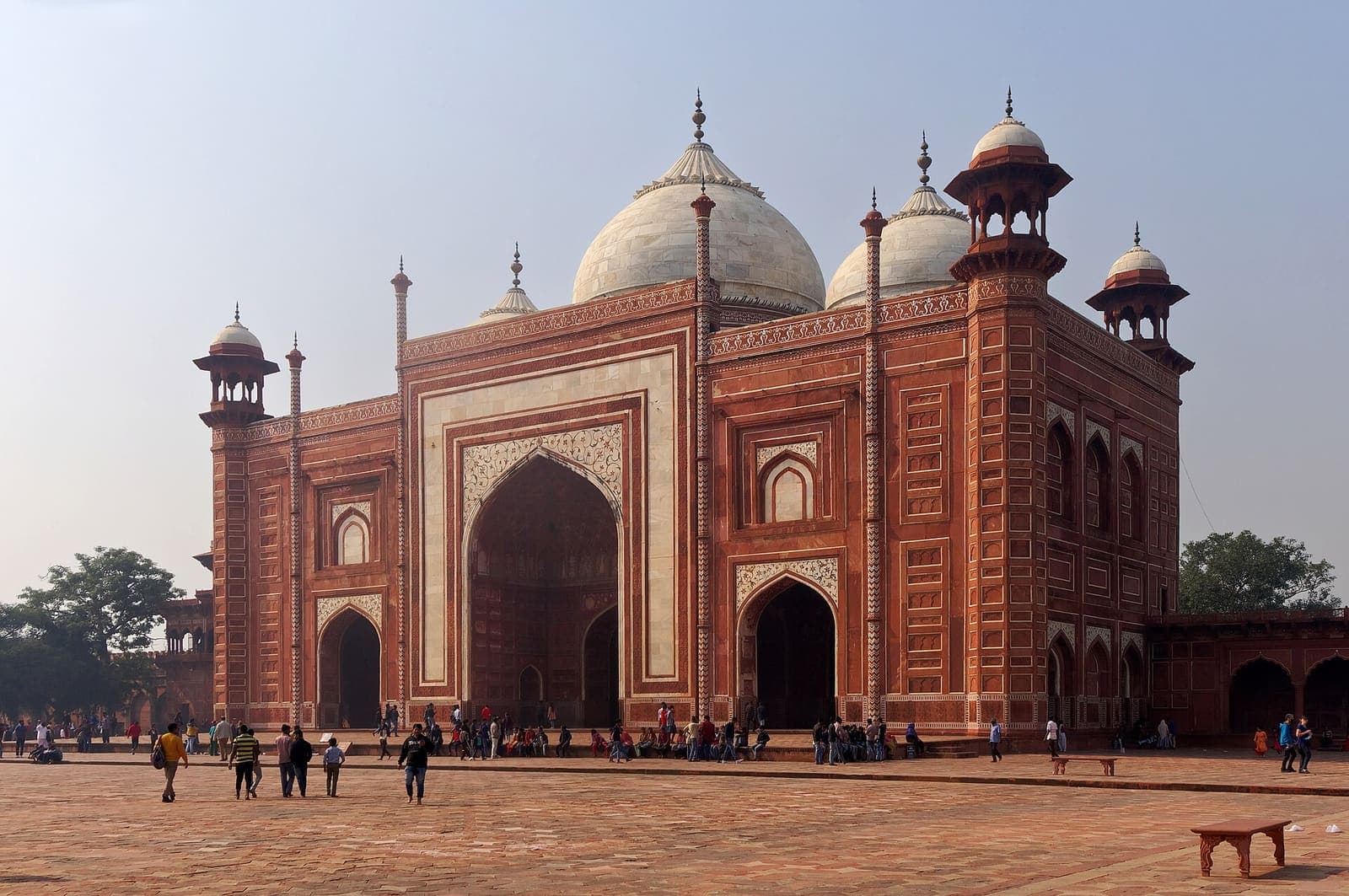
Photo: Jakub Hałun · Wikimedia Commons · CC BY-SA 4.0 · resized for web
The great gate, the garden and the Taj Museum
The great gate, the darwaza-i rauza or “gate of the mausoleum”, is the red sandstone gateway in the middle of the garden’s south wall, and the first frame you see the tomb through. Quranic calligraphy and inlaid flowers run round its arch; the official site translates its verse as “O Soul, thou art at rest. Return to the Lord at peace with Him, and He at peace with you.”
Beyond it lies the charbagh, a paradise garden in the Persian manner: four quarters divided by walkways, each split into four again. At the centre is a raised marble platform with a pool and five fountains, and the four marble benches around it were added in 1907–08 on Lord Curzon’s orders. For the reflections in the water and the best light on the dome, see the guide to the Taj Mahal at sunrise.
The Taj Museum
The Taj Museum is a small museum in a pavilion on the west side of the garden, with a Mughal-era plan of the Taj, ivory portraits of Shah Jahan and Mumtaz Mahal, coins of the period and British-era drawings of the monument. The official site lists it as open from 10:00 AM to 5:00 PM with free entry, though another listing says 9:00 AM, so check on the day. Like the rest of the Taj, it is closed on Fridays.
After the Taj: where to eat, and what to see next
An early visit leaves you hungry well before lunch. For breakfast close to the gates, the journal’s guide to cafés in Agra has places by the South and East Gates.
For a long lunch or dinner, Altitude Rooftop Lounge, the rooftop restaurant that publishes this journal, is about 6.5 km from the Taj, roughly 25 minutes by road, on the top floor above MG Road 2, Jaipur House. Altitude opens every day at 12:00 PM, which suits a morning at the Taj and a rest at the hotel, and closes at 12:30 AM. Travellers on a foreign passport can get buy one, get one free on all drinks ordered between 1:00 PM and 7:00 PM, dine-in only; a passport photo is accepted, and the published terms explain the second-drink value and exclusions.
The menu is online in English, with every dish marked veg, non-veg or egg: North Indian and Mughlai, Chinese, Continental and Italian, from a tandoor and a pizza oven on the roof. There is no Taj view, but there are 40 seats indoors in air conditioning and a lift to the top floor, and booking a table is free, with free cancellation up to two hours before. Tell the driver “MG Road 2, Jaipur House”: there is a Domino’s at street level.
To fit the rest of Agra around the Taj, one day in Agra runs from sunrise to dinner. The Taj by moonlight is a separate visit with its own tickets and rules, on the nights around each full moon: see the night viewing guide.