Jaipur to Agra by road: the route, the stops worth making and a timed plan
The drive between Jaipur and Agra is one road and about five hours, and the stops are the point: a stepwell thirteen storeys deep, a bird sanctuary in winter, and Akbar’s red sandstone capital forty kilometres short of Agra. Here is the Jaipur to Agra road trip done properly — the route, the tolls, what each stop costs in time, and a plan that has you at a lunch table in Agra by three.
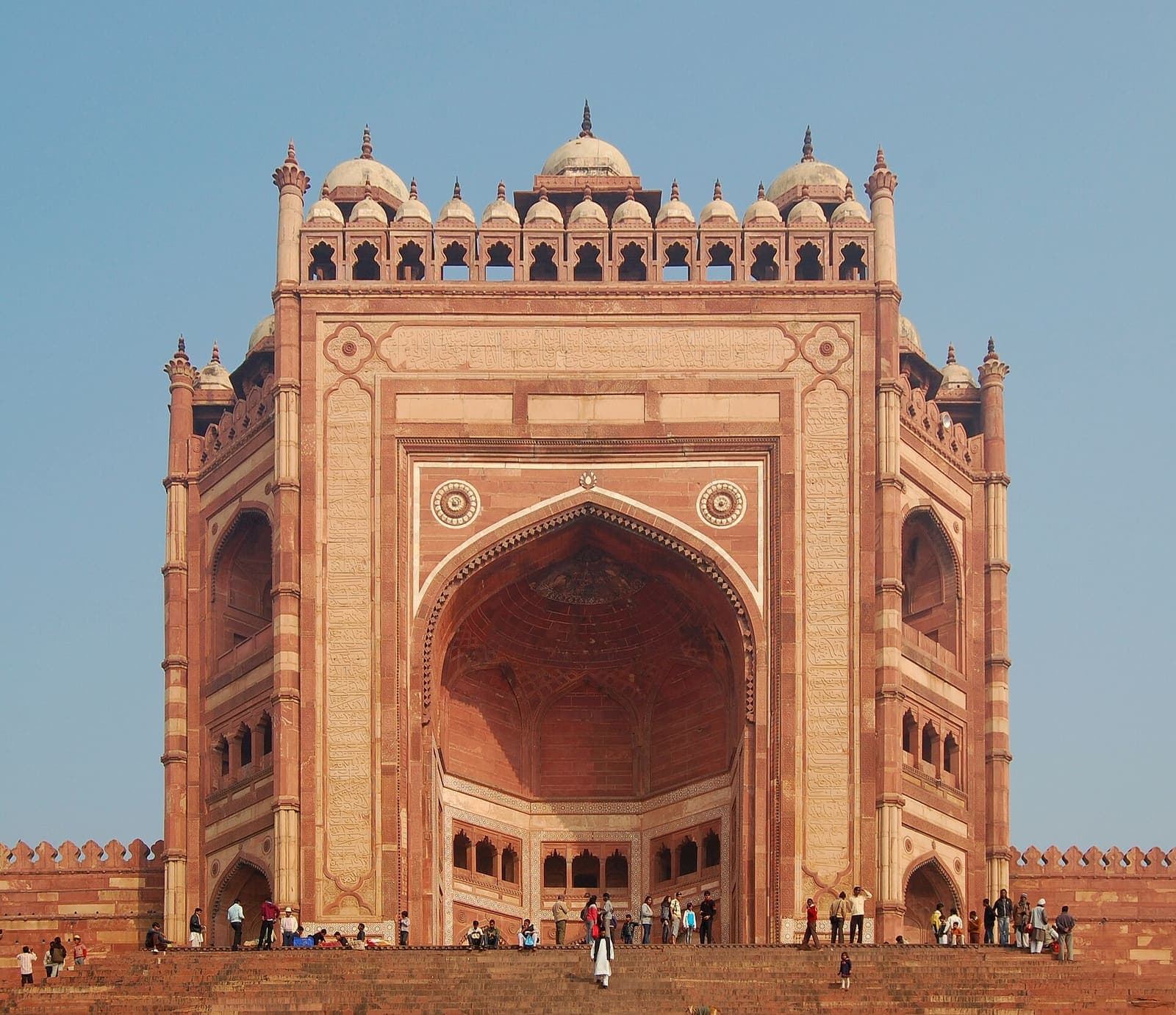
Photo: Marcin Białek · Wikimedia Commons · CC BY-SA 3.0
Jaipur to Agra by road is about 240 km on NH-21, through Dausa and Bharatpur: four and a half to five hours of driving. Three stops earn their time: Chand Baori, the stepwell at Abhaneri, 9 km off the highway; Keoladeo National Park at Bharatpur, in winter; and Fatehpur Sikri, 40 km short of Agra. Leave Jaipur at 7:00 AM and you can see Abhaneri and Sikri and still sit down to lunch in Agra at about 3:00 PM.
This is Altitude’s journal, so weigh the last stop accordingly: the lunch at the end is ours. Everything before it is what we would tell a friend doing the drive, checked on 7 October 2026.
The Jaipur to Agra route by road: NH-21 via Dausa and Bharatpur
The whole drive is on one road. NH-21 leaves Jaipur by the Agra Road, passes Dausa, Sikandra, Mahwa and Bharatpur, crosses from Rajasthan into Uttar Pradesh, runs past Fatehpur Sikri and comes into Agra from the west. You do not have to think about the route. You have to think about the stops.
| Place | From Jaipur |
|---|---|
| Dausa | About 55 km |
| Sikandra crossroads, the turn for Abhaneri | About 80 km |
| Chand Baori, Abhaneri, 9 km off the highway | About 90 km |
| Bharatpur and Keoladeo National Park | About 180 km |
| Fatehpur Sikri | About 200 km |
| Shahganj, west Agra | About 235 km |
| The Taj Mahal | About 240 km |
So the distance from Jaipur to Agra by car is about 240 km to the Taj. The time is less tidy. Agra’s district website calls it a four-hour drive, which is the clear-road number. Getting out of Jaipur and into Agra both take longer than the map suggests, so budget four and a half to five hours at the wheel, and put the stops on top.
Fuel stations and dhabas line the road, so there is nothing to plan. Use the toilets at a large fuel station rather than a roadside stall, and keep water in the car. The NHAI’s Rajmargyatra app shows fuel stations, hospitals and toll plazas along the way.
Jaipur to Agra road toll tax and FASTag
The road is tolled. The NHAI’s list of fee plazas has four on the Rajasthan stretch: Rajadhok and Sikandra between Jaipur and Mahwa, and Amoli and Ludhwai between Mahwa and Bharatpur. We have not printed a total, because the rates are revised every year and we could not check this year’s on an official page. Put the route into the Rajmargyatra app instead: it lists every toll on the way and the fee for your vehicle.
- Keep the FASTag topped up. Since 15 November 2025, a vehicle without a working FASTag pays twice the fee in cash, or 1.25 times by UPI.
- The annual pass costs ₹3,075 for 2026–27 and covers 200 crossings or a year at national-highway fee plazas, for non-commercial cars. It pays for people who drive highways often, not for one trip; details are in the NHAI’s announcement.
- In a hired car, ask whether the tolls are in the quote, and get the answer in writing.
Places to visit between Jaipur and Agra, and what each costs in time
Three stops, in the order you reach them. Two are worth it on any day; the bird sanctuary only in winter.
Chand Baori, Abhaneri
Chand Baori is a stepwell: a square pit about 30 metres deep, three of its sides falling away in 13 storeys of narrow steps, about 3,500 of them, in a criss-cross pattern that looks drawn rather than built. The oldest parts are from the 8th and 9th centuries. Carved stones from the ruined Harshat Mata temple next door are lined up in the galleries round the well, and the temple itself is worth ten minutes.
It is a detour. Turn north off NH-21 at the Sikandra crossroads, about 80 km from Jaipur, and the village is about 9 km up a country road. You look down into the well from the top; visitors are no longer allowed down the steps. The ASI has charged for entry since 2019: ₹25 for Indians and ₹300 for foreign visitors when we checked, a little less online. Sources differ on the hours (the official Incredible India listing says 7:30 AM to 6:30 PM), so arrive between eight and five.
Keoladeo National Park, Bharatpur
The old Bharatpur bird sanctuary is on the edge of Bharatpur, about 180 km from Jaipur and some 20 km short of Fatehpur Sikri. It has been a UNESCO World Heritage Site since 1985, and in winter big flocks of ducks, geese, pelicans and waders come in down the Central Asian flyway. November to February is the season, December and January the peak. Outside it, keep driving.
No cars go inside: you go round by cycle rickshaw — the pullers have been trained to spot and name the birds — by bicycle or on foot. The park is open from sunrise to sunset, with its own ticket. The catch is the hour. Birds are best in the first light and a drive from Jaipur gets there nearer midday, so if birds are the point, sleep in Bharatpur and go in at dawn; you can still be at Sikri by late morning.
Fatehpur Sikri
Akbar’s red sandstone capital is the stop we would never skip. It is beside the highway, open from sunrise to sunset every day, Fridays included, and the palace complex costs ₹50 for Indian visitors and ₹610 for foreign visitors, while the Jama Masjid and the Buland Darwaza are free. Cars stop at a car park about a kilometre short, and a shuttle runs up to the palace.
Our Fatehpur Sikri guide has the tickets in full, the order to walk it in and how to handle the touts at the mosque. It allows three to four hours from car park to car park. On a day with Abhaneri in it, two and a quarter is brisk but complete: take a guide for the palace and keep moving.
| Stop | Time it adds |
|---|---|
| Chand Baori, Abhaneri | About 1¼ hours, detour included |
| Keoladeo National Park, November to February | 2½ hours or more; best at dawn |
| Fatehpur Sikri | 2¼ hours brisk, 3 to 4 hours unhurried |
Two Sikandras: the highway village and Akbar’s tomb
There are two Sikandras on this trip, and they are easy to mix up. The first is on NH-21 in Dausa district, Rajasthan, about 25 km past Dausa: a crossroads village known for its sandstone carving, with a toll plaza of the same name, and the place where you turn off for Abhaneri.
The second is in Agra. Sikandra is the part of the city on the Delhi highway, about 10 km from the centre, where Akbar is buried, and it is not on the Jaipur road at all. From Shahganj it is about 9 km, 20 to 25 minutes, which makes it a good first stop on your first morning in Agra; our guide to Akbar’s tomb has the timings and tickets.
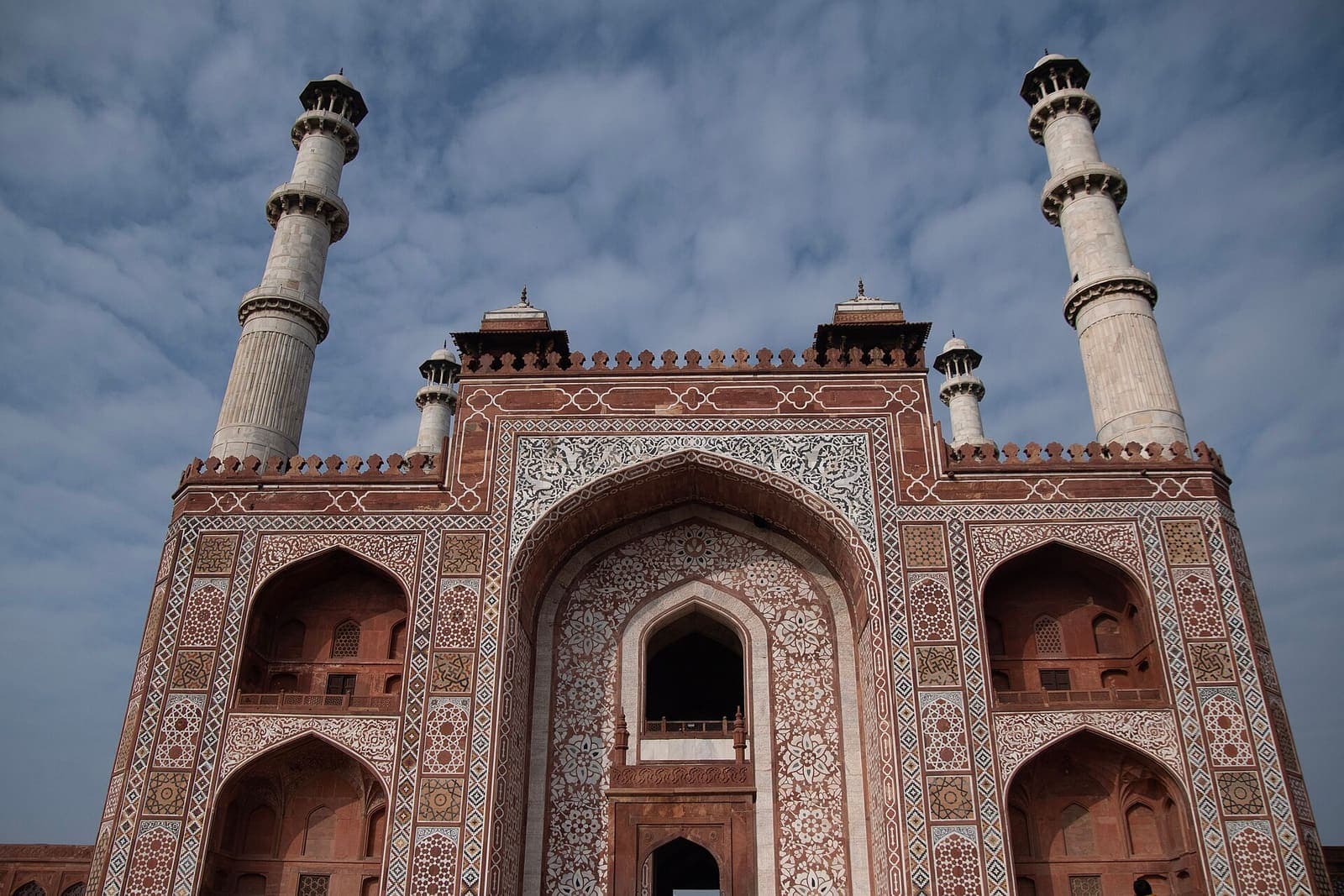
Photo: Darshanavenugopal · Wikimedia Commons · CC BY-SA 4.0
Jaipur to Agra by road in a day: a timed plan
This is the Jaipur to Agra road trip we would hand a friend with a car and driver between October and March. It takes in Abhaneri and Fatehpur Sikri and leaves the birds for another trip.
| Time | Plan |
|---|---|
| 7:00 AM | Leave Jaipur’s old city. Eat first, or stop for tea on the way. |
| 8:45 AM | Chand Baori and the Harshat Mata temple at Abhaneri. |
| 9:20 AM | Back to NH-21 at Sikandra, then east past Mahwa and Bharatpur. |
| 11:45 AM | Fatehpur Sikri car park, and the shuttle to the palace. |
| 12:00 to 1:45 PM | The palace, then the Jama Masjid and the Buland Darwaza. |
| 2:00 PM | Leave Sikri for Agra: about 35 km, 50 to 60 minutes. |
| 3:00 PM | Lunch in Shahganj, the first part of Agra you reach. |
| 4:30 PM | Check in. The Taj is for tomorrow’s sunrise, unless tomorrow is a Friday. |
- Skipping Abhaneri? Leave at 8:00 AM and keep the other times.
- April to June: leave at 6:00 AM, think twice about Abhaneri, and be through Sikri’s courtyards by about noon; they are hard going after that. We open at 1:00 PM, with 40 seats indoors in air conditioning.
- Keoladeo in winter: make it two days, with a night in Bharatpur and the park at dawn.
- Arriving on a Thursday? The Taj is closed on Fridays; here is what to do in Agra on a Friday instead.
Lunch when you reach Agra
Coming in from Sikri, the first part of Agra you reach is Shahganj, on the west side of the city, well before the Taj side. That is where we are: Altitude, on the top floor above MG Road 2. Ours, so take this as a recommendation from an interested party.
We open at 1:00 PM every day, not before, which suits a 3:00 PM arrival. The kitchen is on the roof — tandoor, wok and pizza oven — and for a group on a driver’s clock the sensible order is our One Plate Wonders: complete meals that each serve one, with a butter naan, two butter rotis or steamed rice. On our menu as we write: the Dal Makhani, Kadhai Paneer or Chole Meal at ₹380, Chilli Paneer with Hakka Noodles at ₹410, the Chicken Curry Meal at ₹450, Punjabi Chole Bhature at ₹280 and Pav Bhaji Paaji at ₹250. The 12-inch thin-crust pizzas are baked to order and worth the wait of about 25 minutes, if the driver can spare it.
There are 60 seats on the open terrace and 40 indoors in air conditioning. There is no Taj view from our roof, just the city and the sky. We do not serve alcohol; the cold list is mocktails, mojitos, iced teas, lemonades, shakes, frappes and coffee, and every mocktail is 30% off from 1 to 6 PM.
Book a table online before you leave Jaipur: it is free, confirmed instantly, and free to cancel up to two hours before if the road has other ideas. On a weekday, a table booked for between 1:00 and 6:00 PM gets 30% off whatever is ordered before 6:00 PM, which on this timetable is the whole lunch; other weekday bookings get 20%, and weekends 15%. It is one offer per bill, and none applies on 31 December, 1 January, major festivals or public holidays. The offers page has the terms.
Rather compare? Our guide to lunch in Agra covers the rest of the city. And if the drive has won, order from the same kitchen to your hotel.
Agra to Jaipur via Fatehpur Sikri
Going the other way, Sikri is on the road out. Agra to Jaipur via Fatehpur Sikri is about 245 km from the Taj, only a few kilometres more than the direct drive, and going by way of Shahganj adds about two more. The difference is the clock: Sikri shuts at sunset, and by the time you pass the Abhaneri turn, Chand Baori will be closed too. So the afternoon is for Sikri and the evening is for the road.
| Time | Plan |
|---|---|
| 5:45 AM | The Taj Mahal as the gates open, 30 minutes before sunrise. Not on a Friday. |
| 9:00 AM | Breakfast and check-out, then Agra Fort or a slow morning. |
| 1:00 PM | Lunch in Shahganj, on the way out of town towards Sikri. |
| 2:15 PM | Leave for Fatehpur Sikri, about 35 km. |
| 3:15 to 5:30 PM | The palace and the mosque, out before the gates shut at sunset. |
| About 10:00 PM | Jaipur, some 200 km and four hours on. |
In December and January the light goes at about 5:30 PM, so be away from lunch by 2:00. In the fog weeks of late December and January, do not plan four hours of highway after dark: stay the extra night and see Sikri on the way out the next morning. Lunch would then be on the road rather than with us, and that is fine.
Hiring a car and driver, and other practical tips
- One way or return. One-way cabs are widely sold on this route, so ask for a one-way price. Whatever you book, write the stops and the waiting time into it.
- The state line. A car with an all-India tourist permit can cross from Rajasthan into Uttar Pradesh without a separate state permit. If yours has none, ask who pays for crossing, and have that in the quote too.
- The driver’s day. Agree where the driver will eat and wait while you are at Sikri and at lunch. If they are driving back the same night, do not push them into the fog.
- Fog. From late December into January, dense fog can sit on the plains at night and in the early morning. Start after sunrise, slow down when it thickens, and finish before dark.
- Not driving? UPSRTC buses run between the two cities; on MakeMyTrip in October 2026 they were timetabled at between 4 hours 40 minutes and about 6½ hours, from about ₹300 non-AC or ₹550 with AC. A bus gets you there. It cannot do the stops.