Agra Fort: timings, tickets, what to see and how long you need
Agra Fort is open every day from sunrise to sunset, Fridays included, and a ticket costs ₹50 for Indians and ₹650 for foreign visitors. Here is what each ticket covers, the route through the palaces that are open, where to see the Taj from, and whether the evening show is on.
By Priyanka Singh, Travel expert
 (opens in a new tab)
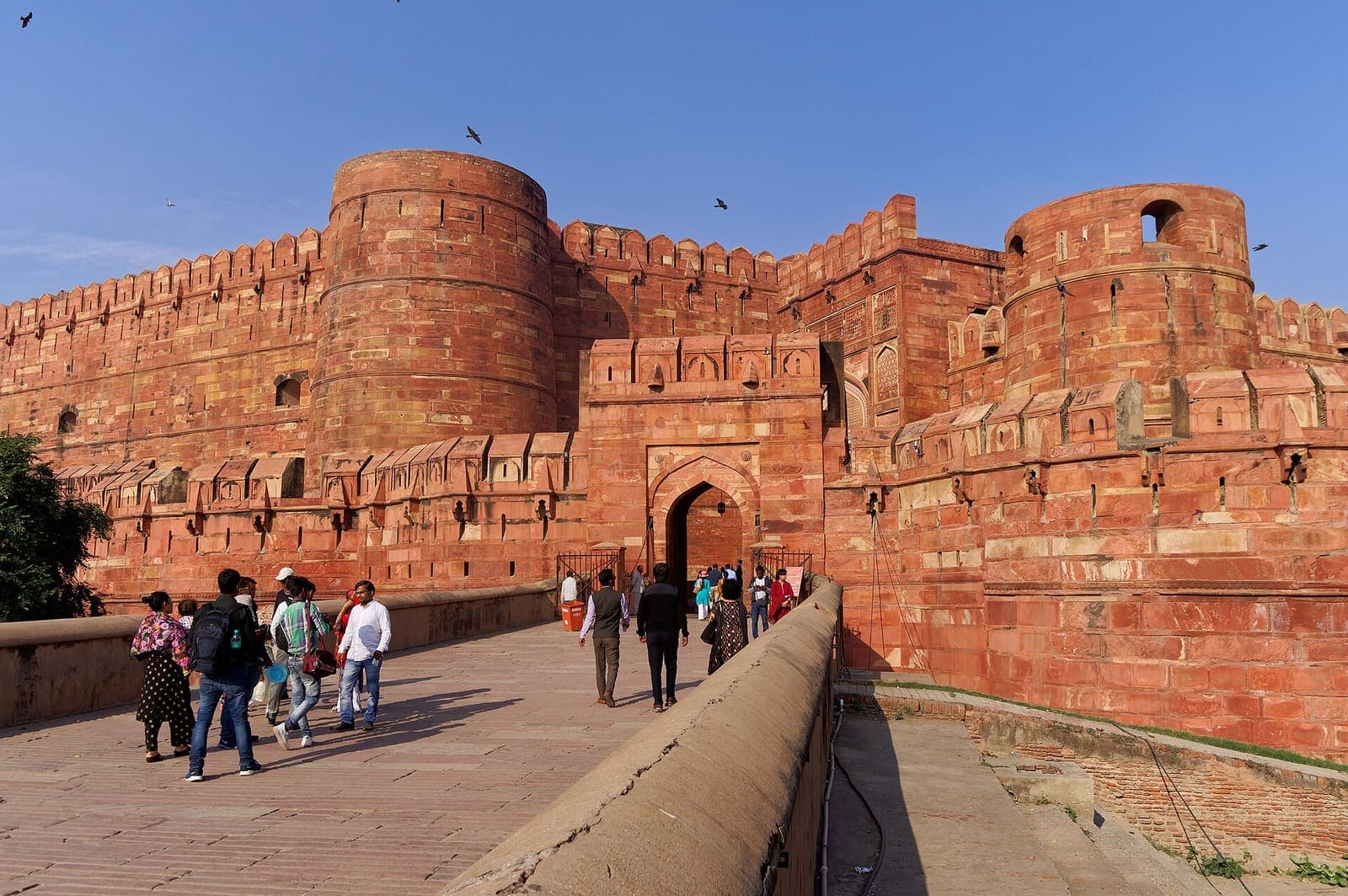
Photo: Jakub Hałun · Wikimedia Commons · CC BY-SA 4.0 · resized for web
Agra Fort timings are sunrise to sunset, seven days a week, including Fridays, when the Taj Mahal is closed. A ticket costs ₹50 for Indians, ₹90 for SAARC and BIMSTEC citizens and ₹650 for other foreign visitors (₹600 with a same-day Taj ticket); children under 15 go free. Enter by the Amar Singh Gate and allow about two hours.
| What | Details |
|---|---|
| Open | Every day, sunrise to sunset, Fridays included |
| Ticket window | Closes 30 minutes before sunset |
| Indian visitors | ₹50, or ₹40 on a Friday |
| SAARC and BIMSTEC visitors | ₹90, or ₹40 on a Friday or with a same-day Taj ticket |
| Other foreign visitors | ₹650, or ₹600 on a Friday or with a same-day Taj ticket |
| Children under 15 | Free |
| Entrance | Amar Singh Gate only; cash, UPI or card at the counter |
| Time to allow | About two hours |
| From the Taj Mahal | About 2.5 km by road |
| Light and sound show | Hindi 6:30 PM, English 7:30 PM, as listed by UP Tourism; check on the day |
| Built | By Akbar, 1565 to 1573; a UNESCO World Heritage Site since 1983 |
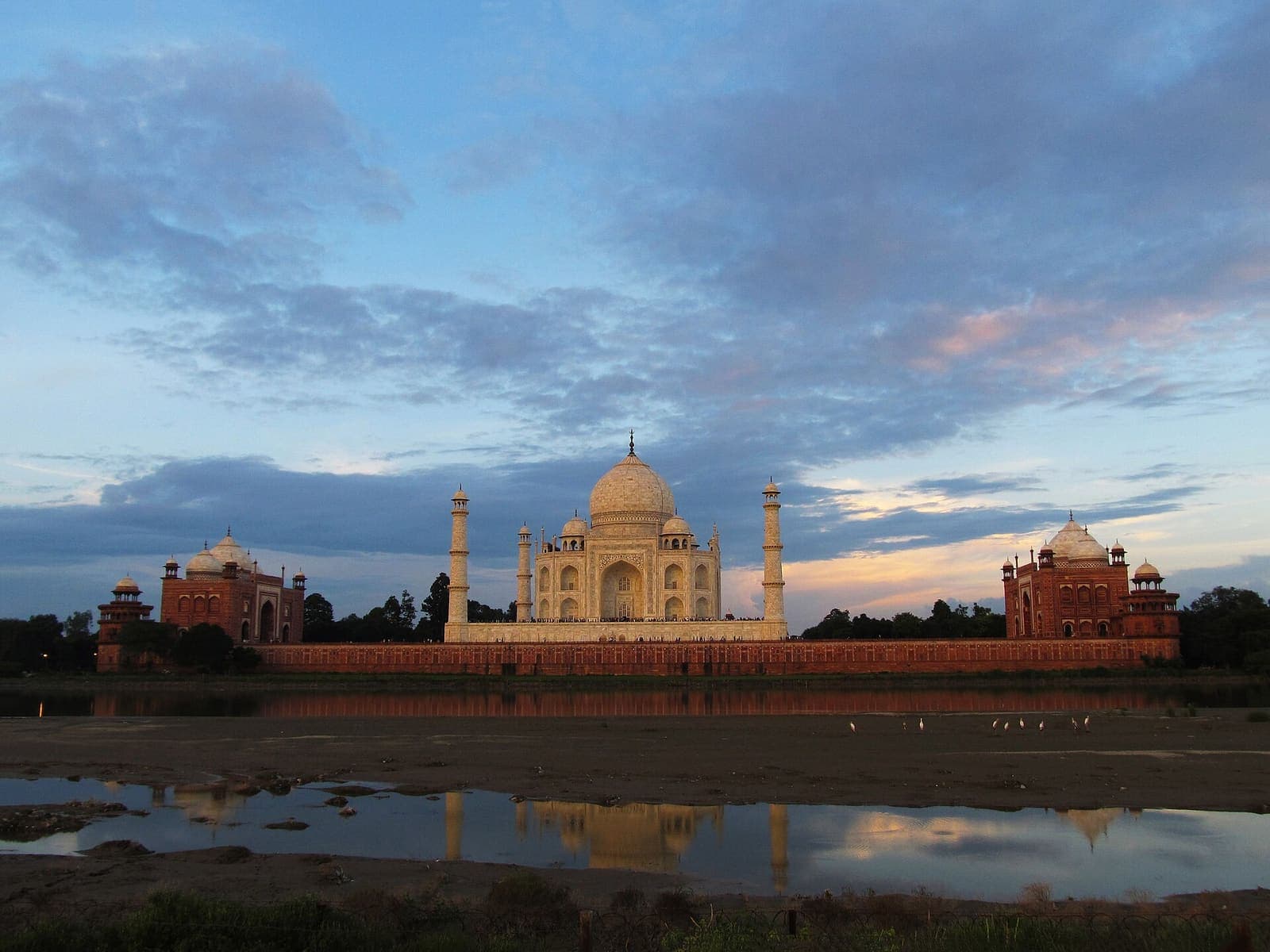
Agra Fort is the walled palace-city of the Mughal emperors, on the bank of the Yamuna: red sandstone ramparts round Akbar’s palaces, with Shah Jahan’s white marble pavilions along the river. From those pavilions you can see the Taj Mahal, where Shah Jahan was buried after his last years as a prisoner here. Prices and times were checked again on 22 October 2026 against the official pages; they do change, so look again before you go.
Agra Fort timings: when does it open and close?
Agra Fort opens at sunrise and closes at sunset on all seven days, according to both the UP Tourism site and the district administration’s page on the fort. There is no weekly closing day. The Agra Development Authority, whose toll is part of the ticket, says the ticket window closes 30 minutes before sunset, so arrive with at least an hour in hand.
Sunrise and sunset move by about two hours over the year, and the clock times move with them. The district page rounds them to 6:00 AM and 6:00 PM; around the middle of each month, expect roughly:
| Mid-month | Opens / closes |
|---|---|
| October | 6:15 AM / 5:50 PM |
| November | 6:35 AM / 5:30 PM |
| December | 7:00 AM / 5:25 PM |
| January | 7:10 AM / 5:45 PM |
| March | 6:30 AM / 6:25 PM |
| June | 5:20 AM / 7:15 PM |
The first hour after opening is the coolest of the day, and from April to June it is the only comfortable one. In December and January, morning haze can hide the Taj from the fort’s terraces, so if that view matters most to you, a clear late morning may serve you better.
Agra Fort ticket price for Indian, SAARC and foreign visitors
The Agra Fort ticket price at the counter is ₹50 for Indian citizens and ₹650 for foreign visitors, as listed in the official fee table for Agra’s monuments in October 2026. Each price is the Archaeological Survey of India’s entry fee plus a toll for the Agra Development Authority (ADA), which is why it drops on a Friday and after a visit to the Taj.
| Visitor | Ticket |
|---|---|
| Indian citizens | ₹50; ₹40 on a Friday |
| SAARC and BIMSTEC citizens | ₹90; ₹40 on a Friday or with a same-day Taj ticket |
| Other foreign visitors | ₹650; ₹600 on a Friday or with a same-day Taj ticket |
| Children under 15, Indian or foreign | Free |
- Why Friday is cheaper. The ADA does not collect its toll on Fridays: ₹10 of the Indian ticket and ₹50 of the foreign one.
- Keep your Taj ticket. A foreign visitor’s Taj Mahal ticket already includes the ADA’s ₹500 toll, which covers Agra Fort on the same day, so the fort then costs ₹600. The Taj Mahal ticket guide has the Taj’s own prices.
- Who counts as SAARC and BIMSTEC. Citizens of Afghanistan, Bangladesh, Bhutan, the Maldives, Myanmar, Nepal, Pakistan, Sri Lanka and Thailand.
- Paying. The counter at the Amar Singh Gate takes cash, UPI and cards. The ASI also sells tickets online at asi.paygov.org.in; at the Taj an online ticket is ₹5 cheaper for Indians and ₹50 for foreign visitors, so compare the fort’s online price before you buy.
- Carry a photo ID. UP Tourism asks every visitor to carry a government-issued identity proof.
Which gate do you enter by, and how do you get there?
Every visitor goes in and out through the Amar Singh Gate, on the south side of the fort. The Delhi Gate on the west side, once the main entrance, is closed to the public, because part of the fort is still used by the Indian Army.
The gate is about 2.5 km by road from the Taj Mahal, 10 to 15 minutes by auto-rickshaw or cab in ordinary traffic. Agra Fort railway station stands right beside the fort, between the Delhi Gate and the Jama Masjid, but the entrance is round on the south side, so allow for the walk. Through the gate, expect a bag check, then a long ramp up to the palaces; wear comfortable shoes.
Agra Metro is another way across from the Taj. Its first line, open since March 2024, runs from Taj East Gate through Taj Mahal station to Mankameshwar, which connects with Agra Fort railway station; from there it is the same walk round to the Amar Singh Gate. Our Agra Metro guide has the stations, and the Taj Mahal parking guide covers parking at the fort if you are driving.
Licensed guides and audio guides are available at the entrance, according to the district page. If you hire a guide, agree the fee and the length of the tour before you start. Water bottles are allowed inside, and on a warm day you will want one.
Inside Agra Fort: a route through the buildings that are open
Inside Agra Fort, the visit is a loop through the palaces on the south-eastern side, the part where the Mughal buildings survive. Abul Fazl, Akbar’s court historian, recorded 5,000 buildings inside these walls; according to the ASI, Shah Jahan demolished some to make room for his marble palaces, the British pulled down most of the rest for barracks, and hardly 30 are left.
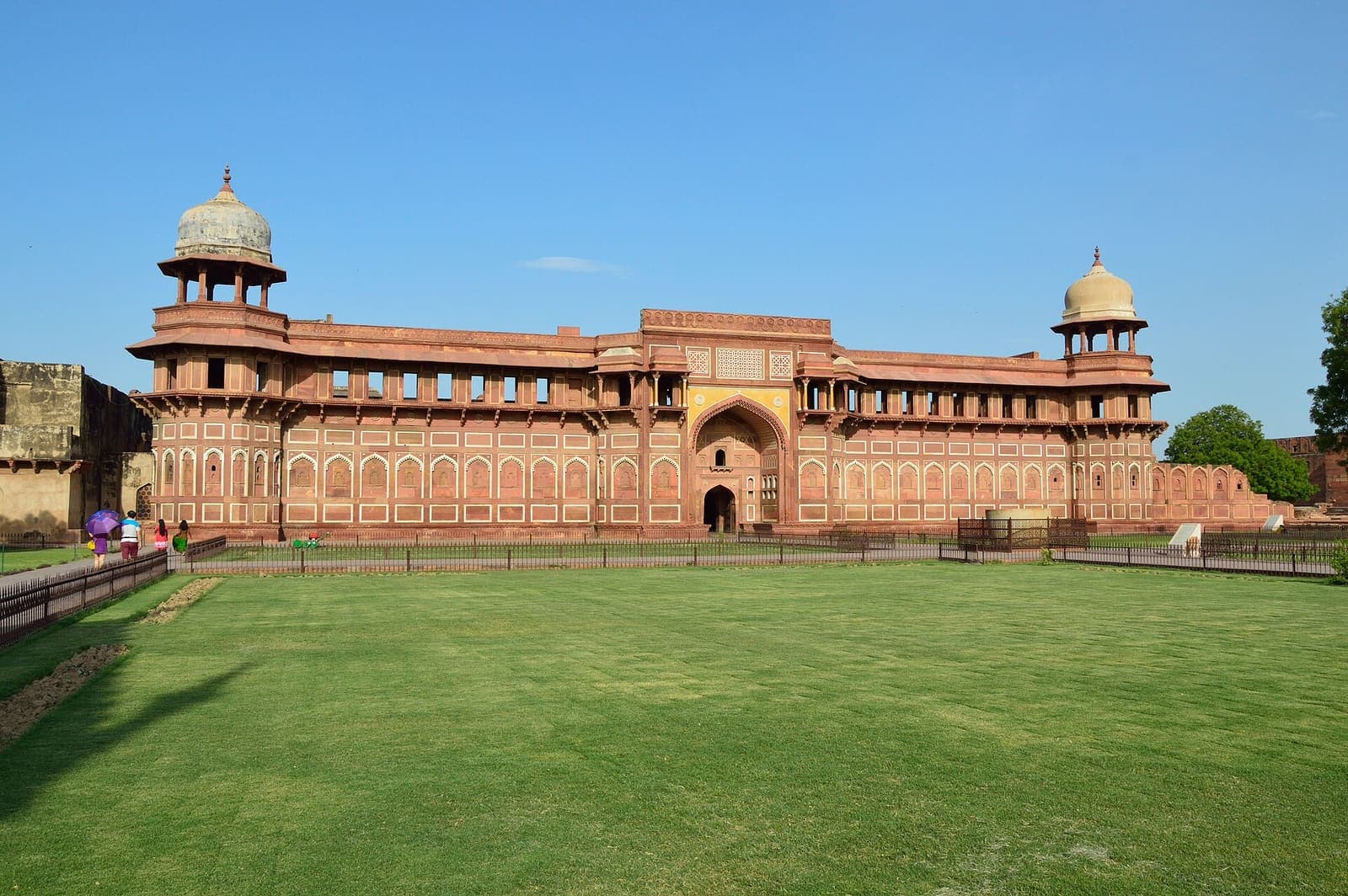
Photo: Biswarup Ganguly · Wikimedia Commons · CC BY 3.0 · resized for web
- Amar Singh Gate and the ramp. A long, walled ramp leads from the gate up to the palaces. The route below runs from the Jahangiri Mahal to the Diwan-i-Am, and works just as well the other way round.
- Jahangiri Mahal. The largest residence in the fort, a red sandstone palace that Akbar built, Britannica says, for his son Jahangir. In front of it stands Jahangir’s Hauz, a giant stone basin made for him.
- Khas Mahal and the Anguri Bagh. Walk on towards the river and the sandstone gives way to white marble. The Khas Mahal, the emperor’s private palace, faces the Anguri Bagh, a formal garden laid out in geometric beds, and looks out over the Yamuna behind.
- Sheesh Mahal. The palace of mirrors, its walls and ceilings set with thousands of small mirrors. It is normally closed to visitors.
- Musamman Burj. The octagonal marble tower where Shah Jahan spent his last years as his son’s prisoner. The tower itself is railed off, but the terrace beside it has the fort’s best view of the Taj.
- Diwan-i-Khas. The marble hall of private audience, where the emperor received important visitors. The hall is usually closed, but you can see it from the terrace in front.
- Machchi Bhawan and the Nagina Masjid. Below that terrace lies the Machchi Bhawan, a large courtyard, and near it the Nagina Masjid, one of three white marble mosques that Shah Jahan built in the fort.
- Diwan-i-Am. The hall of public audience, a long colonnade of scalloped arches facing a great courtyard, where the emperor heard petitions. UP Tourism dates it to 1628, the year Shah Jahan came to the throne, and the light and sound show is staged here after dark.
- Moti Masjid. The Pearl Mosque, also white marble, is closed to visitors, but its domes rise above the wall beside the Diwan-i-Am courtyard.
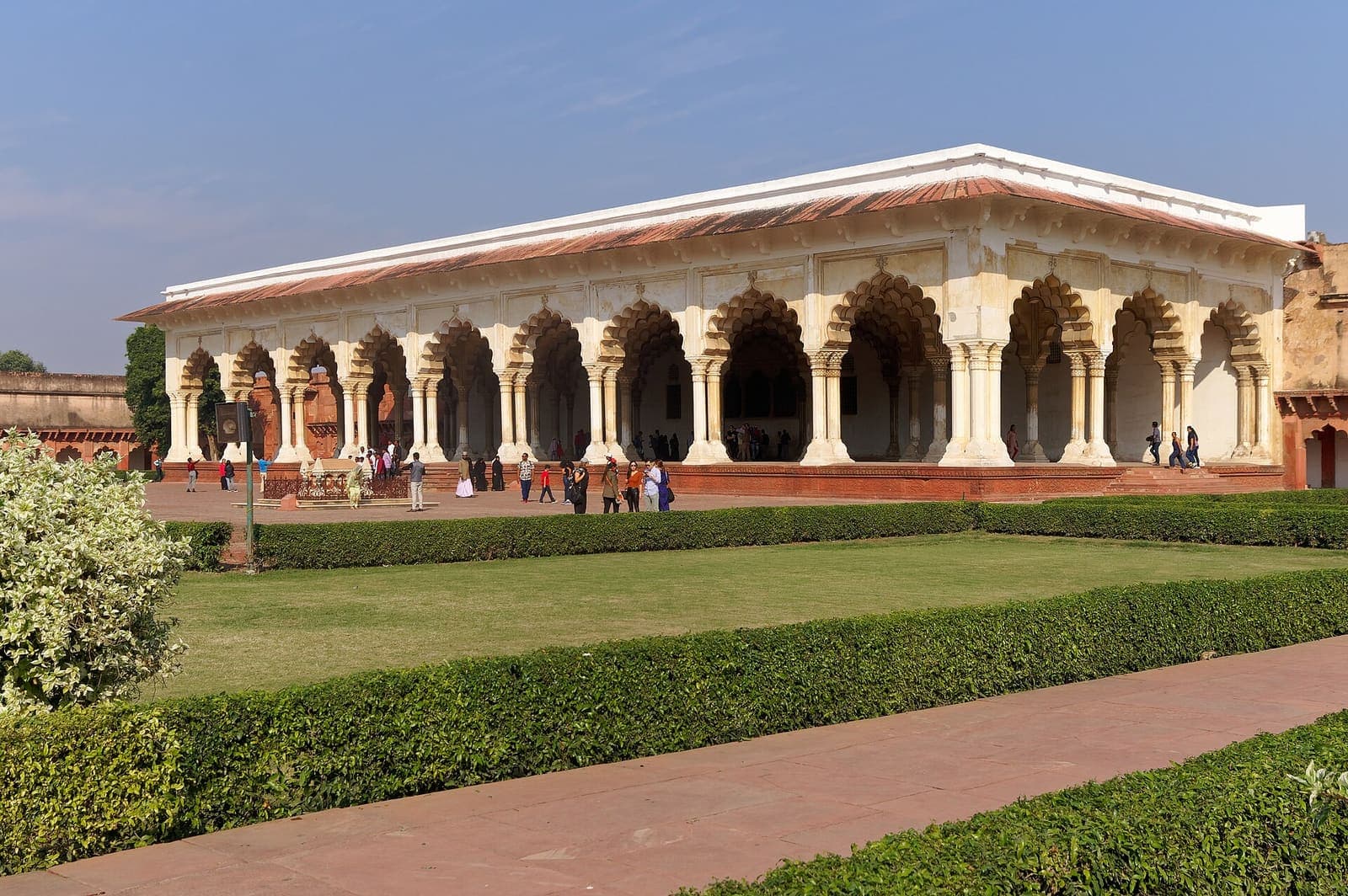
Photo: Jakub Hałun · Wikimedia Commons · CC BY-SA 4.0 · resized for web
What is railed off changes with conservation work, so read the closed list as what to expect rather than a rule. Visitor guides put the open part at less than half of the fort; the rest is out of bounds.
Where to see the Taj Mahal from Agra Fort
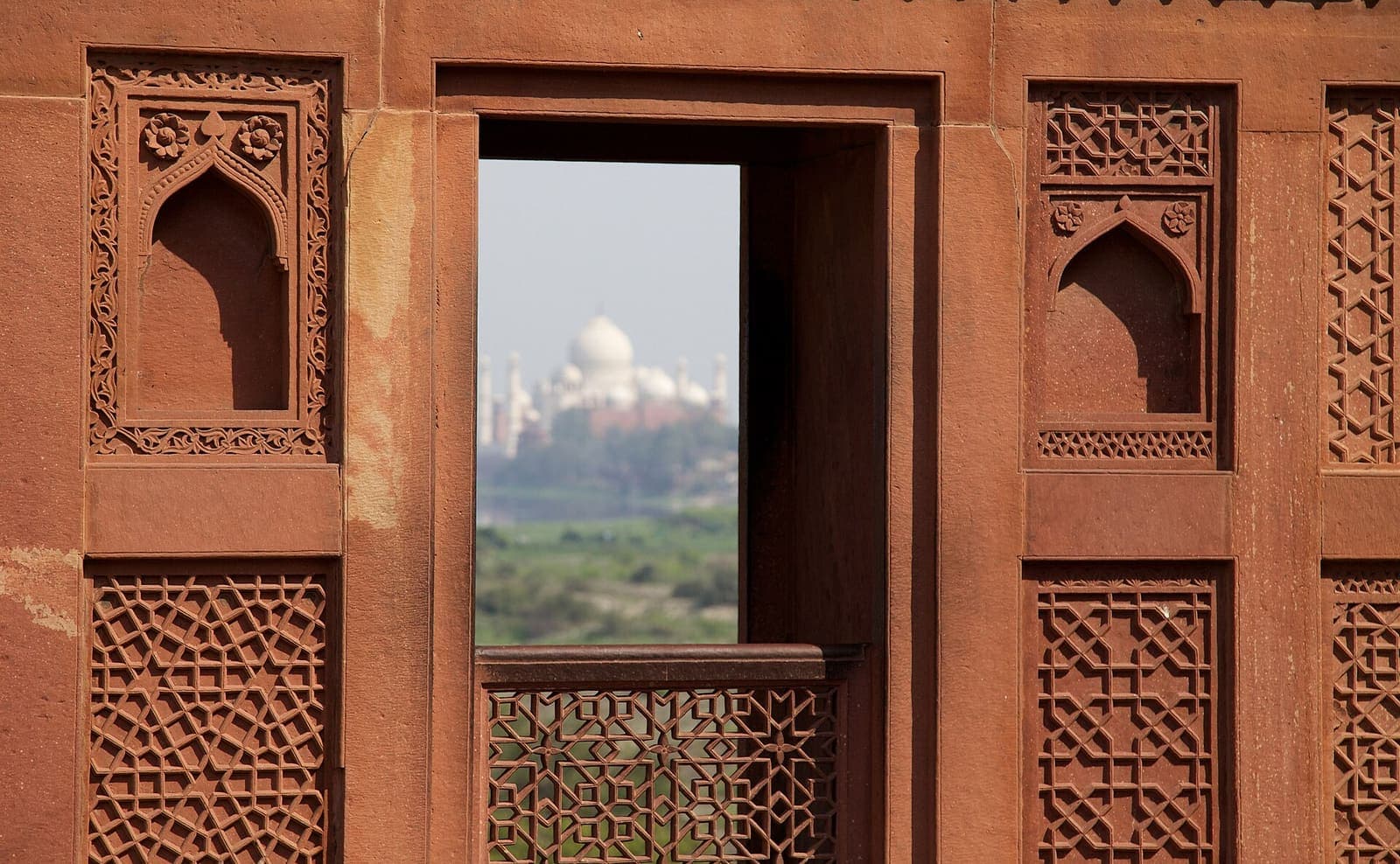
The best view of the Taj Mahal from Agra Fort is from the terrace beside Musamman Burj, looking down the Yamuna to the east. The marble palaces along the river, from the Khas Mahal to the Diwan-i-Khas, look the same way through their arches and screens.
It is also the view with the most famous story. From 1658 Aurangzeb kept his father, Shah Jahan, confined in the fort, and Shah Jahan died here in 1666. Tradition has it that he spent those years looking down the river at the tomb he had built for his wife, Mumtaz Mahal, where he was buried in turn.
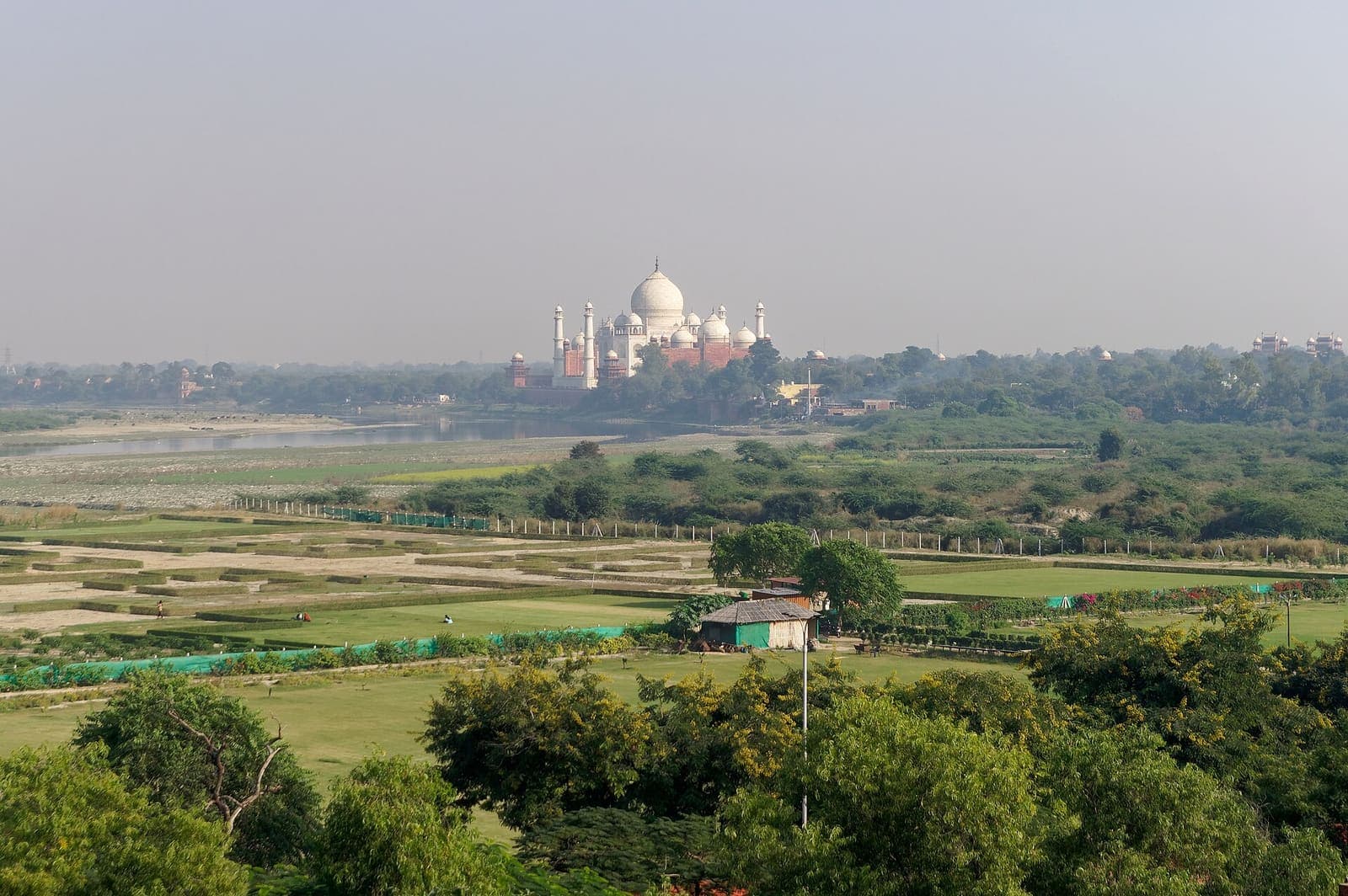
Photo: Jakub Hałun · Wikimedia Commons · CC BY-SA 4.0 · resized for web
At this distance the Taj is clear but small, so bring a zoom lens or binoculars if you want detail; the Taj Mahal photography guide has this view among its spots outside the walls. To see it close up on the same day, the one-day Agra itinerary puts the Taj at sunrise and the fort straight after.
How long do you need at Agra Fort, and when should you go?
Allow about two hours to walk the route above at an easy pace. One hour covers the highlights: the Jahangiri Mahal, the Khas Mahal, the view from beside Musamman Burj and the Diwan-i-Am. Three hours suits anyone with a guide, a camera and an interest in the detail.
- With the Taj Mahal. The Taj opens 30 minutes before sunrise and is closed on Fridays, so on the other six days see it first and come on to the fort by mid-morning. The Taj Mahal timings guide has its hours, and the hour-by-hour guide shows when the crowds build.
- In the hot months. From April to June, be at the gate when it opens and out before midday; the courtyards are open stone and the sun is fierce.
- In winter. From December to February the middle of the day is the pleasant part, so a late-morning visit suits the fort well.
- In the evening. Come back after dark for the light and sound show, described next.
Is the Agra Fort light and sound show running?
Yes, on the latest reports. Rang-e-Agra: Yugon Ka Safar, UP Tourism’s light and sound show at Agra Fort, reopened on 18 April 2025 after a gap of six years and was running in July 2026. It tells 5,000 years of Agra’s history in 45 minutes, projected onto the Diwan-i-Am, with Harish Bhimani narrating in Hindi and Kabir Bedi in English.
| Show | Details |
|---|---|
| Hindi | Every day, 6:30 to 7:15 PM |
| English | Every day, 7:30 to 8:15 PM |
| Adults | ₹300 Indian, ₹800 foreign |
| Ages 8 to 17 | ₹150 Indian, ₹400 foreign |
| Seats | 300 a show, first come, first served |
| Tickets | Online, or at the venue in the fort |
Check before you go. Reports at the launch gave the shows an hour later, and on 2 July 2026 Amar Ujala reported that Agra’s divisional commissioner had ordered the ₹300 Indian ticket cut to ₹100. UP Tourism’s show listing still gave ₹300 on 22 October 2026, so confirm the time and the price at the fort on the day. Take insect repellent too: the same report said mosquitoes had been bothering audiences.
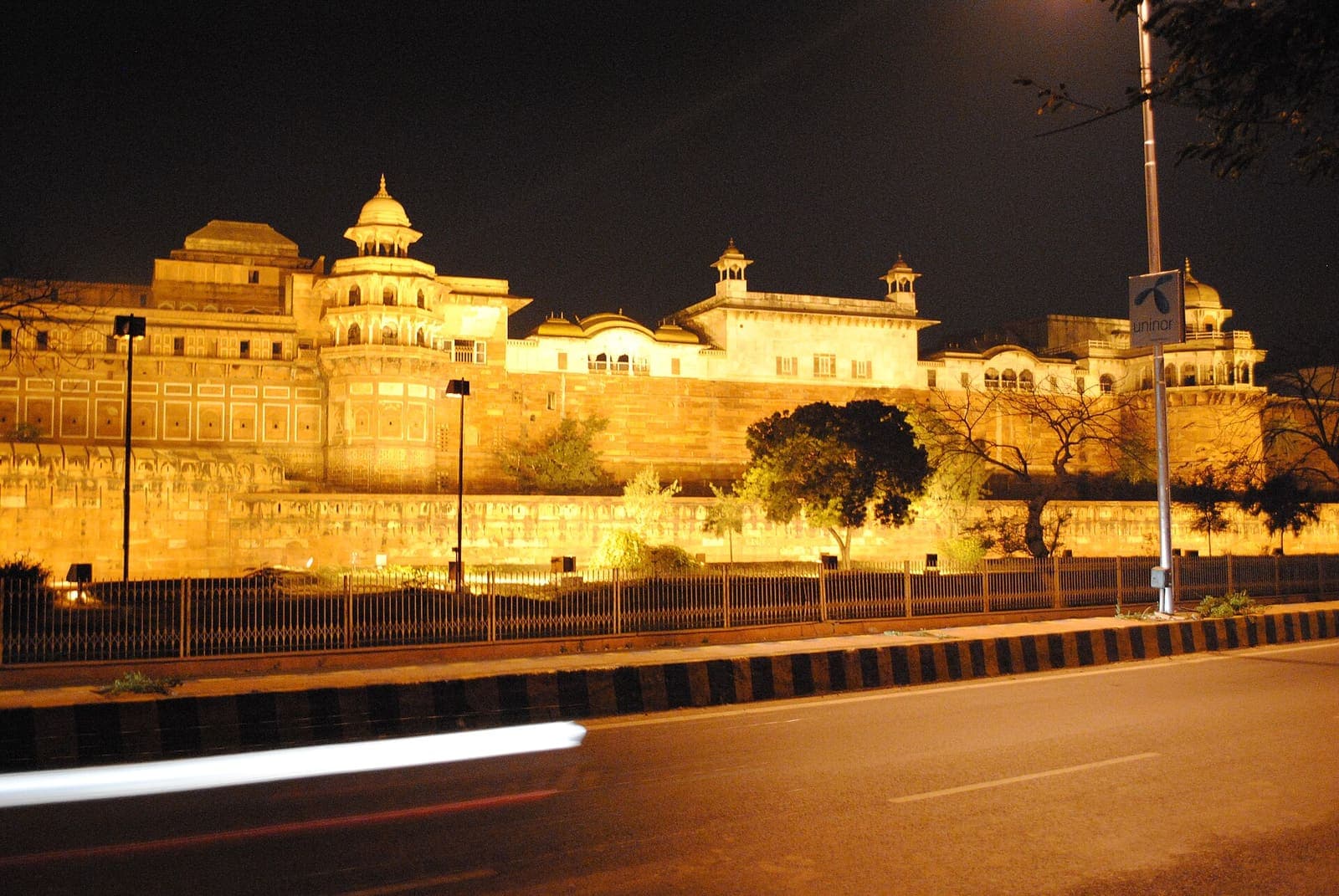
Photo: Shikhar Sharma · Wikimedia Commons · CC BY-SA 3.0 · resized for web
Who built Agra Fort? A short history
Akbar built Agra Fort, rebuilding an older fort in red sandstone between 1565 and 1573. Some 4,000 builders worked on it every day for eight years, according to the ASI’s history of the fort, and its walls run for 2.5 km and stand 21.4 metres high around about 94 acres.
The site was already old. Akbar built on the remains of a fort called Badalgarh, which the Lodi sultans had held: Sikandar Lodi was the first sultan of Delhi to move his capital to Agra, and his son Ibrahim held the fort until he was killed at the battle of Panipat in 1526. The first Mughals took it over, and Humayun was crowned here in 1530.
Akbar’s grandson Shah Jahan replaced many of the sandstone buildings with white marble palaces and three marble mosques, then moved his capital to Delhi in 1638. His son Aurangzeb confined him in the fort from 1658 until Shah Jahan died in 1666, and that same year the Maratha leader Shivaji came to Agra and met Aurangzeb in the Diwan-i-Khas, the ASI records. In the 18th century the fort was held by the Jats and the Marathas, and the British took it from the Marathas in 1803.
UNESCO inscribed Agra Fort as a World Heritage Site in 1983, and calls it the Red Fort of Agra, which is where the confusion with Delhi starts.
Agra Fort vs the Red Fort in Delhi
They are two different forts, easily confused because both are red sandstone and both are known as the Red Fort, or Lal Qila. Agra Fort is the older: Akbar’s, begun in 1565. Delhi’s Red Fort was built by his grandson Shah Jahan in the mid-17th century as the palace-fort of his new capital, Shahjahanabad, and became a World Heritage Site in 2007. If an Agra itinerary says “Red Fort”, it means this one.
After the fort: the old city, lunch and dinner
Agra Fort stands on the edge of the old city. On the far side of Agra Fort station from the Delhi Gate is the Jama Masjid, with Kinari Bazaar and the old market lanes packed in around it; our guide to shopping in Agra covers what each market is good for. Start early and the old city’s sweet shops are frying bedai and jalebi for breakfast, usually sold out by mid-morning; the guide to Agra’s street food has the rest.
For lunch or dinner on the west side of the city, Altitude Rooftop Lounge, the rooftop restaurant that publishes this journal, is on the top floor above MG Road 2, Jaipur House, about 5 km (20 minutes) from Agra Fort station. It is open every day from 12:00 PM to 12:30 AM, so it fits lunch after a morning at the fort or dinner after the show. On a foreign passport, lunch is the better fit: from 1:00 PM to 7:00 PM, all drinks are buy one, get one free, dine-in only, and the offers page has the terms. The English menu marks every dish veg, non-veg or egg, and booking a table is free, with free cancellation up to two hours before. There is no Taj view from the roof; you will have had that from the fort. Tell the driver “MG Road 2, Jaipur House”: there is a Domino’s at street level, and a lift to the top floor.
Nearer the Taj, the cafés of Taj Ganj and the big hotels on Fatehabad Road, where buffet lunches usually run from 12:30 to 3:00 PM, are the obvious alternatives, and lunch in Agra sorts them by area.