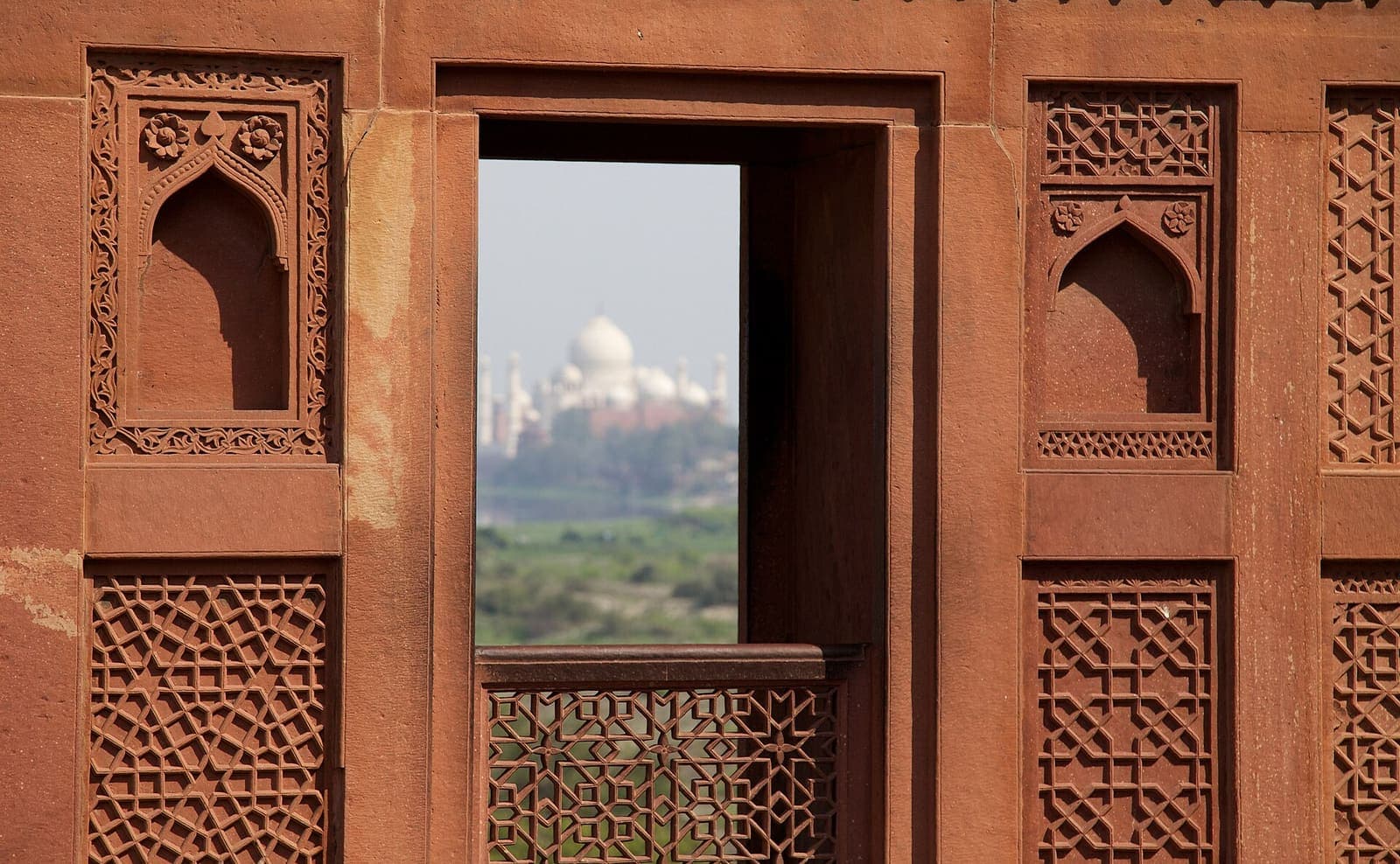
Mehtab Bagh: the Taj Mahal at sunset from across the river, and the Black Taj legend
Mehtab Bagh is the garden laid out exactly opposite the Taj Mahal, and the place to watch the dome as the light goes. Here is when to arrive, what it costs and how to get there, and what the excavations found of the Black Taj that never was.
By Priyanka Singh, Travel expert
 (opens in a new tab)
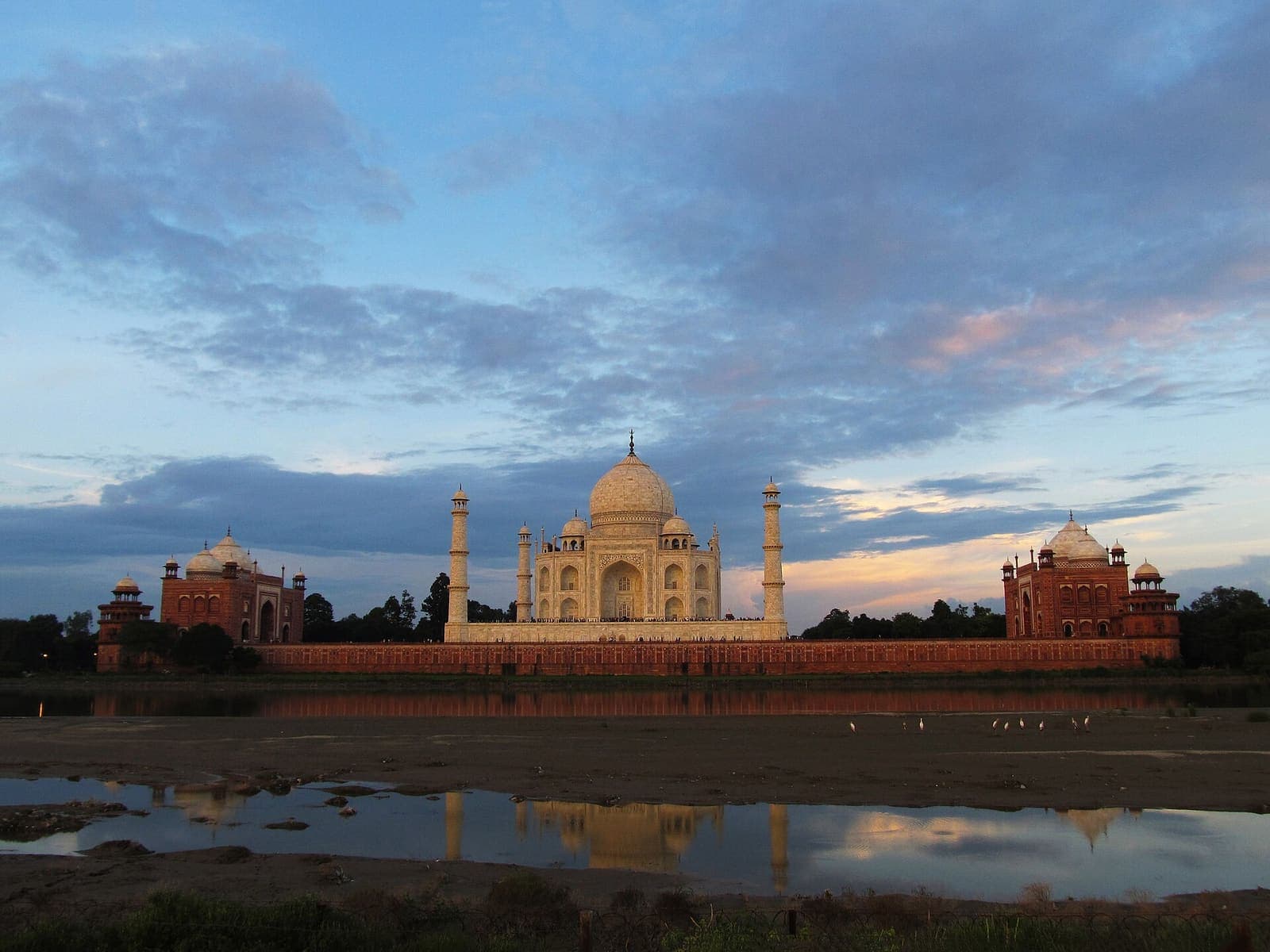
Photo: Ranadeep Talukdar · Wikimedia Commons · CC BY-SA 3.0 · resized for web
Mehtab Bagh is the Mughal garden across the Yamuna from the Taj Mahal, laid out on the same axis, and the place to watch the Taj as the light goes. It opens every day, Friday included, from sunrise to sunset; tickets cost ₹25 for Indians and ₹300 for foreign visitors. No Black Taj was ever built here.
| Mehtab Bagh | The facts |
|---|---|
| What it is | A Mughal “moonlight garden” on the Yamuna’s north bank, on the Taj Mahal’s axis |
| Open | Every day, Friday included, from sunrise to sunset |
| Ticket: Indian, SAARC and BIMSTEC visitors | ₹25 |
| Ticket: other foreign visitors | ₹300, the same with or without a Taj ticket |
| Children under 15 | Free |
| Best time | The last hour before sunset |
| Time to allow | About an hour |
| Getting there | About 8 km by road from Agra Fort, over the Yamuna |
| Food and water | No food stalls inside; carry water |
| The Black Taj | A legend: excavations found a garden, not a tomb |
What is Mehtab Bagh, and why does it line up with the Taj?
Mehtab Bagh, the “moonlight garden”, is a square Mughal garden about 300 metres a side on the north bank of the Yamuna, directly opposite the Taj Mahal. It is the same width as the Taj’s own garden and shares its north–south axis, so from the river end the tomb stands dead centre across the water. Drawn on one plan, the two gardens read as a single design with the river running through the middle.
Who made it is told two ways. Agra’s district website says Babur, the first Mughal emperor, laid out a garden here and Shah Jahan later aligned it with the Taj. A seven-year study by the Archaeological Survey of India (ASI) and the Smithsonian’s Sackler Gallery, published in 2000 as The Moonlight Garden, concluded that it was most likely Shah Jahan’s, designed for looking at the Taj; the Smithsonian’s summary describes a garden “matching the Taj gardens in width and alignment”.
Its centrepiece was a raised terrace by the river with an octagonal pool, each of its eight sides 17.3 metres long and its floor set with 25 fountains, and a pavilion looking over it. Still water there held the Taj upside down, a second, reflected Taj for whoever sat in the pavilion. It was a garden for evenings, planted with night-flowering trees and laid with white plaster paths that showed up in the moonlight.
It did not last. In a letter dated 9 December 1652, Prince Aurangzeb told his father that “the Mahtab Garden was completely inundated”, though its octagonal pool and pavilion were “in splendid condition”. The floods kept coming, villagers carried off the sandstone, and the pool lay under two to three metres of silt until the ASI dug it out in 1993–94.
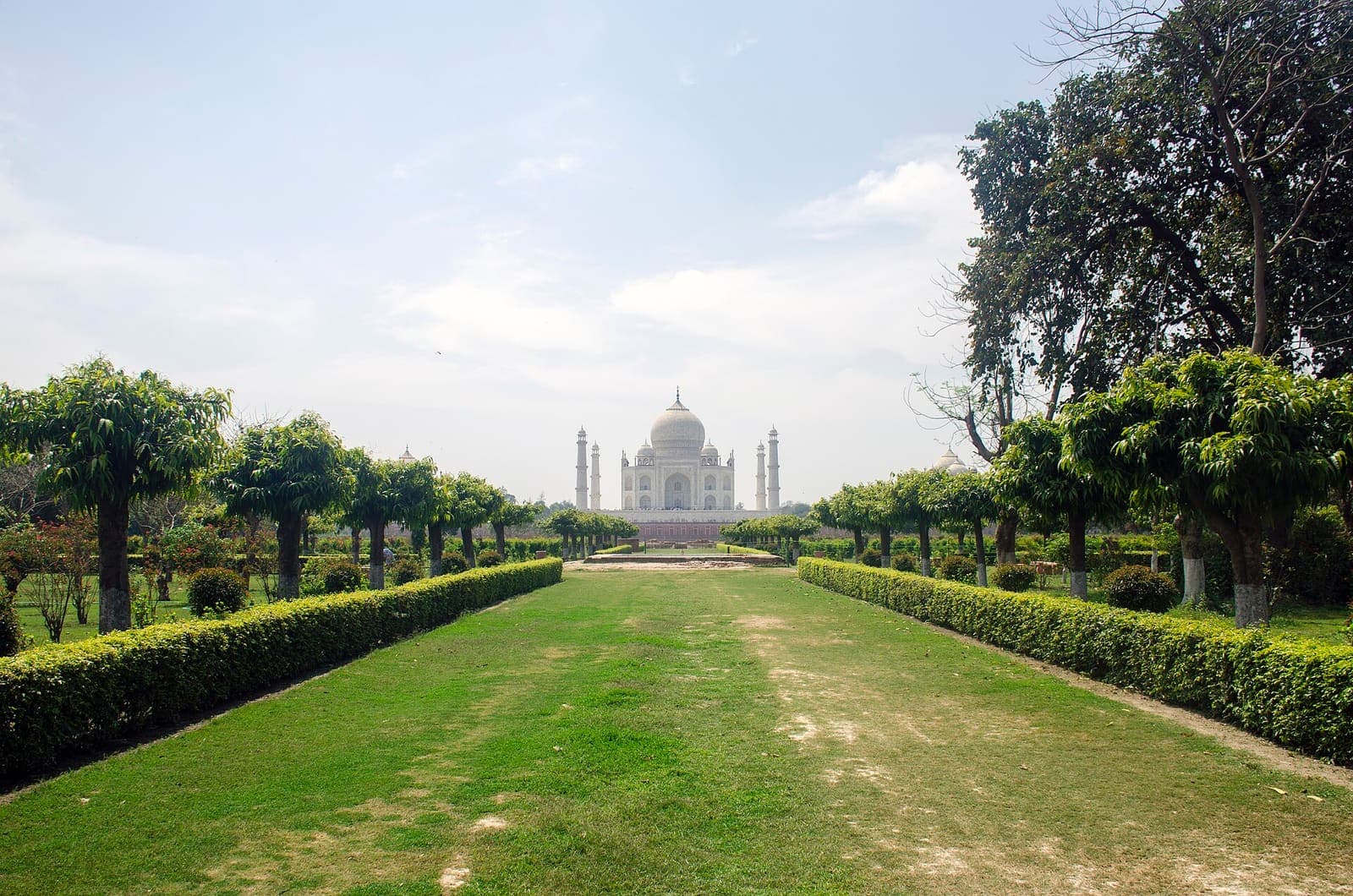
Photo: Rangan Datta · Wikimedia Commons · CC BY-SA 4.0 · resized for web
Was there a Black Taj Mahal? The legend and the evidence
No. The Black Taj Mahal, or Kala Taj Mahal in Hindi, is a legend. As guides tell it, Shah Jahan meant to build himself a twin of the Taj in black marble at Mehtab Bagh, joined to the first by a bridge, until his son Aurangzeb deposed him in 1658. Excavations at Mehtab Bagh found a pleasure garden and no foundations for a tomb.
The story begins with one sentence. Jean-Baptiste Tavernier, a French jewel merchant who said he saw the Taj begun and finished, wrote in his Travels, first published in 1676: “Shah Jahan began to build his own tomb on the other side of the river, but the war which he had with his sons interrupted his plan, and Aurangzeb, who reigns at present, is not disposed to complete it.” Read it in the 1889 English translation and there is no black marble in it. The colour was added later.
The ground tells a different story. The ASI’s own page on Mehtab Bagh calls it “the myth of black Taj” and says the excavations “provided ample evidence for a garden complex”: the octagonal tank with its 25 fountains, a small central tank and a pavilion on the east side. The Smithsonian study adds that ASI archaeologists examined the garden thoroughly at least twice from the 1970s and found no sign of the extensive foundation a second tomb would need.
| The claim | What the evidence shows |
|---|---|
| Shah Jahan began a second tomb across the river | The claim first appears in Tavernier, who never mentions black marble |
| Its foundations lie in Mehtab Bagh | Digs since 1993 found a pool, fountains and pavilions, but no tomb foundation |
| Work on it had begun | In 1652, six years before he seized power, Aurangzeb described a flooded garden there, its pool and pavilion intact |
| Shah Jahan’s off-centre cenotaph shows he meant to lie elsewhere | Itimad-ud-Daulah’s tomb, finished in 1628, has the same off-centre arrangement |
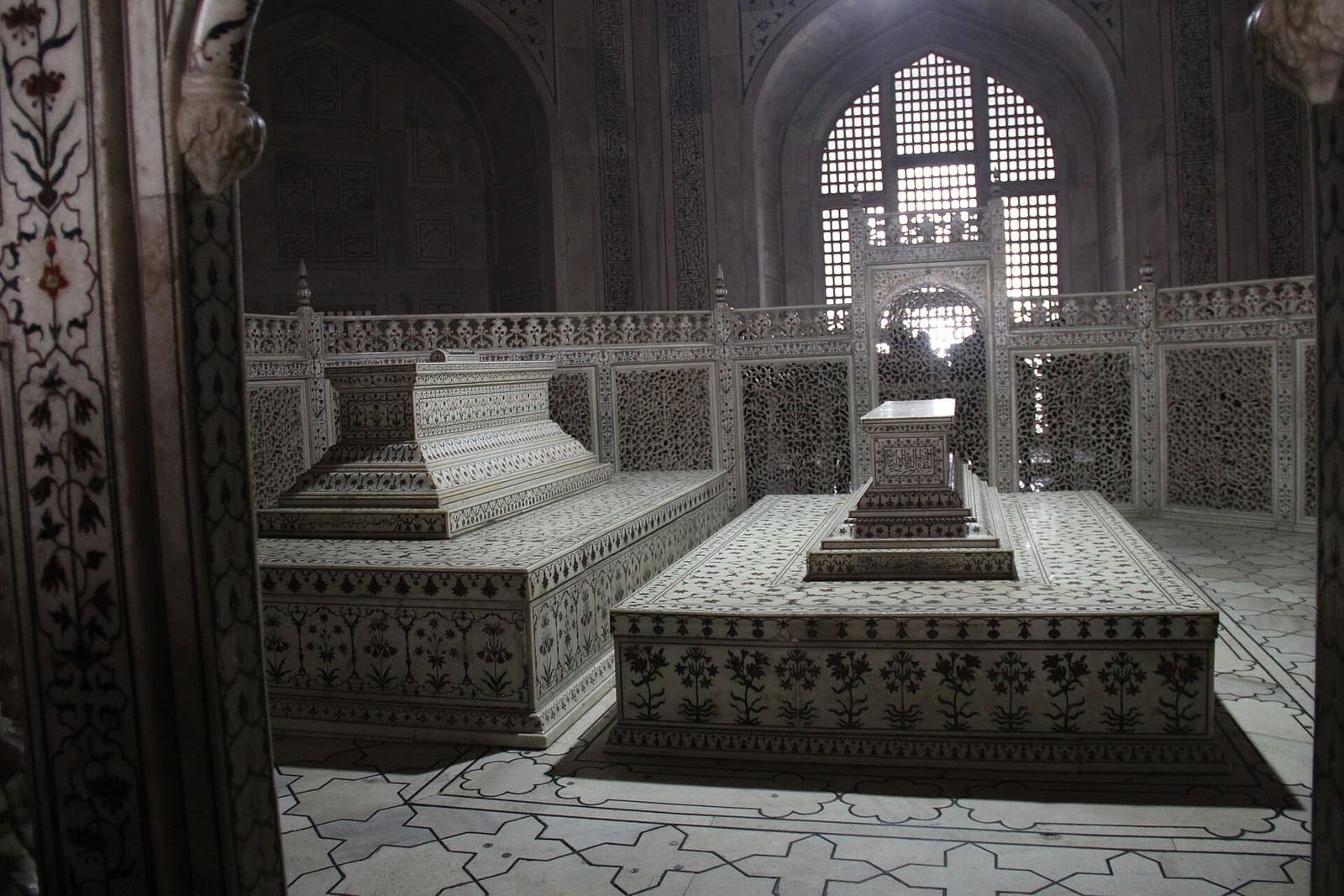
Where did the idea come from, then? Two of the study’s authors, John Fritz and George Michell, suggest that once the garden was abandoned, the octagonal outline of the terrace and the hollow of the pool were taken for the footings of an unfinished building. Shah Jahan’s cenotaph helped too: it sits to one side of Mumtaz Mahal’s rather than at the centre, which seemed to say he had meant to lie elsewhere. Our guide to what you see inside the Taj Mahal shows where both lie.
One scholar cited in the study, M. C. Joshi, thought a tomb across the river might have been in the first plan for the Taj and dropped before building began. Even on that reading, nothing was ever built. Shah Jahan spent his last years confined in Agra Fort, died in 1666 and was buried in the Taj beside Mumtaz Mahal.
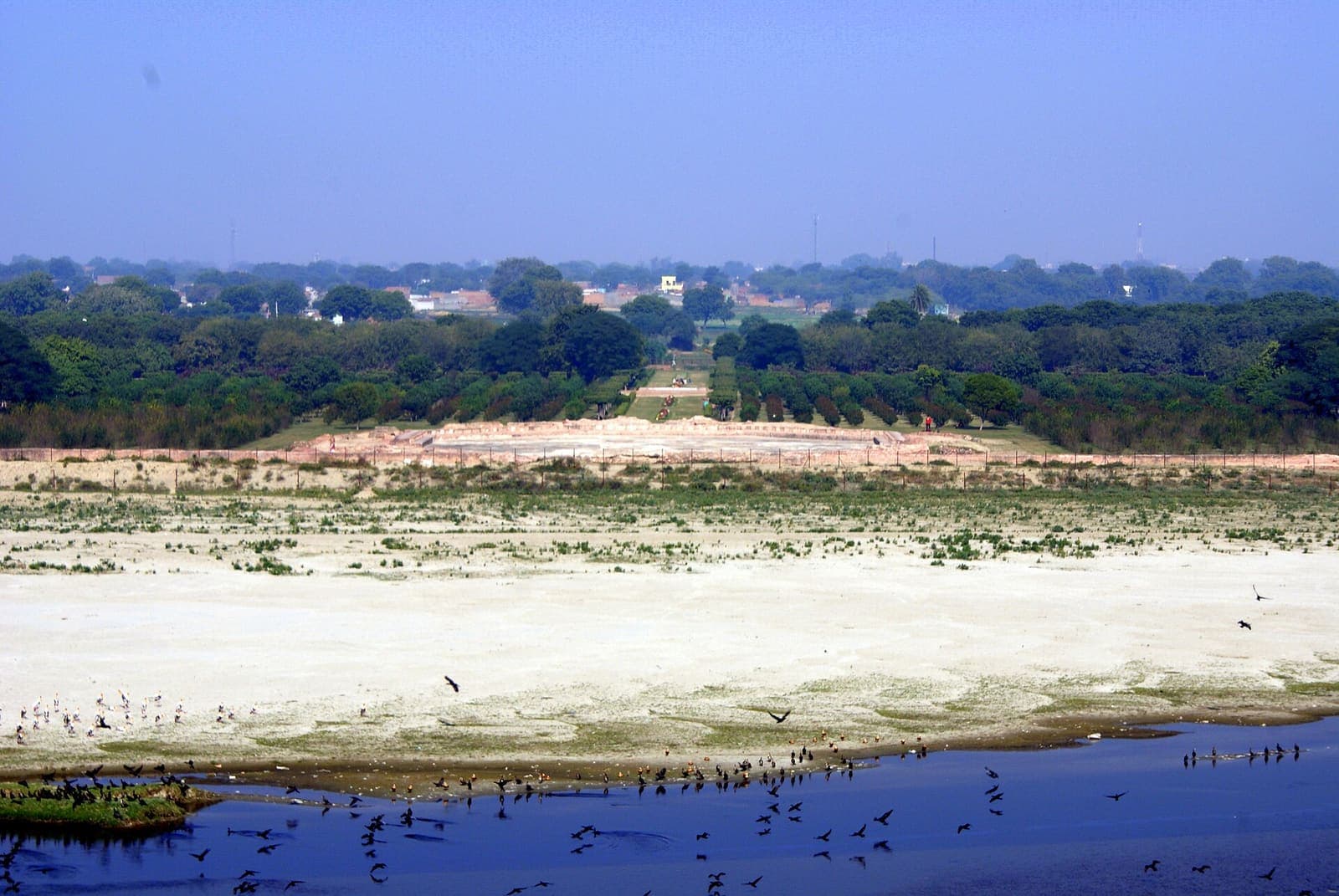
Photo: Teufel1987 · Wikimedia Commons · CC BY-SA 3.0 · resized for web
Mehtab Bagh timings and ticket price
Mehtab Bagh is open every day from sunrise to sunset, Friday included, which makes it the natural place to see the Taj on the one day the Taj is closed; our guide to Agra on a Friday plans the rest of that day. Tickets can be bought online on the ASI’s booking site, asi.paygov.org.in, and the price is the same on Fridays.
- Indian visitors: ₹25.
- Visitors from SAARC and BIMSTEC countries: ₹25.
- Other foreign visitors: ₹300. A same-day Taj ticket brings no discount here, as it does at Agra Fort and Itimad-ud-Daulah.
- Children under 15: free.
Those are the fees in the ticket table on the official Taj Mahal website on 16 October 2026; fees are revised from time to time, so check before you go. Unlike the Taj, Agra Fort and Itimad-ud-Daulah, Mehtab Bagh carries no extra toll for the Agra Development Authority, so ₹25 or ₹300 is the whole price.
When is the best time to visit Mehtab Bagh?
Go for the last hour before sunset. The garden closes when the sun goes down, the marble warms as the light drops, and you watch it from across the river, away from the crowds at the Taj’s gates. Be inside at least an hour before sunset: the light changes fast at the end, and the gates shut with it.
| Month | Sunset (be there by) |
|---|---|
| October | 5:49 PM (4:45 PM) |
| November | 5:26 PM (4:25 PM) |
| December | 5:26 PM (4:25 PM) |
| January | 5:45 PM (4:45 PM) |
| February | 6:09 PM (5:05 PM) |
| March | 6:26 PM (5:25 PM) |
| April | 6:42 PM (5:40 PM) |
| May | 6:58 PM (5:55 PM) |
| June | 7:13 PM (6:10 PM) |
| July | 7:14 PM (6:10 PM) |
| August | 6:55 PM (5:55 PM) |
| September | 6:23 PM (5:20 PM) |
The sunset times are timeanddate.com’s for Agra and shift by a minute or so from year to year. The season matters as much as the hour. From July to September the monsoon fills the riverbed, and sometimes the old pool, so you may get the Taj’s reflection in the water; the rest of the year the pool is usually dry. December and January bring haze, and the India Meteorological Department’s 1991–2020 averages give Agra about five days of fog in each month, enough to hide the dome.
Sunrise works too, since the garden opens at first light, though it means two early starts if you also want the Taj at dawn. Our guide to the Taj Mahal at sunrise covers the morning inside the walls; Mehtab Bagh is the evening’s answer. For the camera rules and the other viewpoints, see our Taj Mahal photography guide.
How to get to Mehtab Bagh from the Taj Mahal
You cannot cross straight over. There is no bridge between the Taj and the garden, so the road goes round by a bridge upstream near Agra Fort. Mehtab Bagh is about 8 km from Agra Fort over the Ambedkar (Yamuna) bridge, according to the district administration, and about 9.3 km from Agra Cantt station, according to the Agra Development Authority. From the Taj’s gates it is roughly 8 km by road, to a garden a few hundred metres away across the water.
- Auto-rickshaw or taxi. The simplest way. Agree the return, or the waiting time, before you set off: you will be leaving at dusk.
- Your own car or a hired driver. Parking at the gate is limited; our Taj Mahal parking guide covers Mehtab Bagh too.
- From the Baby Taj. Itimad-ud-Daulah is on the same side of the river, about 5 km away, so the easiest plan is to come on from there (see below).
- Bring water. There are no food stalls inside the garden.
What you see at Mehtab Bagh today
The garden you walk through is largely a replanting: in 1998–99 the ASI planted seven thousand saplings in the four-part garden behind the river terrace, and a long central walk now runs between hedges and fruit trees straight at the Taj. At the river end lie the remains of the octagonal pool, usually dry, and a stretch of the old sandstone-faced river wall.
One original building still stands: the octagonal red sandstone tower at the south-east corner, three storeys high with an open domed kiosk on top, the only survivor of the garden’s corner towers. From the river end, the whole north face of the Taj fills the view, with its red sandstone mosque and guest house on either side.
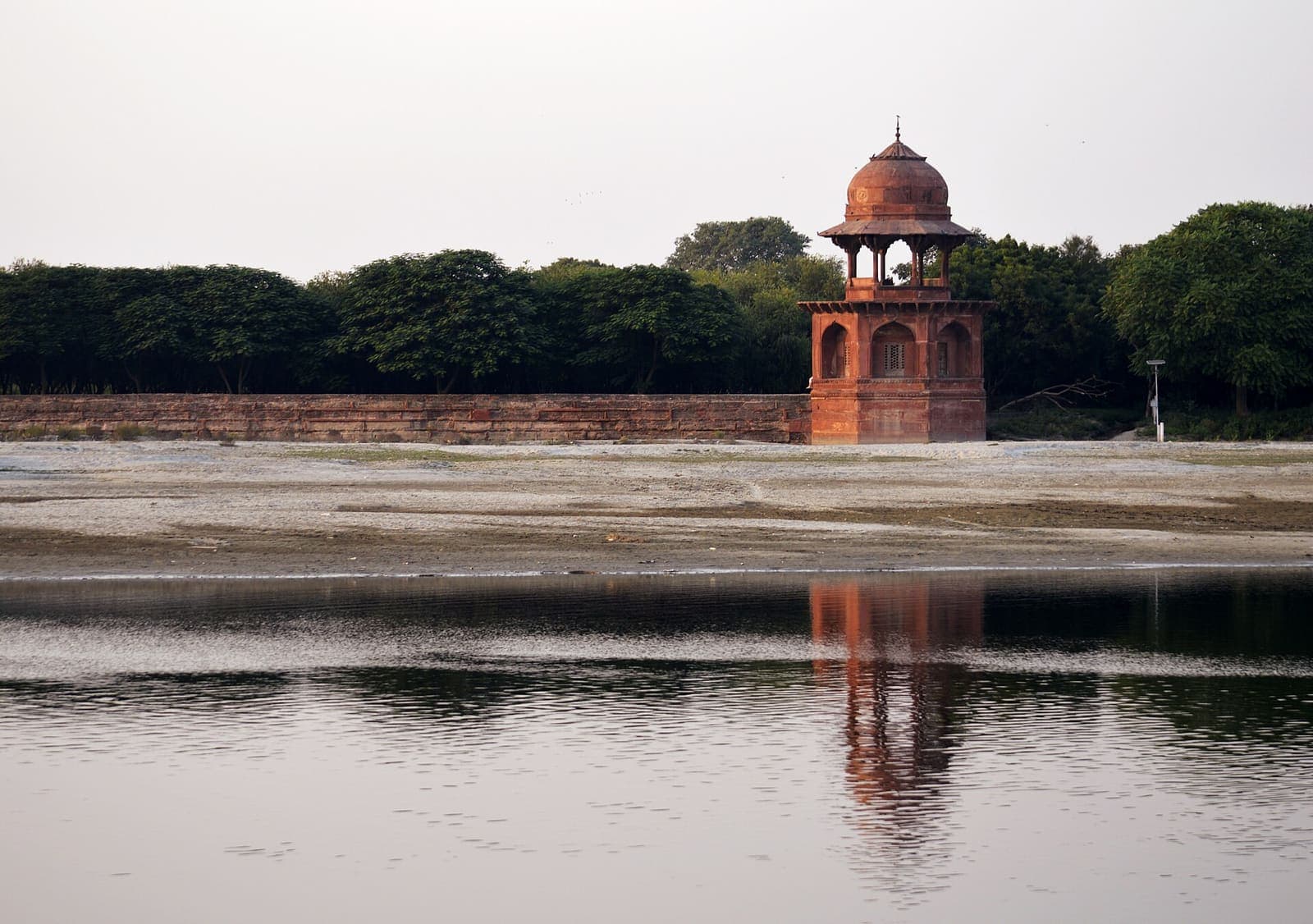
Photo: Yann · Wikimedia Commons · CC BY-SA 4.0 · resized for web
Other places to see the Taj from across the river
Near the garden, on the riverbank, the Agra Development Authority runs a separate Taj View Point with its own ticket: ₹50 for Indian visitors and ₹200 for foreign visitors, with children free, on the authority’s ticket site in mid-October 2026. Its hours have been given differently over the years, so check them at the gate. It is a viewpoint rather than a garden, so it suits a quick look. In some years it has stayed open late around the full moon; that is not on the ticket site, so ask before you plan an evening around it.
Two more views complete the set. Upstream, Musamman Burj in Agra Fort, where Shah Jahan spent his last years, looks along the river to the Taj. For the Taj after dark, the ASI opens the monument for night viewing on the full-moon night and the two nights either side, except on Fridays and during Ramzan; our guide to the Taj at night has the dates and the drill. Mehtab Bagh itself shuts at sunset, full moon or not.
Combine Mehtab Bagh with the Baby Taj and Chini ka Rauza
Mehtab Bagh is the southern end of a string of Mughal tombs and gardens on the far bank of the Yamuna. Take two of them on the way and the afternoon ends in the garden as the light goes.
- Chini ka Rauza, free. The tomb of Afzal Khan Shirazi, poet-scholar and prime minister to Shah Jahan, built around 1635. The district calls it the only monument in Agra faced in Persian glazed tiles, and patches of blue and turquoise still show on the river side. Open sunrise to sunset, about 1 km north of Itimad-ud-Daulah.
- Itimad-ud-Daulah, the Baby Taj. Built between 1622 and 1628 by the empress Nur Jahan for her father, and the first Mughal building made entirely of white marble. ₹30 for Indians and ₹310 for foreign visitors; ₹25 and ₹300 on Fridays, and ₹300 for foreign visitors with a same-day Taj ticket. Allow about an hour.
- Mehtab Bagh, about 5 km on by road, for the last hour of light.
| Time | Stop |
|---|---|
| 2:30 PM | Chini ka Rauza, about 20 minutes |
| 3:00 PM | Itimad-ud-Daulah, about an hour |
| 4:00 PM | On to Mehtab Bagh, about 5 km by road |
| 4:15 PM to sunset | Mehtab Bagh; the sun sets at about 5:25 to 5:35 PM in November |
| After dark | Back across the river for dinner |
In other months, move the whole plan by the change in sunset time in the table above. To fit these into a longer stay, our ranked list of places to visit in Agra groups each sight with its neighbours, and one day in Agra fits the Taj, the Fort, the Baby Taj and this garden into a single day.
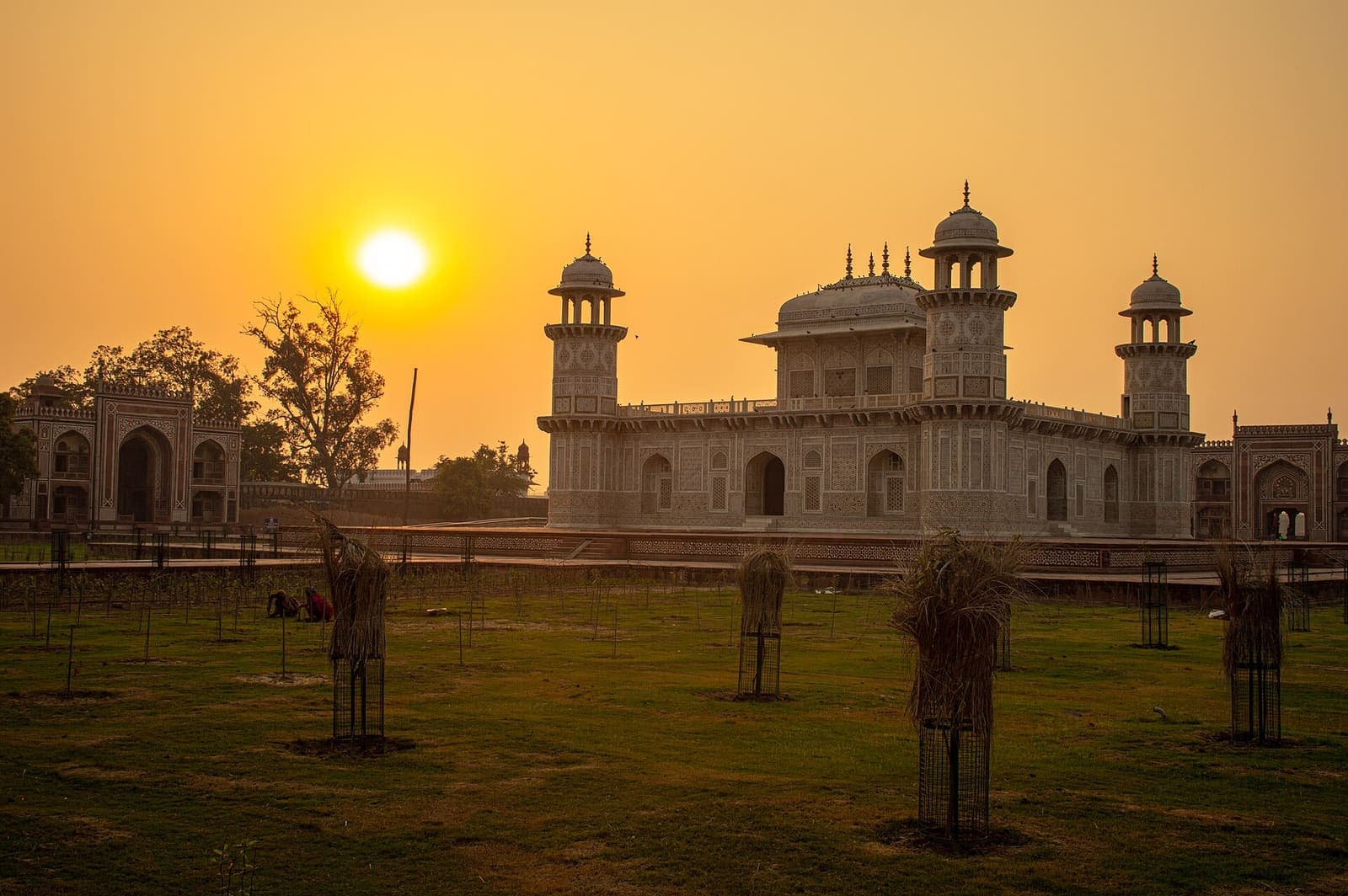
Photo: Philip Nalangan · Wikimedia Commons · CC BY 4.0 · resized for web
Where to eat after sunset at Mehtab Bagh
There is nothing to eat inside the garden, so plan dinner back across the river. Altitude Rooftop Lounge, the rooftop restaurant that publishes this journal, is on the top floor above MG Road 2, Jaipur House, on the west side of the city, and is open every day from 12:00 PM to 12:30 AM. Anyone travelling on a foreign passport can get buy one, get one free on all drinks ordered between 1:00 PM and 7:00 PM, dine-in only, under the published offer terms. Tell the driver “MG Road 2, Jaipur House”: there is a Domino’s at street level, and a lift to the top floor.
To be plain, it has no Taj view; you will just have seen the Taj from across the river. What it does have is an English menu online with every dish marked veg, non-veg or egg, and a tandoor and a pizza oven on the roof. There is a bar. Booking a table is free, with free cancellation up to two hours before.
If you would rather eat with the Taj in sight, the terraces of Taj Ganj and some hotel roofs near the East Gate look straight at it, and our top 10 rooftop restaurants in Agra sorts them out. Whichever you choose, book before you cross the river, because you will leave the garden at dusk with an appetite.