Taj Mahal facts: who built it, when and why, and the myths answered
Who built the Taj Mahal, when and why, what it is made of and how tall it is, answered from UNESCO, the ASI and Britannica. Then the legends guides still tell, from the Black Taj to the cut hands, set against the evidence.
By Priyanka Singh, Travel expert
 (opens in a new tab)
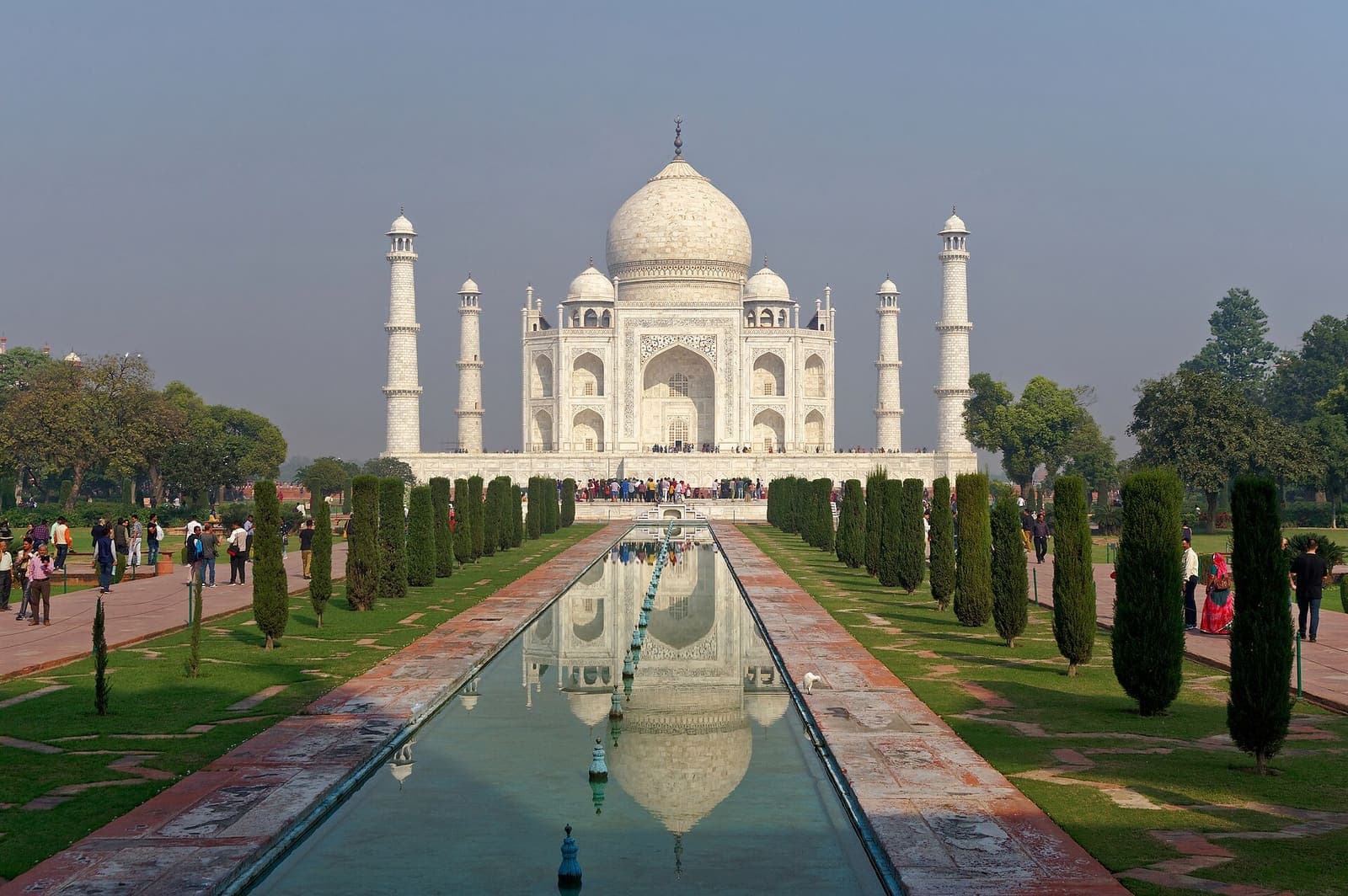
Photo: Jakub Hałun · Wikimedia Commons · CC BY-SA 4.0 · resized for web
The key Taj Mahal facts: the Mughal emperor Shah Jahan built it in Agra as a tomb for his wife Mumtaz Mahal, who died in 1631. Work ran from about 1632 to 1648, with the outer courtyard finished in 1653. The Taj Mahal is a mausoleum, not a mosque, and has been a UNESCO World Heritage Site since 1983.
| Question | Answer |
|---|---|
| What is it? | A white marble mausoleum in a walled garden complex of about 17 hectares |
| Where is it? | Agra, Uttar Pradesh, on the south bank of the Yamuna |
| Who built it? | Shah Jahan, the fifth Mughal emperor, who reigned from 1628 to 1658 |
| For whom? | His wife Mumtaz Mahal, born Arjumand Bano Begum, who died in 1631 |
| When? | About 1632 to 1648; outer courtyard and cloisters finished in 1653 |
| Main architect | Ustad Ahmad Lahori, according to UNESCO |
| Workforce | About 20,000 workers |
| Materials | Brick faced with white Makrana marble and red sandstone, inlaid with semi-precious stones |
| Height | About 73 metres (240 feet) to the tip of the main dome’s finial |
| Who is buried there? | Mumtaz Mahal, and Shah Jahan, who died in 1666 |
| World Heritage Site | Since 1983 |
| New 7 Wonders | One of seven winners of a private global vote, 7 July 2007 |
| Opening hours | 30 minutes before sunrise to 30 minutes before sunset; closed on Fridays |
| Looked after by | The Archaeological Survey of India (ASI) |
Who built the Taj Mahal?
The Taj Mahal was built by Shah Jahan, the fifth Mughal emperor, who reigned from 1628 to 1658 and was a grandson of Akbar. He commissioned it after his wife Mumtaz Mahal died in 1631; the building itself was done by some 20,000 masons, stonecutters, inlayers, carvers, painters and calligraphers.
Before he took the throne, Shah Jahan was Prince Khurram, son of the emperor Jahangir, who gave him the title Shah Jahan, Persian for “King of the World”. His reign ended in 1658, when his son Aurangzeb deposed him and kept him in Agra Fort for the rest of his life. Shah Jahan died in 1666 and was buried in the Taj Mahal beside Mumtaz Mahal.
Who was Mumtaz Mahal?
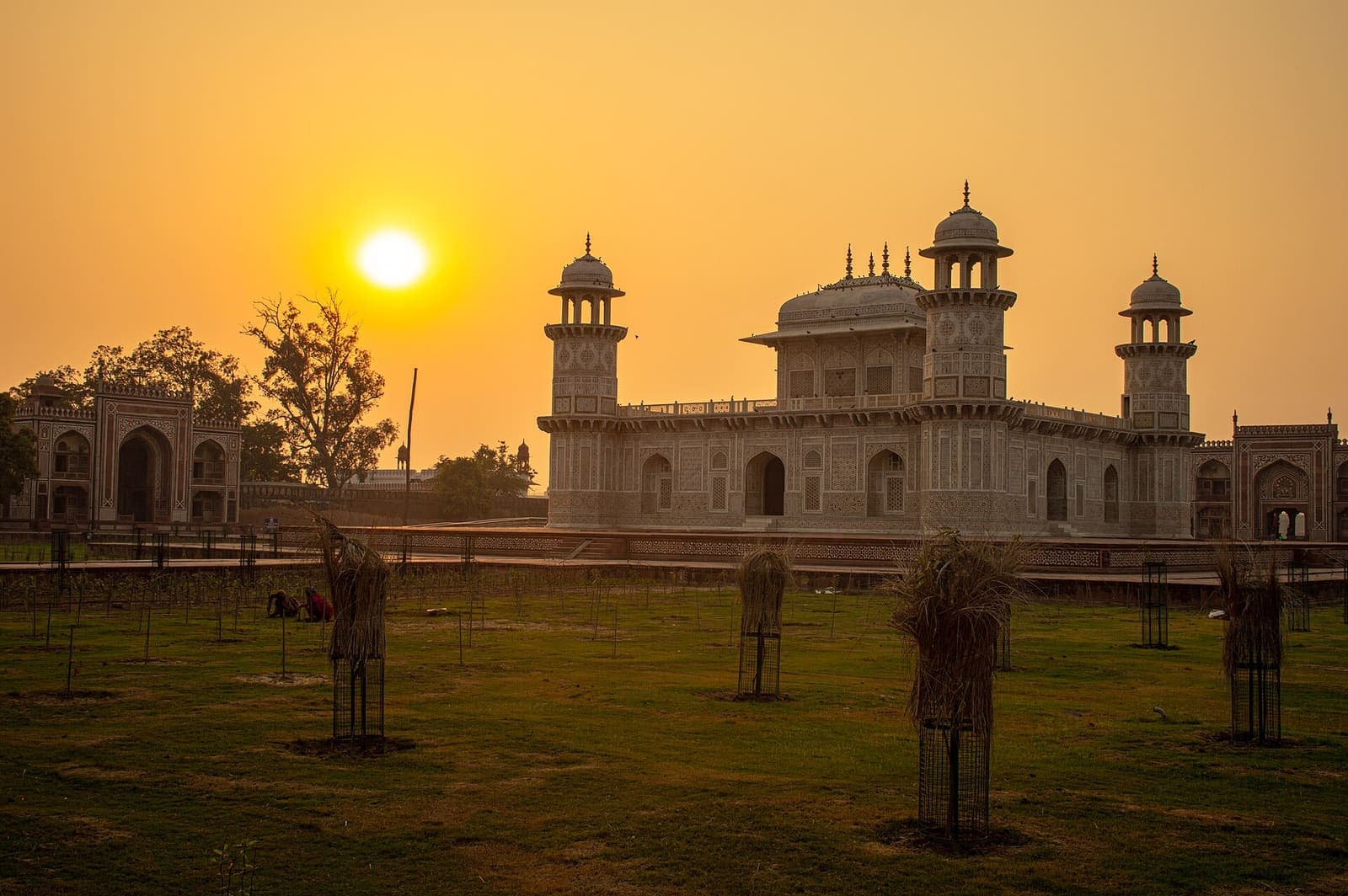
Mumtaz Mahal was Shah Jahan’s empress, born Arjumand Bano Begum in 1593. The ASI notes that she was a niece of the empress Nur Jahan and a granddaughter of Itimad-ud-Daulah, chief minister to Jahangir, whose marble tomb across the Yamuna is the one now called the Baby Taj.
She married Prince Khurram in 1612, and he gave her the title Mumtaz Mahal, usually translated as “chosen one of the palace”. She travelled with him on campaign and died in 1631 at Burhanpur, giving birth to their fourteenth child. She was first buried in the Zainabad garden there; six months later her body was brought to Agra, to the crypt of the tomb built for her. As for the monument’s own name, the official Taj Mahal website translates it as “Crown Palace”, and Mughal writers called it the Rauza-i-Munauwara, the illumined tomb.
Why was the Taj Mahal built?
The Taj Mahal was built as a tomb for Mumtaz Mahal, and the court chronicles of Shah Jahan’s grief for her are where its love story comes from. It was meant as more than a grave: Britannica and the official Taj Mahal website both describe the complex as an earthly copy of Mumtaz Mahal’s house in paradise, an idea taken from a verse by Bibadal Khan, the imperial goldsmith and poet.
That idea shapes what you see. The tomb stands at the far end of a garden quartered by water channels, the Mughal picture of paradise, rather than at its centre, which UNESCO notes adds depth and perspective to the view. The Taj Mahal was also meant to impress: Shah Jahan’s court historian, Muhammad Amin Qazwini, wrote that it would be “a masterpiece for ages to come, increasing the amazement of all humanity”.
When was the Taj Mahal built?
The Taj Mahal was built between about 1632 and 1648, and UNESCO records the outer courtyard and its cloisters as completed in 1653. Work began the year after Mumtaz Mahal died. The tomb itself came first, finished by about 1638 to 1639 according to Britannica, and the rest followed in stages.
| Year | What happened |
|---|---|
| 1612 | Prince Khurram, the future Shah Jahan, marries Arjumand Bano Begum |
| 1628 | Shah Jahan becomes emperor |
| 1631 | Mumtaz Mahal dies at Burhanpur |
| About 1632 | Building begins on the south bank of the Yamuna in Agra |
| About 1638–39 | The mausoleum itself is complete (Britannica) |
| 1643 | The buildings around it are finished, and the marble screen around the cenotaphs is set up |
| 1647 | Decoration is still going on (Britannica) |
| 1648 | The complex is completed (UNESCO and the ASI) |
| 1653 | The outer courtyard and its cloisters are completed (UNESCO) |
| 1658 | Aurangzeb deposes Shah Jahan and confines him in Agra Fort |
| 1666 | Shah Jahan dies and is buried beside Mumtaz Mahal |
| 1983 | UNESCO inscribes the Taj Mahal as a World Heritage Site |
| 7 July 2007 | Named one of the New 7 Wonders of the World |
How long did it take to build the Taj Mahal?
It took 17 to 22 years to build the Taj Mahal, depending on the source and on what you count. The Archaeological Survey of India says the complex took 17 years and was completed in 1648. Britannica counts 22 years for the whole 17-hectare complex, with the tomb itself standing after six or seven.
The gap comes from building in stages, and from where each source stops the clock: at the tomb, at the main complex in 1648, or at the outer courtyard in 1653. The work started at the river: the official Taj Mahal website says the riverfront terrace was the first part built, and the ASI describes a network of wells sunk along the river to carry the weight of the buildings.
Who designed the Taj Mahal?
UNESCO names Ustad Ahmad Lahori as the main architect of the Taj Mahal, and Britannica calls him probably the chief architect, an Indian of Persian descent. The caution is fair. As the official Taj Mahal website explains, a building of that time was credited to its patron rather than its architects, and contemporary sources show a team at work but name its members only now and then.
The same page lists a creative unit of 37 men. Among them were Ismail Afandi from the Ottoman Empire, credited with the main dome, and the calligrapher Amanat Khan from Shiraz, who signed his work at the base of the inner dome: “Written by the insignificant being, Amanat Khan Shirazi.” One detail of the calligraphy is easy to miss. The Qur’anic lettering around the tomb’s great arches grows larger the higher it goes, so that from the terrace it reads as one even size.
How many people built the Taj Mahal, and what did it cost?
About 20,000 people built the Taj Mahal: Britannica gives more than 20,000, recruited from India, Persia, the Ottoman Empire and Europe, and the official Taj Mahal website about twenty thousand. The official site adds where some of the specialists came from: sculptors from Bukhara, calligraphers from Syria and Persia, inlayers from southern India and stonecutters from Baluchistan.
The materials came by animal power, though the numbers differ: Britannica says hundreds of elephants carried them, the official site a fleet of 1,000. The cost has no agreed figure. The Agra Development Authority puts it at around 32 million rupees in the money of the day; UNESCO, the ASI and Britannica give no figure at all, and turning 17th-century rupees into today’s money is guesswork.
What is the Taj Mahal made of?
The Taj Mahal is made of brick, faced with white marble from Makrana in Rajasthan and with red sandstone, and inlaid with semi-precious stones. UNESCO describes the core as brick in lime mortar. The ASI says the bricks were made locally, the sandstone came from quarries at Sikri and Dholpur, and the inlay stones from India, Ceylon (now Sri Lanka) and Afghanistan.
The inlay is pietra dura, known in India as parchin kari: cut stones set flush into the marble as flowers and vines. Britannica names lapis lazuli, jade, crystal, turquoise and amethyst among them, and the official site counts as many as 28 kinds of stone. The colours follow a rule: the tomb is the only building in the complex faced entirely in white marble, while the mosque, the guest house and the great gate are red sandstone. Even the gold on top is a copy. The original gold finial was replaced with one of gilded bronze in the early 19th century.
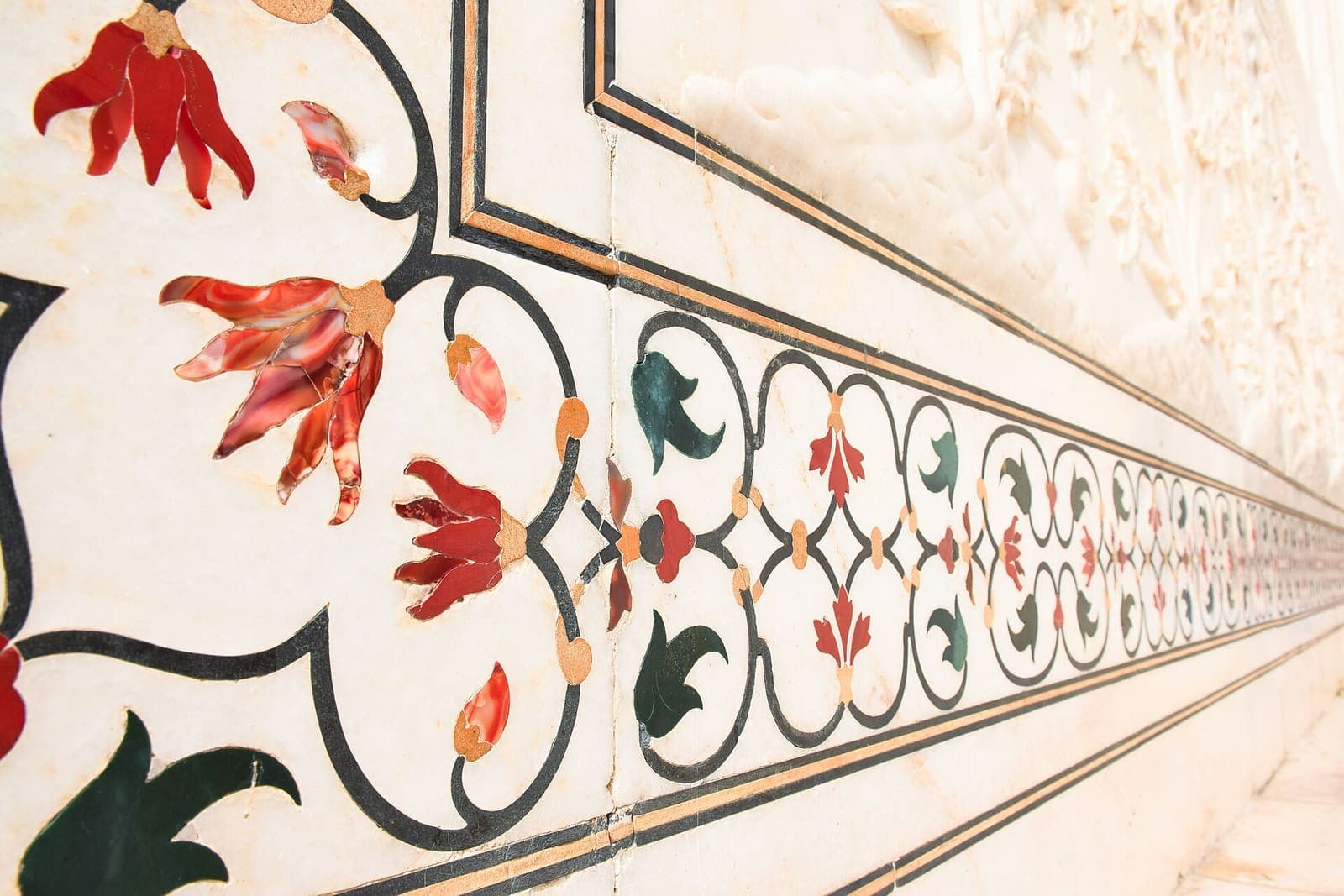
Photo: Raya Sharbain · Wikimedia Commons · CC BY-SA 4.0 · resized for web
How tall is the Taj Mahal?
The Taj Mahal is about 73 metres (240 feet) tall, measured to the tip of the finial on its main dome, according to Britannica; its student edition gives 74 metres above the garden. The tomb stands on a marble plinth about 7 metres (23 feet) high, and the great central arch on each of its four faces rises to 33 metres (108 feet).
The four minarets, one at each corner of the platform, are more than 130 feet, about 40 metres, tall by the official Taj Mahal website’s figure. They were set slightly outward on purpose: the official site says that if one ever fell, it would fall away from the tomb.
Is the Taj Mahal a mosque?
No, the Taj Mahal is a mausoleum, a tomb, though a working mosque stands beside it inside the complex. The mosque is the red sandstone building on the west side of the tomb, facing east. On the east side stands its mirror image, the Mehman Khana or jawab, the “answer”, built so that the whole composition balances.
The official Taj Mahal website says the Mehman Khana was first used for gatherings on the anniversaries of Mumtaz Mahal’s death, and that the mosque floor is marked out in black marble with the outlines of 569 prayer rugs. Because the mosque is in use, the ASI keeps the Taj Mahal closed to visitors every Friday and opens it only for the midday prayer, from 12 noon to 2 PM. Our guide to Agra on a Friday has what to see instead.
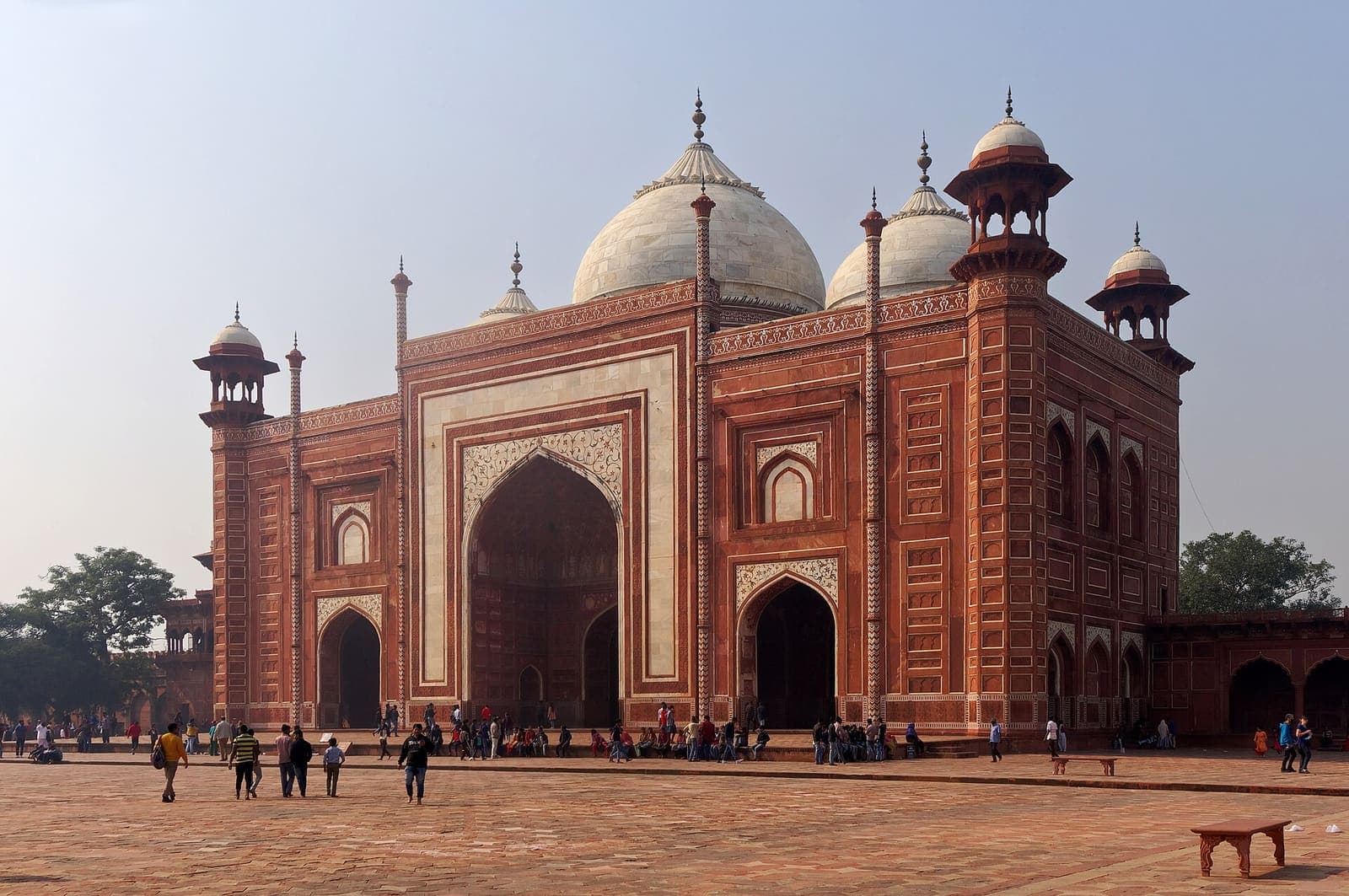
Photo: Jakub Hałun · Wikimedia Commons · CC BY-SA 4.0 · resized for web
Where are Shah Jahan and Mumtaz Mahal buried?
Shah Jahan and Mumtaz Mahal are both buried in the Taj Mahal, in a crypt below the main hall. The two marble tombs visitors see inside, ringed by a pierced marble screen, are cenotaphs. The real graves lie beneath them in a lower chamber that is closed to visitors, except during the Urs, the three-day commemoration of Shah Jahan’s death anniversary, when the official Taj Mahal website says the tombs are opened to pilgrims and tourists.
Mumtaz Mahal’s cenotaph is at the exact centre of the hall. Shah Jahan’s, which is larger, was added on its west side after his death in 1666, and it is the one thing in the Taj Mahal that breaks the symmetry. The screen around them dates from 1643, when it replaced a screen of enamelled gold that was evidently thought too precious.
When did the Taj Mahal become a World Heritage Site?
The Taj Mahal was inscribed on UNESCO’s World Heritage List in 1983. UNESCO’s entry calls it “the jewel of Muslim art in India and one of the universally admired masterpieces of the world’s heritage”, and lists it under a single criterion, as the finest architectural and artistic achievement in the whole range of Indo-Islamic tomb architecture.
Agra has two more World Heritage Sites, Agra Fort and Fatehpur Sikri. The ASI manages the Taj Mahal, which is protected by the Ancient Monuments and Archaeological Sites and Remains Act of 1958, and UNESCO’s page lists the pressures it watches: air pollution, the weight of visitor numbers and development around the site.
Is the Taj Mahal one of the Seven Wonders of the World?
Yes, the Taj Mahal is one of the New 7 Wonders of the World, named in Lisbon on 7 July 2007 after a global public vote that its organisers say drew more than 100 million votes. The other six, announced as equals, were the Great Wall of China, Petra, Chichén Itzá, Christ the Redeemer, the Colosseum and Machu Picchu.
It helps to know what that title is. The campaign was a private initiative launched in 2000 by Bernard Weber, and two days after the announcement UNESCO stated that there was “no link whatsoever” between it and the World Heritage programme. For official recognition, look to the Taj Mahal’s World Heritage listing, 24 years earlier.
Was there going to be a Black Taj Mahal?
Probably not: the Black Taj Mahal is a legend, and the closest study of the site argues against it. The story, which Britannica calls a tradition, is that Shah Jahan meant to build his own tomb in black marble across the Yamuna, joined to the Taj by a bridge, until Aurangzeb deposed him in 1658. The official Taj Mahal website traces it to the French traveller Jean-Baptiste Tavernier, who was in Agra in 1665, and Britannica notes that some historians dismiss it.
The land across the river is Mehtab Bagh, a Mughal garden. A seven-year study of it by the ASI and the Smithsonian’s Sackler Gallery found that it matches the Taj garden in width and alignment and has a raised octagonal pool, and concluded that it was most likely laid out for looking at the Taj and its reflection, which the Smithsonian described as de-bunking the myth. Our guide to Mehtab Bagh and the Black Taj legend covers the garden and how to visit it.
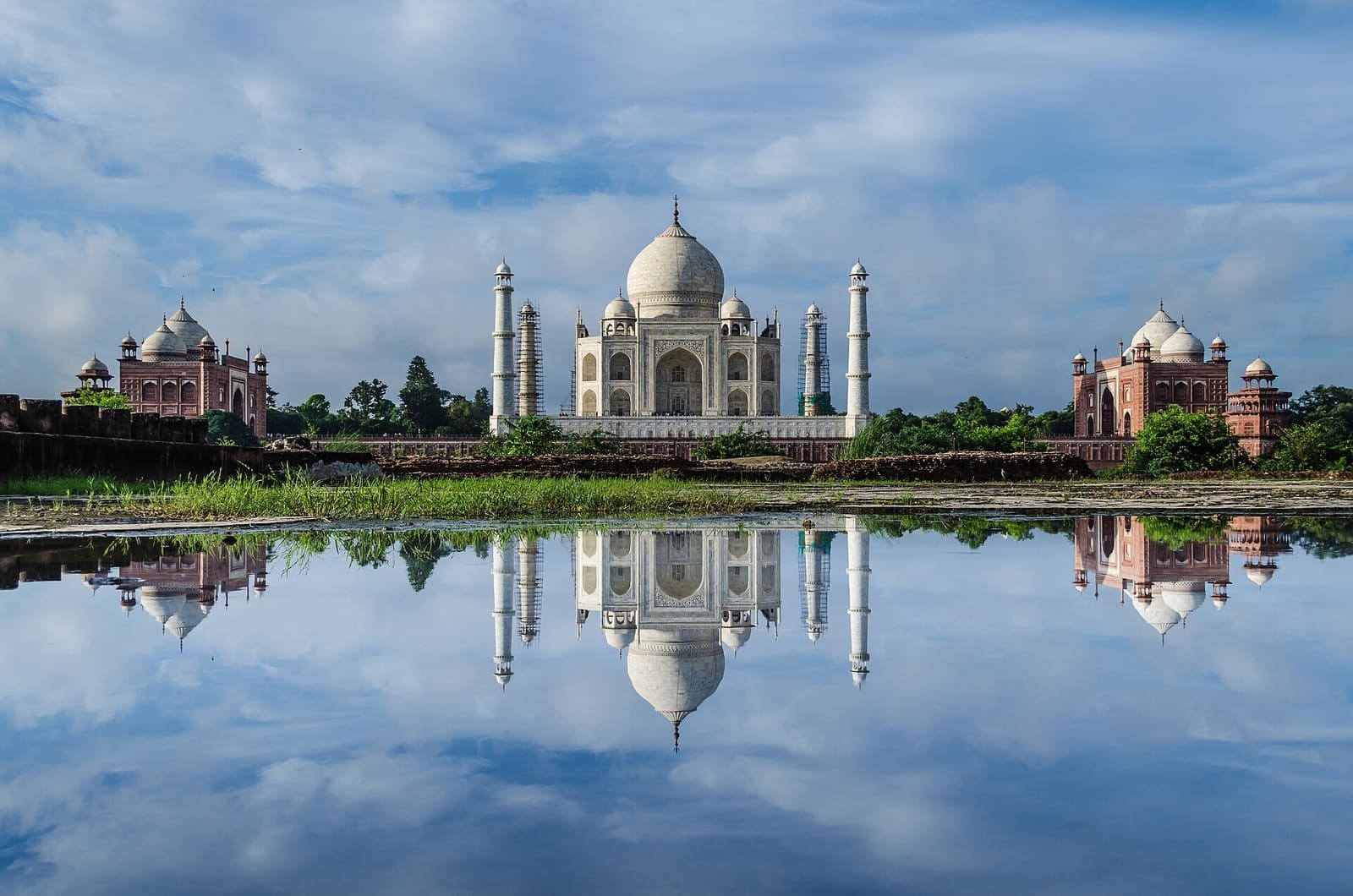
Photo: Antrix3 · Wikimedia Commons · CC BY-SA 4.0 · resized for web
Did Shah Jahan cut off the workers’ hands?
No, there is no historical evidence that Shah Jahan cut off the hands of the men who built the Taj Mahal, and historians treat the story as a legend. It is often repeated, but a 2021 fact check by Alt News found nothing to support it and quoted the historian S. Irfan Habib: there is “neither any evidence to back this story nor any credible historian has ever made this claim”.
The record points the other way. The official Taj Mahal website names members of the team, and Alt News pointed to Taj Ganj, the quarter beside the Taj that, by its account, was settled by the monument’s masons and artisans and is still home to their descendants.
Is pollution damaging the Taj Mahal?
Yes, air pollution has damaged the Taj Mahal’s marble, and protecting it is a long-running effort. Britannica names emissions from foundries and other factories and exhaust from motor vehicles, and lists what has been done: some foundries closed, pollution controls fitted to others, a parkland buffer zone around the complex and a ban on nearby traffic. Progress, it adds, has been slow.
In December 1996 the Supreme Court banned the use of coal and coke by industries in the Taj Trapezium Zone, the 10,400 square kilometres around the monument that UNESCO describes as protected from pollution. Care for the building is older than that: a major restoration ordered by the viceroy Lord Curzon was completed in 1908, and a research and restoration programme began in 1998.
Which Taj Mahal facts matter on the day you visit?
Three Taj Mahal facts shape a visit: the Taj Mahal is closed every Friday, it opens 30 minutes before sunrise and closes 30 minutes before sunset, and the main mausoleum has its own optional ticket on top of entry. Children under 15 go in free, by the official site as of October 2026. Prices change, so check the Taj Mahal ticket prices for 2026 before you go, and the Taj Mahal timings guide for the clock times.
- At night: the Taj Mahal opens on the full-moon night and the two nights either side, never on a Friday or in Ramzan. The night viewing guide has the dates and the rules.
- Inside: the marble tombs behind the screen are cenotaphs; the crypt with the real graves opens only during the Urs. What you see inside the Taj Mahal covers the ₹200 mausoleum ticket and the hall.
- Photos: allowed in the garden and on the terraces, not inside the main mausoleum; tripods and drones are banned. The Taj Mahal photography guide has the spots.
- The best hour: opening time, the quietest of the day; the hour-by-hour guide shows how the crowds and the light change after that.
- Arriving by train: the route from Agra Cantt, the gates and the fares are in Agra Cantt to the Taj Mahal.
If your plans include a long lunch or dinner after the visit, Altitude Rooftop Lounge, the rooftop restaurant that publishes this journal, is on the top floor above MG Road 2, Jaipur House, about 6.5 km and around 25 minutes from the Taj Mahal. It is open every day from 12:00 PM to 12:30 AM, and has no Taj view. One more fact for overseas visitors: from 1:00 PM to 7:00 PM, all drinks there are buy one, get one free on a foreign passport, dine-in only, as the offers page sets out. Booking is free on the reservations page.